Your Cart (0)
Your cart is empty
Free express shipping

Drawer menu
Free express shipping

TL;DR:
- Natural stone endures over centuries due to its geological depth, unique beauty, and ability to age gracefully. It outlasts engineered alternatives, develops an authentic patina, and offers environmentally sustainable benefits through low carbon footprint and recyclability. Proper maintenance and sealing enhance its longevity, making stone a timeless and honest choice for lasting architectural and interior design.
Many people assume stone is a relic of old-world design, too cold, too heavy, or too demanding to fit modern interiors. That assumption couldn’t be more wrong. Why stone is timeless has everything to do with qualities no synthetic material has come close to replicating: geological depth, singular beauty, and a lifespan that outlasts the buildings around it. This article walks through the real reasons stone endures across centuries of architecture and interior design, from its environmental profile to the way it actually improves as it ages.
| Point | Details |
|---|---|
| Stone outlasts alternatives | Natural stone surfaces can last well over 100 years, far exceeding engineered quartz at 25 to 50 years. |
| Aging adds value, not wear | Stone’s patina is a prized design feature in luxury interiors, not a sign of deterioration. |
| Low carbon footprint | Natural stone produces significantly less embodied carbon than concrete or engineered alternatives. |
| Minimal maintenance needed | Resealing every one to two years and basic care keeps stone surfaces looking exceptional for decades. |
| Timeless across design styles | Stone works in both traditional and contemporary interiors, making it one of the most versatile materials available. |
Stone doesn’t just look old. It is old. Most of the marble and travertine used in contemporary interiors took hundreds of millions of years to form under geological pressure, mineral exchange, and the slow crystallization of ancient seabeds. That origin is part of what makes stone so fundamentally different from any manufactured material. Every slab is singular. The veining in a piece of Calacatta marble is a geological event that will never repeat.
Historic stone uses make this point without any argument. The Pantheon in Rome has stood for nearly 2,000 years. The Acropolis, Petra, the great cathedrals of Europe — all built in stone, and still standing. These aren’t just curiosities. They are proof that stone outlasts generations in ways no engineered product can claim. Modern architecture draws on this legacy constantly, whether in a travertine-clad lobby or a marble kitchen that references centuries of European craftsmanship.
Stone also connects to something deeply human. Researchers who study biophilic design note that people respond physiologically to natural materials. Stone’s texture, thermal mass, and visual depth trigger the same sense of calm we get from natural environments. That’s not a trend. It’s wired into us.
A few qualities make stone’s natural origin a design asset rather than a limitation:
“Stone connects people to nature and history in a way synthetic materials simply cannot match. It embodies the principles of biophilic design at their most literal.” — Richmond Stone
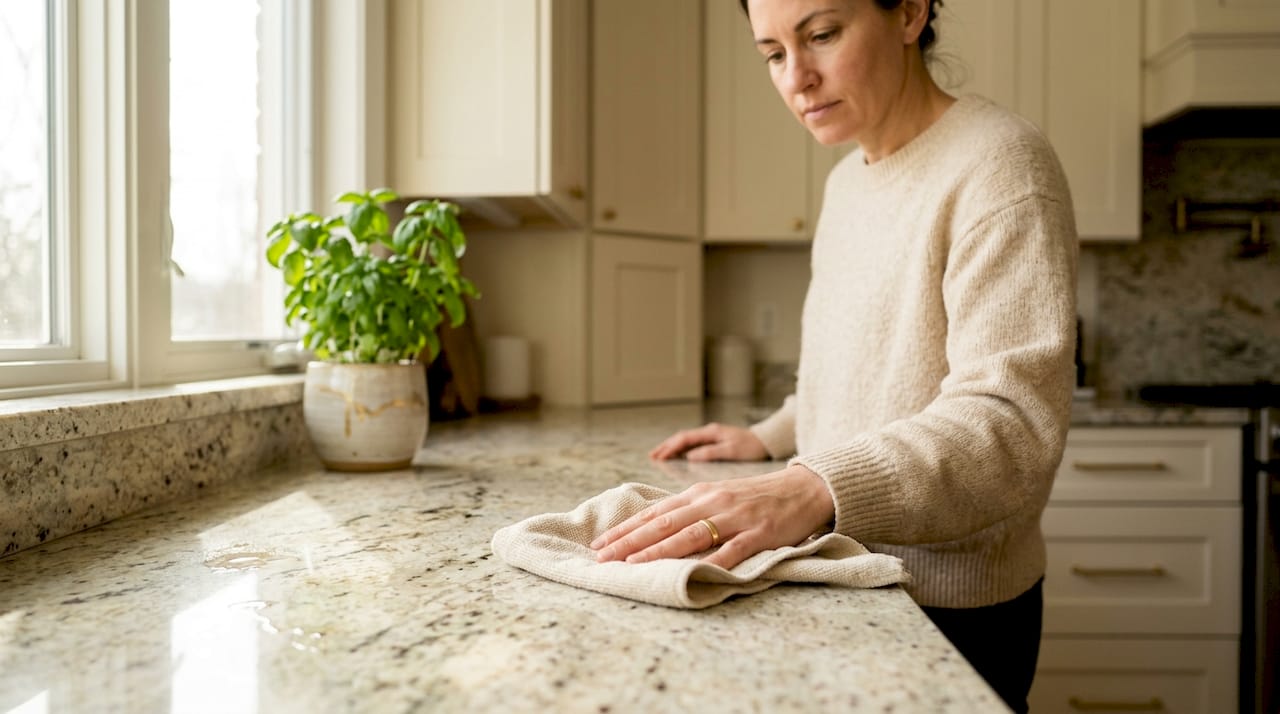
The durability of stone is the argument that closes most debates. Granite and quartzite countertops, properly maintained, can endure for centuries. Engineered quartz, often marketed as the modern answer to natural stone, has a lifespan of roughly 25 to 50 years before the polymer resin that binds its quartz particles begins to break down. That’s a meaningful difference if you’re designing a kitchen you plan to keep.
Here’s how the main surface materials compare across the factors that matter most:
| Factor | Natural stone | Engineered quartz | Ceramic tile |
|---|---|---|---|
| Lifespan | 100+ years | 25 to 50 years | 20 to 30 years |
| Heat resistance | Excellent | Moderate (resin can discolor) | Good |
| Scratch resistance | High (granite, quartzite) | Moderate | Moderate |
| UV stability | Stable | Can yellow over time | Stable |
| Refinishing | Yes, multiple times | No | No |
| Resale value impact | Positive | Neutral | Neutral |
Stone’s resistance to heat and UV is especially relevant in kitchens and outdoor applications. The resin in engineered quartz can yellow or warp under direct sun exposure, which is why most manufacturers void warranties for outdoor use. Natural stone has no such constraint.
One practical insight worth knowing: rounded edge profiles on stone countertops dissipate impact stress better than sharp edges, reducing the chance of chipping over decades of use. If you’re commissioning stone work, specify a bullnose or eased edge for high-traffic surfaces.
Stone can also be refinished multiple times, restoring its original luster after years of use. No synthetic surface offers that. When you invest in natural stone, you’re acquiring something that gets a second life rather than a replacement budget.
Pro Tip: Before purchasing stone for flooring, confirm the subfloor is level and structurally sound. Stone is strong under compression but weak under tension, so uneven subflooring creates flexural stress that can cause cracking over time.
The sustainability argument for stone is stronger than most people realize, and it’s one of the reasons forward-thinking architects are specifying it for net-zero projects. A 2025 to 2026 study found that natural stone produces approximately 3,000 kg CO2 vs 32,000 kg for concrete and 40,000 kg for steel across comparable applications. That’s not a marginal difference. It’s an order of magnitude.
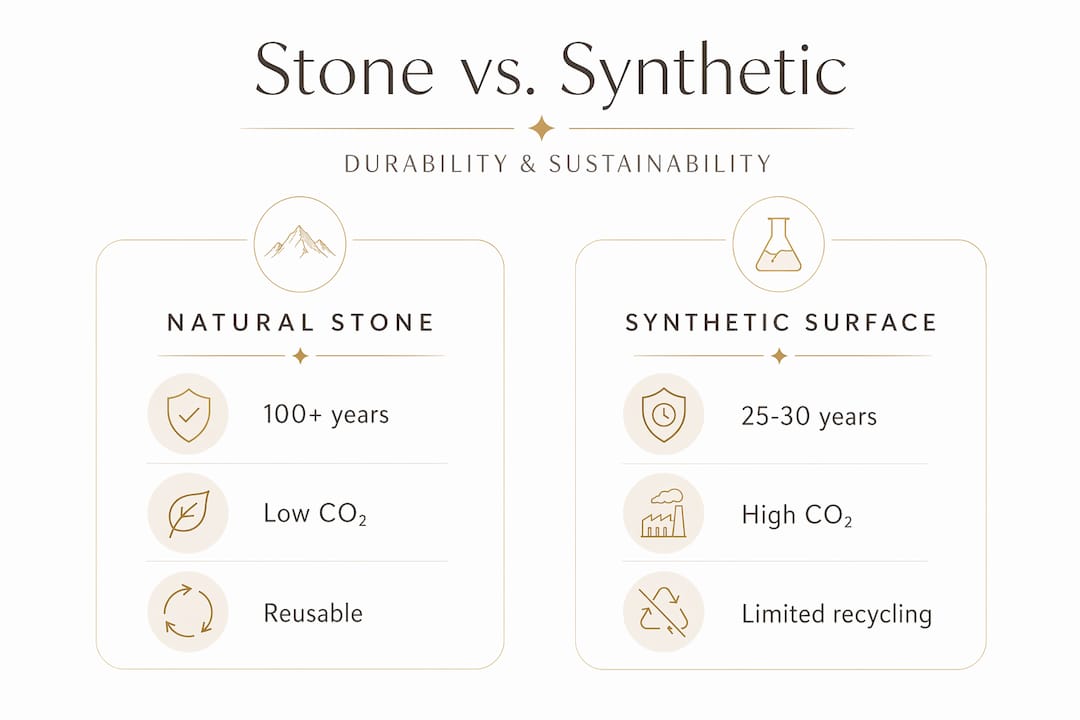
Part of why stone performs so well environmentally is its extraction process. It’s mechanically quarried with no chemical resins, binding agents, or energy-intensive manufacturing processes. Natural stone flooring produces roughly 10.9 kg CO2-eq per square meter, far below ceramic tile and well below carpet over a comparable lifespan.
The circular economy case for stone is equally strong. When a building is demolished or renovated, natural stone can be reclaimed, cut down, and reinstalled. Reclaimed limestone from a 19th-century farmhouse floor can become a contemporary kitchen countertop without losing material integrity. That kind of material life cycle simply isn’t possible with composite or engineered products.
Sourcing matters too. Locally quarried stone reduces transportation emissions substantially, and some suppliers now use rail-integrated logistics to lower the carbon cost of moving heavy material across regions. If environmental credentials matter to your project, ask your supplier about provenance and transportation method.
The low-maintenance profile of stone also contributes to its environmental advantage. Fewer replacements over decades mean less manufacturing waste, less transportation, and less material sent to landfill. An engineered surface replaced twice in 60 years carries three times the embodied carbon of a stone surface that lasted the same period untouched.
This is the quality that separates stone from every material designed to look perfect the day it’s installed. Stone develops patina over time, and patina is exactly what discerning designers and homeowners are now paying a premium for.
Patina on stone is not damage. It’s a record of time and environment, a surface that carries the marks of use in a way that adds authenticity rather than diminishing it. The worn travertine floors of a Florentine palazzo look richer after 300 years than they did when first installed. That’s not an accident. It’s what happens when a living material settles into its context.
Compare that to what happens to synthetic surfaces. Laminate chips. Engineered stone dulls without the possibility of restoration. Ceramic grout discolors. These materials are designed to a fixed aesthetic that only degrades. Stone moves in the opposite direction.
“Patina is not just wear. It is an irreplaceable signature of a space and lifestyle, adding authentic value that no factory finish can replicate.” — Janine Stone
Reclaimed and vintage stone has become one of the most sought-after materials in high-end residential design on the French Riviera and across European luxury markets, precisely because aged stone carries a depth that new material cannot fake. Designers working in this space often specify reclaimed limestone or antique marble for feature walls, floors, and bath surrounds to achieve an immediate sense of history and place.
A few design contexts where stone’s aging character works especially well:
Pro Tip: If you want stone with immediate patina in a new build, ask your supplier about tumbled or antique-finished travertine. These mechanical finishes mimic decades of natural wear and give new installations the character of reclaimed material from day one.
Stone’s reputation for being difficult to maintain is largely a myth. The reality is that well-sealed, properly cared-for stone requires less attention than most flooring and surface materials. Here’s what actually matters:
Seal at the right intervals. Most homeowners should reseal stone every 1.5 to 2.5 years. High-traffic floors or kitchen countertops may need attention annually. Bathroom walls used only for decoration may go longer.
Use the water-bead test. Pour a small amount of water on the surface. If it beads, the seal is still active. If it absorbs into the stone, it’s time to reseal. No guesswork needed.
Don’t over-seal. This is the mistake most people don’t expect. Applying too many coats traps moisture beneath the surface, causing a cloudy discoloration that is difficult to reverse. One well-applied coat is enough.
Clean with pH-neutral products. Acidic cleaners like vinegar, lemon-based sprays, or bathroom descalers will etch the surface regardless of sealing. Sealing protects against staining but does nothing to prevent acid etching.
Restore rather than replace. When stone loses its polish or develops scratches over years, a professional honing or polishing service brings it back to specification. This typically costs a fraction of replacement and extends the surface life by decades.
Resealing a standard countertop area takes 30 to 60 minutes and requires 24 to 48 hours of curing time. That’s the maintenance commitment. For a surface that lasts over a century, it’s a remarkably small ask.
I’ve spent years working with natural stone across residential and commercial projects, and the one thing I keep coming back to is this: stone is the only material that genuinely improves with age rather than simply surviving it. Every other surface category starts at its best the day it’s installed. Stone starts a conversation that takes decades to develop.
What I’ve found is that homeowners who hesitate around stone are almost always responding to the wrong concerns. They worry about staining or maintenance when the reality is that a single afternoon of proper sealing every two years is all it takes. The imperfections that appear over time are not failures. They are the material doing what it’s supposed to do.
In my experience, the deeper issue is that people have been conditioned to expect surfaces that look factory-perfect indefinitely. Stone refuses that. It weathers, it marks, it changes, and that’s exactly what makes it worth living with. A marble kitchen that carries 20 years of family use has a story built into its surface that no new installation can match.
The architects and designers I respect most specify stone not because it’s fashionable but because it’s honest. It performs. It endures. And decades from now, it will still be the best material in the room.
— Nick
If the case for stone has you thinking about your own space, Marmorique has done the curation work for you. The collection focuses on natural marble and travertine pieces selected for their material quality, character, and long-term beauty. Every product is chosen with the same standard: will this piece look better in 20 years than it does today?
From travertine lamps and marble side tables to complete bathroom sets in natural stone, the range covers both statement pieces and foundational elements for any interior. Each item ships with material care guidance, and the team is available to help you match stone finishes to your existing palette. If you’re ready to bring something genuinely lasting into your home, browse the full collection and see what sets natural stone apart from everything else on the market.
Stone has been used in architecture and design for thousands of years because it outlasts virtually every alternative, develops beauty with age, and connects to natural origins in a way no synthetic material can replicate. Its durability, singular appearance, and low environmental impact make it a permanent reference point in design.
Natural stone surfaces can last well over 100 years with basic maintenance, while engineered quartz typically degrades within 25 to 50 years as its polymer resin breaks down. That lifespan gap is the central reason stone is considered a long-term investment rather than just a premium finish.
Yes. Natural stone produces roughly 3,000 kg of CO2 equivalent in comparable applications where concrete generates 32,000 kg and steel generates 40,000 kg. Its durability also means fewer replacements over time, reducing total lifecycle emissions significantly.
Sealing protects stone against liquid penetration and staining, but it does not prevent etching from acidic substances. Lemon juice, vinegar, and descaling cleaners will dull sealed stone surfaces, so pH-neutral cleaners are non-negotiable for long-term care.
Most stone surfaces should be resealed every 1.5 to 2.5 years, with high-traffic areas potentially needing annual attention. The water-bead test is the most reliable way to know when resealing is actually due rather than guessing by a calendar.


