Your Cart (0)
Your cart is empty
Free express shipping

Drawer menu
Free express shipping

TL;DR:
- Choosing the right finish, fill, and cut is essential for high-end travertine installations.
- Travertine’s applications include luxury floors, walls, outdoor patios, and facades, with specific considerations.
- Proper sealing and detail-oriented selection prevent costly mistakes and ensure timeless, authentic luxury.
Few natural stones carry the same weight of history and elegance as travertine. Formed over thousands of years in mineral-rich springs, it brings warmth, depth, and organic texture that no manufactured surface can replicate. But choosing travertine for a luxury project is not as simple as picking a slab you love. Finish type, fill method, cut direction, and placement all determine whether the result feels like a five-star resort or a renovation that missed the mark. This guide walks you through every critical decision with precision and clarity.
| Point | Details |
|---|---|
| Choose the right finish | Match honed, polished, or tumbled travertine to each space for ideal safety and elegance. |
| Prioritize filled for function | Use filled and sealed travertine for kitchens and baths to enhance hygiene. |
| Outdoor safety matters | Select tumbled or brushed finishes for patios and pool decks to prevent slips. |
| Luxury is in details | Pair the right cut, color, and finish to create a harmonious, upscale look. |
| Maintenance is key | Schedule regular sealing, especially in wet areas, to protect and prolong travertine’s beauty. |
With the basics established, let’s break down the guiding principles that ensure both beauty and practicality in upscale environments.
The single most important decision you will make is the finish. Each finish type creates an entirely different atmosphere, and using the wrong one in the wrong space is one of the most common and costly mistakes in high-end design.
Beyond finish, you need to decide between filled and unfilled travertine. Travertine naturally forms with small voids and pores created during its geological development. Filled travertine has those voids grouted or resin-filled, creating a smooth, hygienic surface that is easier to maintain. Unfilled travertine preserves those openings, delivering a more authentic, textural look that appeals to designers going for raw luxury or artisanal character.
For kitchens and spa bathrooms, filled travertine is almost always the right call. For a dry feature wall or a wine cellar, unfilled travertine adds an irreplaceable depth of character. Understanding these travertine use essentials before sourcing your stone will save you from expensive corrections later.
Pro Tip: Always request a physical sample of your chosen finish and hold it against your planned lighting. Travertine looks dramatically different under warm incandescent light versus cool LED, and what looks perfect in a showroom can shift significantly in your actual space.
Once the right style is chosen, it’s time to see where travertine makes the most dramatic difference inside the home.
Travertine has been used in high-traffic flooring and feature walls for centuries, and for good reason. Its density and natural variation make it both durable and visually compelling in ways that porcelain tiles simply cannot match.
Entryways and living rooms are where travertine makes its strongest first impression. A large-format honed travertine floor in a grand entryway communicates luxury before a single word is spoken. The stone’s warm ivory, walnut, and gold tones create an immediate sense of welcome and refinement. In living rooms, travertine floors pair exceptionally well with natural wood furniture and neutral textiles, grounding the space without overwhelming it.
Bathrooms and spas are arguably travertine’s most celebrated interior application. Its natural resistance to moisture, combined with the right sealing protocol, makes it a practical and breathtaking choice for shower walls, freestanding bath surrounds, and heated floors. Honed or tumbled finishes are preferred here for slip safety. A full travertine bathroom, from floor to ceiling, creates a cohesive spa-like environment that feels genuinely luxurious rather than decoratively assembled.
Kitchens require a more considered approach. The stone’s porosity means it must be properly sealed and filled before it comes into contact with oils, acids, or food residue. Filled and honed travertine works beautifully as a backsplash or island countertop when sealed with a penetrating stone sealer every 12 to 24 months.
| Application | Recommended finish | Fill type | Sealing frequency |
|---|---|---|---|
| Entryway floor | Honed | Filled | Every 12 to 18 months |
| Shower walls | Honed | Filled | Every 12 months |
| Feature wall (dry) | Polished | Either | Every 24 months |
| Kitchen countertop | Honed | Filled | Every 12 months |
| Living room floor | Honed | Filled | Every 18 to 24 months |
These recommended travertine applications are not arbitrary. They reflect decades of real-world performance data from luxury installations around the world.
Pro Tip: When installing travertine in a bathroom, use a penetrating impregnating sealer rather than a topical coating. Topical sealers can peel and cloud over time in wet environments, while penetrating sealers bond with the stone at a molecular level for lasting protection.
Moving outdoors, travertine’s versatility continues, offering high-end solutions for leisure and curb appeal.
Travertine is one of the few natural stones that genuinely excels in outdoor environments. Its thermal properties are particularly remarkable. Unlike concrete pavers or dark granite, travertine stays cool underfoot even under intense summer sun, making it the preferred material for pool decks in warm climates. This is not a minor convenience. For barefoot outdoor living, it is a genuine quality-of-life advantage.
Pool decks and patios benefit most from tumbled or brushed travertine. The textured surface provides natural slip resistance when wet, which is a critical safety consideration around water. The weathered aesthetic also ages gracefully, developing a gentle patina that actually improves its appearance over time rather than degrading it.
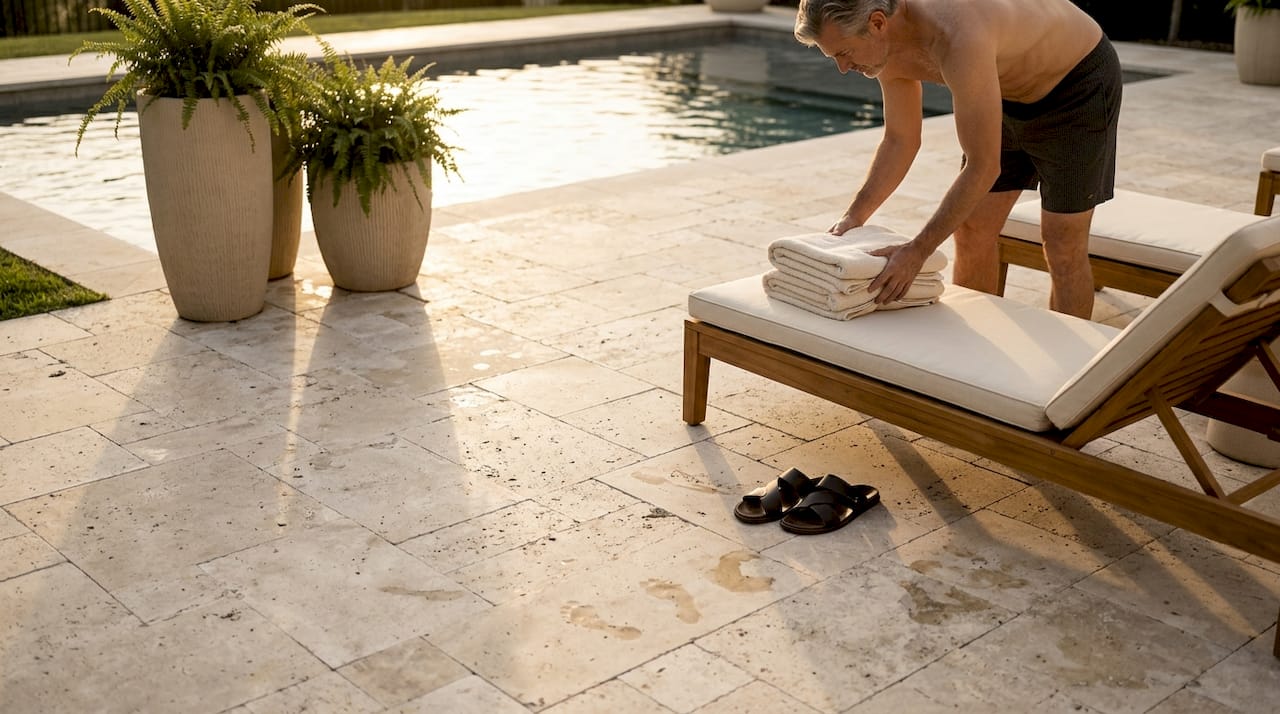
Facades and exterior cladding represent a more ambitious but spectacular use of travertine. Mediterranean-style homes have used travertine facades for centuries, and the look has never gone out of fashion. A travertine-clad exterior creates an immediate sense of permanence and prestige that no other material replicates at the same price point. For contemporary minimalist exteriors, large-format vein-cut travertine panels in a light ivory tone create a sleek, monolithic effect that reads as genuinely architectural.
Key considerations for outdoor travertine uses include:
| Outdoor use | Best finish | Key benefit | Maintenance level |
|---|---|---|---|
| Pool deck | Tumbled | Cool underfoot, slip-resistant | Moderate |
| Patio | Brushed or tumbled | Weathering patina, durability | Low to moderate |
| Facade cladding | Honed or brushed | Prestige, thermal mass | Low |
| Garden path | Tumbled | Natural look, traction | Low |
Beyond placement, nuanced choices in cut and finish unlock the next tier of design sophistication.
Most designers know about finish types, but far fewer pay attention to cut direction, which is one of the most powerful tools for shaping the visual personality of a travertine installation.
Cross-cut travertine is sliced perpendicular to the stone’s natural growth layers, revealing an organic, cloud-like pattern with swirling veins and irregular pores. This cut has a distinctly Mediterranean, earthy character that suits warm, layered interiors. It works beautifully in Tuscan-inspired homes, rustic luxury retreats, and any space where organic texture is the design language.
Vein-cut travertine is sliced parallel to the growth layers, producing a more linear, striated pattern with longer, more directional veins. This cut reads as more structured and architectural. It is the preferred choice for Japandi and quiet luxury aesthetics, where calm, restrained beauty is the goal. Vein-cut travertine in a light walnut or silver-beige tone paired with matte black fixtures and pale oak joinery is one of the most sophisticated combinations in contemporary interior design right now.
Color pairing is equally important. Consider these combinations:
“The most successful travertine installations we see are the ones where the designer treated the stone as a living material with its own personality, not just a surface to cover square footage. Every cut, every finish, every pairing should feel intentional.” This perspective reflects what separates truly extraordinary interiors from merely expensive ones.
Pro Tip: When working with vein-cut travertine on a large wall or floor, book-matching adjacent slabs creates a mirror-image pattern that feels deliberately artistic. It requires more planning and slightly more material, but the visual payoff is extraordinary.
Now, let’s see how travertine stacks up against competing luxury options when style and practicality are on the line.
Every client eventually asks the same question: why travertine instead of marble, granite, or high-end porcelain? The honest answer depends entirely on priorities, but travertine holds some genuinely compelling advantages.
Cost and value: Travertine is less expensive than marble and most premium granite, yet it delivers a comparable level of visual sophistication. For large-scale projects like full-floor installations or exterior cladding, this cost difference becomes significant without any meaningful sacrifice in aesthetic quality.
Maintenance commitment: This is where travertine requires honest conversation. It demands more maintenance than porcelain, which is essentially maintenance-free, and comparable maintenance to marble. Sealing every 12 to 24 months is non-negotiable in wet or high-traffic areas. However, unlike porcelain, travertine can be honed, polished, or refinished if it sustains damage. That repairability is a genuine long-term advantage.
Authenticity factor: No manufactured surface replicates the depth and variation of natural travertine. Porcelain tiles that mimic travertine are improving rapidly, but they still read as imitations to an educated eye. For luxury clients who value authenticity, this matters enormously.
Here is a structured comparison to guide your decision:
Travertine sits in a sweet spot for luxury residential projects where authenticity, warmth, and long-term value matter more than zero-maintenance convenience.
After years of working with natural stone and observing what separates extraordinary installations from disappointing ones, a clear pattern emerges. The stone itself rarely fails. The details around it almost always do.
The most common mistake we see is choosing the right stone and then applying the wrong finish for the context. A polished travertine floor in a family bathroom looks spectacular in a showroom and becomes a safety hazard and a maintenance nightmare within six months. A tumbled travertine feature wall in a sleek contemporary living room creates a jarring tonal conflict that no amount of styling can resolve. These are not small errors. They are expensive ones that require full replacement to correct.
The second most common failure is inconsistent sealing. Travertine is a porous stone, and skipping or delaying the sealing schedule is not a minor oversight. Staining from wine, oils, or hard water deposits can penetrate deeply into unsealed stone and become permanent. The sealing commitment is part of the cost of owning natural stone, and clients need to understand that before installation, not after.
What the best designers understand is that technical precision and creative vision are not separate concerns. They are the same concern. Choosing the right cut, the right finish, and the right fill type is not just a practical decision. It is an aesthetic one. The case studies on travertine that produce genuinely spectacular results are always the ones where every detail was treated with the same level of intention as the overall design concept.
Our recommendation is simple: never delegate finish and fill decisions to a contractor. These choices belong in the design brief, made deliberately by someone who understands both the technical requirements and the visual outcome being pursued.
Ready to turn inspiration into reality? Discovering the right partner elevates every phase of your luxury travertine journey, from initial sourcing to final installation guidance.
At Marmorique, we curate natural stone pieces that go beyond standard tile offerings. Our collection includes travertine lamps, tables, bathroom sets, and decorative accessories that bring the material’s warmth into every corner of a luxury interior. Whether you are an interior designer sourcing statement pieces for a client project or a homeowner ready to invest in something genuinely lasting, our team is here to help you navigate every choice. Explore our full stone collection and discover how the right travertine piece transforms a room from beautiful to unforgettable.
Honed travertine has a matte, slip-resistant surface ideal for floors and wet areas, while polished travertine has a glossy finish best reserved for dry feature walls where safety and moisture are not concerns.
Travertine in showers, bathrooms, or outdoor environments should be sealed every 12 to 24 months to maintain protection against staining, moisture infiltration, and surface degradation.
Filled and honed travertine, when properly sealed with a penetrating stone sealer, is hygienic and appropriate for kitchen countertops and backsplashes, provided it is resealed on schedule.
Tumbled or brushed travertine is the best choice for outdoor settings because its textured surface provides natural slip resistance and develops an attractive weathered patina over time.
Choose filled travertine for kitchens, bathrooms, and any high-maintenance area; opt for unfilled in dry decorative applications where the authentic, textural character of the stone is the primary design goal.


