Your Cart (0)
Your cart is empty
Free express shipping

Drawer menu
Free express shipping

TL;DR:
- Bookmatched marble creates symmetrical veining patterns for a dramatic, cohesive visual statement.
- It involves careful slab selection, precise fabrication, and expert installation from a single stone block.
- This technique enhances high-end interiors but requires higher costs, longer timelines, and skilled craftsmen.
Most people select luxury marble for its quality and color. Few realize that how slabs are arranged on a wall can matter just as much as the stone itself. Bookmatched marble takes a single block of stone and transforms it into a visual composition so striking it can anchor an entire room. It’s the difference between a beautiful surface and a genuine statement. This guide walks you through what bookmatched marble actually is, which stones work best, where to use it, what it costs, and how to plan your project so the result looks exactly as dramatic as you imagined.
| Point | Details |
|---|---|
| Bookmatching defined | Bookmatched marble uses mirrored slabs to create dramatic symmetry and visual impact. |
| Best stones to use | Heavily veined marbles like Calacatta and Statuario are perfect for bookmatching. |
| Investment required | Expect a premium in both cost and time versus standard marble installation. |
| Expert installation needed | Achieving the bookmatched look demands skillful planning and professional execution. |
Imagine opening a book flat on a table. Both pages mirror each other perfectly. That’s the core idea behind bookmatching. Bookmatched marble is a technique where consecutive slabs cut from the same stone block are placed side by side, mirrored like open book pages, to create symmetrical veining patterns. The result isn’t just two slabs of marble next to each other. It’s one cohesive artwork, where veins flow outward from a central axis in perfect symmetry.
This technique transforms ordinary marble into a dramatic focal point. A Calacatta slab on its own is beautiful. Two bookmatched Calacatta slabs on a fireplace wall? That’s something you stop and stare at.
A lot of clients confuse bookmatching with vein matching, but they’re different effects. Vein matching aligns the direction of veins across adjacent slabs so they appear to flow continuously. Bookmatching goes further by creating an actual mirror image. The visual dominance is completely different.
Here’s what makes bookmatched marble stand apart at a glance:
“The mirror effect in bookmatching turns geological accident into intentional art. The stone’s natural history becomes the design.”
This technique works best with natural stone. Some mixing marble in interiors approaches use porcelain tiles that replicate marble patterns, and yes, bookmatching is technically possible with porcelain. But natural stone carries depth, translucency, and character that porcelain can’t fully replicate. When you’re investing in bookmatching, the authentic material makes a real difference.
The artistry of bookmatched marble begins long before installation. It starts at the quarry, where blocks are cut in a specific sequence to preserve pattern continuity. Bookmatching requires careful slab selection, cutting, and installation to achieve mirrored imagery, and every step of that chain matters.
Here’s how the process unfolds from block to finished wall:
Each step requires skill and experience. The margin for error is almost zero. A misaligned seam doesn’t just look off; it breaks the entire symmetry of the design. That’s why fabricators who specialize in large art wall installations are worth seeking out specifically for this kind of work.
Pro Tip: Ask your fabricator to do a full dry layout of the bookmatched slabs on the floor before any adhesive touches the wall. Seeing the pattern flat gives you a chance to fine-tune orientation and catch alignment issues before they’re permanent.
This is not a DIY project. Even experienced general contractors who work with stone regularly will admit that bookmatching requires a different level of precision planning. The results, when done right, are simply not achievable any other way.
Not every marble is a good candidate for bookmatching. The technique relies entirely on visible, dramatic veining to create its impact. Heavily veined marbles like Calacatta, Statuario, and Carrara are ideal for bookmatching, while uniform stones produce almost no visual effect from the mirror technique.
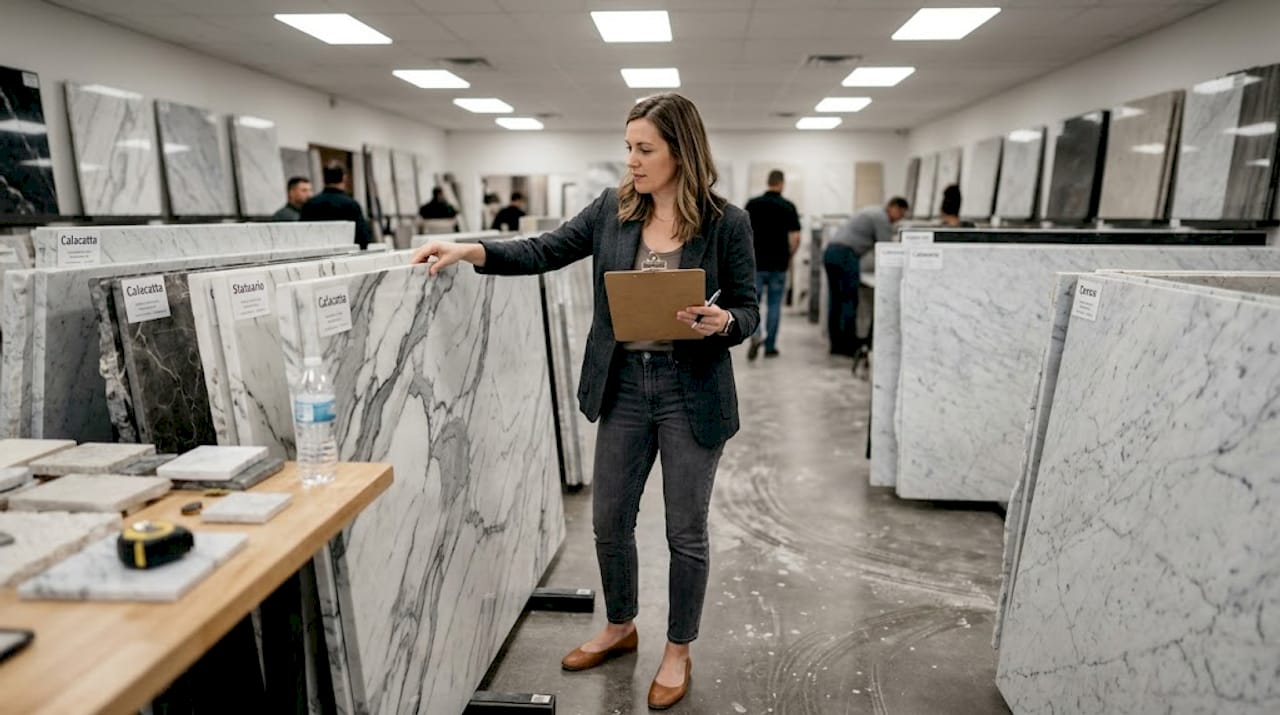
| Stone | Visual impact | Durability | Estimated cost per sq ft |
|---|---|---|---|
| Calacatta Gold | Very high | Moderate | $80 to $200+ |
| Statuario | Very high | Moderate | $70 to $180+ |
| Carrara | Medium to high | Moderate | $40 to $120 |
| Taj Mahal Quartzite | High | Very high | $60 to $150 |
| Nero Marquina | High (contrast) | High | $50 to $130 |
Taj Mahal quartzite deserves special mention. It has the warm, creamy tones of marble with significantly better resistance to etching and moisture, making it a smart choice for bookmatched shower walls or bathroom feature panels where marble’s sensitivity to acids becomes a practical concern.
For marble application inspiration, consider where bookmatched installations create the strongest returns in a high-end interior:
The commercial application of bookmatched marble is often underestimated. A four-way bookmatched floor medallion or a continuous bookmatched wall across an entire lobby signals a level of investment and craft that clients and visitors notice immediately.
Beauty like this comes with a real investment. Bookmatched marble typically costs 15 to 30% more in materials and 20 to 40% more fabrication time compared to standard marble installations. Here’s what that looks like in practical terms:
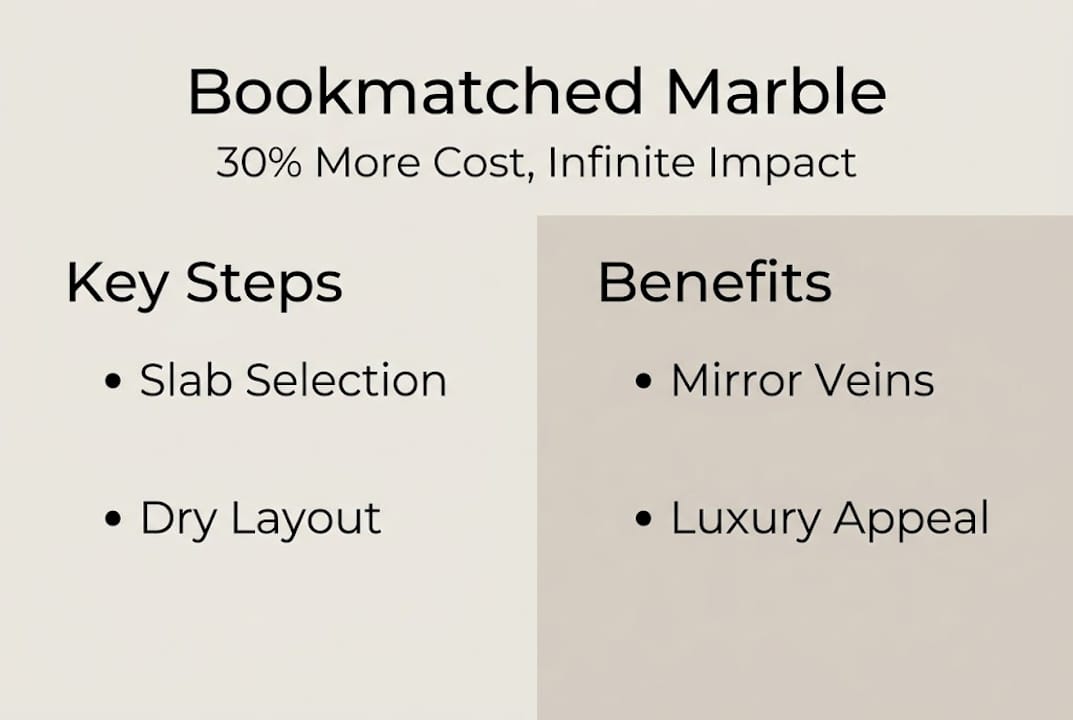
| Cost factor | Standard marble install | Bookmatched marble install |
|---|---|---|
| Material cost | Baseline | 15 to 30% higher |
| Fabrication time | Baseline | 20 to 40% longer |
| Slab waste | 10 to 15% typical | 20 to 30% typical |
| Installer skill level required | General stone installer | Specialist fabricator |
| Lead time | 2 to 4 weeks | 4 to 8 weeks |
The material premium comes from a few compounding factors. First, you’re selecting specific slabs from a single block, which limits your options and sometimes means passing on otherwise excellent stone because the veining isn’t dramatic enough. Second, slab waste runs higher because maintaining the mirrored pattern through cuts doesn’t always work out cleanly. Third, the labor involved is genuinely more intensive at every stage.
Pro Tip: Budget for at least 25% overage in slab material for a bookmatched project. Pattern alignment at corners and seams will consume more stone than a standard installation, and having extra from the same block ensures you can address repairs or adjustments without a mismatch.
Planning timelines need to reflect this reality. A bookmatched feature wall that might take two weeks to complete with standard marble can run six to eight weeks once you account for slab sourcing from a single block, fabricator scheduling, dry layout review, and installation. Factor this into any renovation project timeline early.
Before signing off on a bookmatched installation, double-check these details: confirm the fabricator has seen the full slab layout in person, verify that seam placement lands away from eye-level focal points wherever possible, and get explicit confirmation that the stone supplier has enough matched material to complete the full scope of the project from a single block.
Here’s something that most design conversations miss: standard luxury marble installations, even with premium stone, often feel like an upgrade rather than a transformation. Bookmatching changes that entirely. The symmetry doesn’t just look expensive. It communicates intentionality in a way that even untrained eyes pick up on immediately.
We’ve seen clients chase absolute perfection in their bookmatched slabs, rejecting stone with minor fissures or subtle color shifts between matched pieces. That’s often a mistake. Those small variations, a slight warm shift toward one edge, a natural fissure that echoes across the mirror seam, can actually deepen the drama of the installation. Perfection in stone means something different than perfection in manufactured materials. The geological character is the luxury.
And bookmatching doesn’t require a grand ballroom to work. A single bookmatched panel behind a floating vanity, or two matched slabs framing a bedroom headboard wall, can shift the entire energy of a room. The scale can be intimate. For expert design advice on how to use stone at different scales, the impact potential is there regardless of room size. The key is placing the bookmatched surface where the eye naturally lands first.
If reading this has made you look at your project differently, you’re already thinking like a designer who understands what makes a space truly exceptional. Bookmatching is one of the most powerful tools in luxury interiors, and it starts with selecting the right stone.
At Marmorique, we curate hand-selected natural stones specifically suited for high-impact installations like bookmatched feature walls, fireplace surrounds, and large-format bathroom applications. Whether you’re in the early planning stage or ready to choose your slabs, explore our discover luxury marble options and find pieces with the dramatic veining that bookmatching demands. Browse our interior marble design inspiration to see how the right stone transforms a space from beautiful to unforgettable.
Bookmatching produces a true mirror image at the seam, while vein matching simply aligns the direction of veins so they appear to flow continuously from one slab to the next without necessarily creating symmetry.
Heavily veined marbles such as Calacatta, Statuario, and Carrara produce the most striking bookmatched effects, while uniform or low-veining stones yield almost no visible mirror effect.
Yes. Plan for a 15 to 30% material premium and 20 to 40% more fabrication time compared to a standard marble installation, plus higher slab waste and specialized labor costs.
Bookmatching works with porcelain tiles that replicate marble patterns, but natural stone delivers far superior visual depth, translucency, and long-term authenticity that porcelain simply cannot match.


