Your Cart (0)
Your cart is empty
Free express shipping

Drawer menu
Free express shipping

TL;DR:
- Natural stone like marble and travertine offers sensory warmth, visual depth, and enduring luxury in timeless interiors. It creates a sense of authenticity and age gracefully over time, unlike synthetic surfaces, which lack character. Proper care, sealing, and strategic integration enhance their beauty and value, ensuring they remain a defining feature for decades.
Stone has a reputation problem. Too many people associate marble and travertine with cold, sterile spaces or the hard minimalism of a gallery floor. In reality, these materials offer something no synthetic surface can replicate: sensory warmth, visual depth, and a presence that only deepens over time. Luxury designers have long understood that marble and travertine don’t just decorate a room. They ground it. This article breaks down exactly how stone earns its place in timeless interiors and shows you how to incorporate it with confidence, from full wall treatments to refined stone accessories.
| Point | Details |
|---|---|
| Stone offers lasting beauty | Marble, travertine, and other stones provide timeless appeal that elevates any interior. |
| Choose stone type wisely | Marble is best for decorative or low-impact uses, while travertine shines in high-traffic areas. |
| Finishes and care matter | Honed or leathered finishes reduce upkeep and highlight natural patina. |
| Authentic stone versus engineered | Natural stone delivers a depth and tactile experience engineered options can’t fully replicate. |
| Resale and sensory value | Well-chosen natural stone features increase both your home’s value and its sensory richness. |
Walk into any genuinely luxurious home and you’ll feel something shift. Part of that shift comes from stone. Marble and travertine carry a physical weight and textural richness that synthetic materials simply can’t imitate. The cool touch of a marble surface in summer, the subtle fossil impressions in travertine, the soft glow of veining under warm light — these are sensory experiences that anchor a room in a way that paint, wallpaper, and laminate never could.
Luxury interiors use stone precisely because it creates what designers call “sensory grounding.” It tells your nervous system that the space is real, permanent, and considered. That’s why the world’s most celebrated homes keep returning to it. Milestone projects like luxury stone trends in cities from Newport to Milan consistently feature natural stone as the foundational material for walls, floors, and statement features.
“Stone doesn’t follow a season. It doesn’t reference a trend. It references the earth itself — and that’s a reference that never goes out of style.”
Marble and travertine also carry measurable financial value. High-end aesthetics are strongly associated with natural stone in top-tier real estate markets, where premium finishes in stone directly support stronger resale outcomes. For homeowners thinking long-term, that matters.
Key reasons stone endures in luxury interiors:
Stone isn’t a trend. It’s a standard that luxury interiors keep returning to because nothing else performs the same function at the same level.
Marble and travertine are both natural stones, but they perform very differently in an interior. Knowing where each one excels will save you from costly mistakes and help you choose the right material for every application in your home.
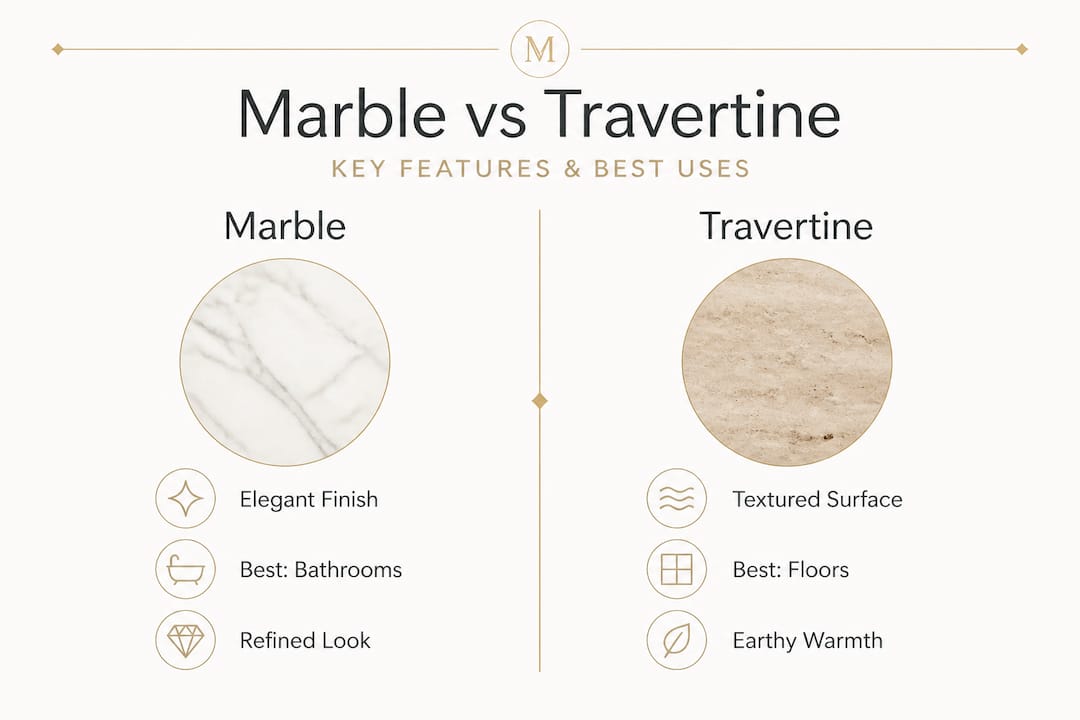
Marble is best suited to lower-impact areas where its refined surface won’t be subjected to heavy daily wear. Think bathroom vanities, feature walls, fireplace surrounds, and decorative objects. Its tight crystalline structure gives it a polished elegance, but that same structure makes it vulnerable to acid etching from lemon juice, wine, and vinegar. Marble on a kitchen island can work beautifully if you’re committed to careful maintenance, but for many households it’s better reserved for surfaces that receive more gentle treatment.
Travertine is a different story. Its naturally textured surface and open pores give it a warmer, earthier look that suits floors, high-traffic hallways, and large wall installations. Travertine for floors is a well-established best practice among interior designers precisely because its texture provides grip and hides minor surface variations better than polished marble. It’s also forgiving in outdoor settings when properly sealed.
Finish options and their real-world impact:
| Finish | Look | Maintenance level | Best for |
|---|---|---|---|
| Polished | Glossy, reflective, high contrast | High (shows scratches, smudges) | Feature walls, vanities, low-traffic |
| Honed | Matte, soft, understated | Moderate (less visible wear) | Floors, countertops, high-traffic |
| Leathered | Textured, velvety, organic | Low (hides fingerprints, dust) | Kitchen surfaces, casual luxury |
| Brushed | Rough, aged, rustic | Low to moderate | Outdoor areas, Mediterranean style |
Pro Tip: If you’re torn between beauty and practicality, a honed or leathered finish almost always wins for timeless interiors. These finishes don’t show scratches or etching as readily as polished stone, and they actually improve in character with age. A polished surface can look incredible in a showroom but punishing in a lived-in home.
For a deeper look at marble vs travertine applications in real home projects, you’ll find that the most successful interiors mix both stones strategically rather than committing exclusively to one.
The most forward-thinking stone interiors of the past decade have moved well beyond countertops and floors. Designers are now treating stone as an architectural material in the fullest sense, integrating it into furniture, plumbing fixtures, and sculptural wall compositions that make a room feel genuinely exceptional.
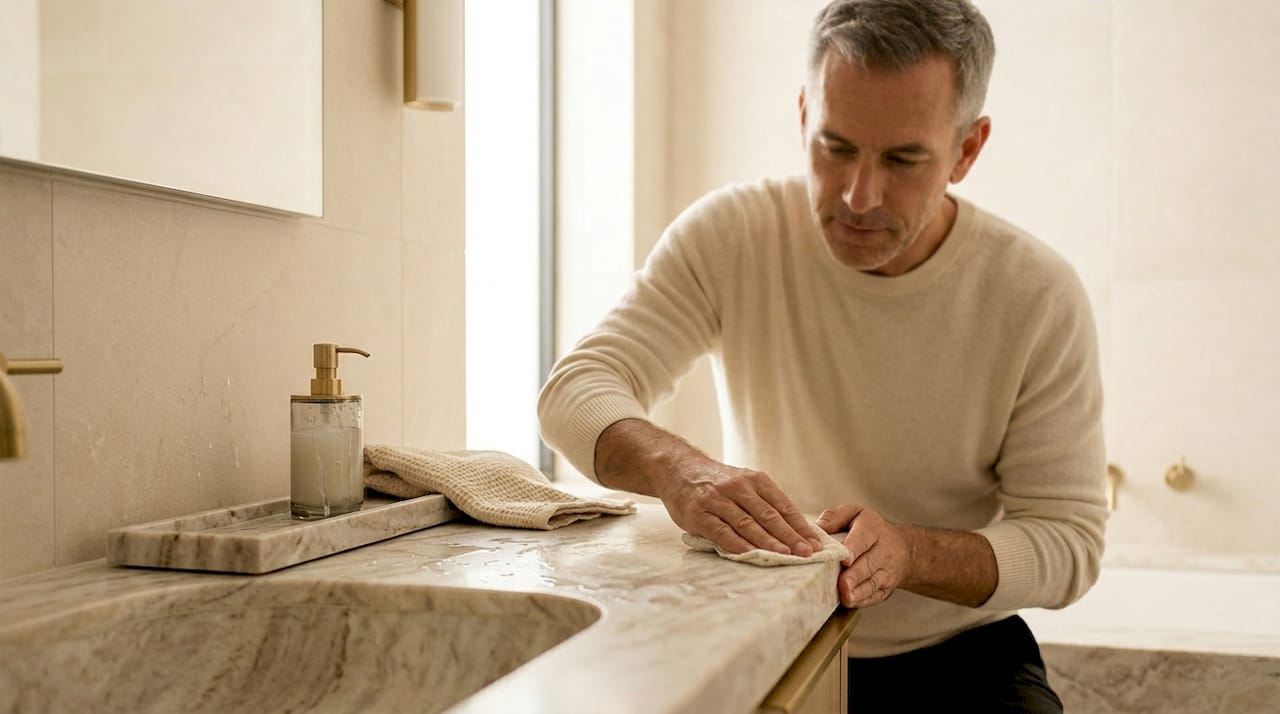
The shift toward integrated stone sinks and custom stone furniture represents one of the most significant changes in luxury interiors. Instead of stone sitting on top of a structure, it becomes the structure itself. A carved travertine sink in a powder room isn’t just a fixture. It’s a sculpture. A solid marble dining table isn’t just functional. It becomes the centerpiece around which every other design decision orbits.
Here are the most impactful ways designers are integrating stone beyond traditional surfaces:
| Stone application | Visual impact | Practical notes |
|---|---|---|
| Integrated sink | Very high | Best in low-use bathrooms |
| Stone dining table | High | Seal regularly, avoid acidic spills |
| Book-matched wall panels | Very high | Professional installation required |
| Stone lamp or decor object | Moderate | Easy to incorporate anywhere |
| Sculptural backsplash | High | Minimal grout = cleaner look |
The appetite for colored stones over plain white has grown steadily among designers looking to create more distinctive, personal interiors. Quartzite Taj Mahal, for example, offers architectural statement quality with warmer tones that feel more inviting than stark white marble alone.
Natural stone is not maintenance-free. That’s a fact worth accepting before you commit to it. But the care it requires is far less demanding than most people expect, and the payoff in beauty and longevity is unmatched by any synthetic alternative. Knowing the basic rules keeps stone looking exceptional for decades.
Marble etches from acids including lemon juice, wine, tomato sauce, and even some cleaning sprays. Etching leaves a dull patch on the surface that differs from the surrounding polish. On a honed or leathered finish, etching is far less visible and can often go unnoticed. On a polished finish, it’s more apparent. This is the single most important care fact marble owners need to understand.
Travertine and marble both benefit from annual sealing. Sealing fills the microscopic pores of the stone and creates a barrier against staining from oils, water, and everyday spills. Skip sealing for a few years and you’ll start to notice deeper discoloration that’s much harder to address.
Stone care do’s:
Stone care don’ts:
Pro Tip: If you love the look of polished marble but want easier maintenance, consider choosing honed or leathered finishes for the most-used surfaces and reserve polished stone for feature walls or vanity backsplashes where wear is minimal. You get the aesthetic without the anxiety.
For porous stones like onyx, the maintenance demands are even higher. Onyx is stunning but genuinely fragile, making it a poor choice for dining surfaces or high-traffic areas. Quartzite offers a compelling alternative: it’s harder than marble, performs better against staining and scratching, and still delivers beautiful natural veining.
Engineered stone has come a long way. Products like Cosentino Éclos and other mineral-based surfaces are specifically designed to mimic the look of natural stone while offering improved stain resistance and lower maintenance demands. For some applications, they’re a perfectly reasonable choice. But there’s a conversation that rarely gets the honesty it deserves.
Engineered surfaces can replicate the pattern of natural stone with increasing sophistication, but they cannot replicate its depth. Natural stone has three-dimensional variation that runs through the entire slab. Light hits it differently at different angles. The veining changes as you look at it from across the room versus up close. Engineered surfaces, however convincing in a photograph, remain visually flat in person. Designers who work closely with both materials notice this instantly.
Here’s an honest comparison of the two:
“What engineered stone can’t replicate is time. Natural stone looks better at twenty years than it did at one. No manufactured surface has ever achieved that.”
For homeowners committed to natural stone depth and long-term character, authentic marble and travertine remain the only true answer. Engineered alternatives fill a practical role, but they were never designed to replace the emotional resonance of the real thing.
Most articles on stone interiors focus on aesthetics. They’ll tell you which marble pairs with which metal finish and which grout color to choose. What they rarely address is the deeper reason stone remains the defining material of genuinely timeless interiors.
Stone improves with time in a way that almost nothing else does. A small scratch on a honed travertine floor doesn’t damage it. It adds to it. A slight etch on a marble countertop, over years, becomes part of a surface that tells a story. This is what patina means in practice, not just aging, but aging beautifully. Mass-produced surfaces age too, but they don’t improve. They just wear out.
We’ve seen too many interiors designed around trend-chasing surfaces that looked incredible in their first year and tired by their fifth. The homes that still feel extraordinary after two decades almost always share one thing: they were built around materials that reward time rather than resist it. Stone is the primary example of this principle. Its enduring stone value isn’t just monetary. It’s experiential.
Here’s the uncomfortable truth about timeless design: it requires accepting minor imperfections as part of the material’s personality. Homeowners who approach stone with that mindset find it endlessly rewarding. Those who expect stone to perform like a sealed synthetic surface will always be disappointed. The goal isn’t a perfect surface. It’s a living one.
If this article has shifted how you see stone, the next step is finding pieces that truly deliver on what natural marble and travertine promise.
At Marmorique, we’ve built our entire collection around the belief that stone decor should be as functional as it is beautiful. From carved travertine lamps to solid marble tables and full bathroom stone sets, every piece in our luxury stone collection is selected for its material quality, craftsmanship, and ability to anchor a space with genuine character. Whether you’re starting with a single statement piece or designing an entire room around natural stone, we’re here to help you make choices that will still feel right twenty years from now.
Marble suits vanities and walls beautifully, while travertine is the stronger choice for floors and high-traffic areas thanks to its grip and texture. Both work in bathrooms, with marble adding elegance and travertine adding warmth.
Annual sealing is the standard recommendation for both marble and travertine. Sealing keeps staining agents from penetrating the stone and helps preserve the surface over time.
Yes. Premium stone finishes are consistently associated with higher-tier real estate in luxury markets, and natural stone signals quality and craftsmanship to discerning buyers.
A honed finish is matte and more forgiving with everyday wear, while a polished finish is glossy and reflective but shows scratches and etching more readily. Honed is generally the better choice for high-use areas.
Engineered surfaces are lower maintenance and more stain resistant, but they can’t replicate the three-dimensional depth, unique veining, or patina of authentic natural stone, qualities that most designers and homeowners ultimately find irreplaceable.


