Your Cart (0)
Your cart is empty
Free express shipping

Drawer menu
Free express shipping

TL;DR:
- Calacatta marble is a luxury Italian stone known for its bright white background and bold, contrasting veining, making it highly sought after despite its premium price. Its dramatic appearance and rarity make it ideal for focal areas like kitchen islands and feature walls, but it requires careful maintenance and in-person slab selection. Proper sealing and routine upkeep are essential to preserve its beauty, and authentic Calacatta offers a unique natural elegance that engineered alternatives cannot replicate.
Not all white marble is created equal. If you’ve ever walked into a kitchen showroom and found yourself confused by slabs that all look vaguely similar, you’re not alone. What is Calacatta marble, exactly, and why do designers pay a serious premium for it? The answer comes down to one quarry region in Italy, an exceptionally bright white background, and veining so bold it turns a slab into a work of art. This guide breaks down everything you need to know before you buy.
| Point | Details |
|---|---|
| Calacatta is a specific marble family | It comes from the Apuan Alps in Italy and is defined by a bright white field with dramatic, bold veining. |
| It differs significantly from Carrara | Calacatta has brighter whites and thicker veins; Carrara has softer grays and subtler patterning. |
| Price reflects rarity | Calacatta marble typically costs $100–$200 per sq. ft., compared to $40–$60 for Carrara. |
| Sealing has real limits | Sealants slow staining but cannot prevent acid etching, which is a chemical reaction, not absorption. |
| Slab selection is critical | Because each slab is unique, seeing the actual stone in person before committing is a must. |
Calacatta marble is a luxury Italian marble family defined by a bright white to near-white background and bold, dramatic veining that runs in shades of gray, gold, brown, or occasionally purple. It belongs to the broader category of different types of marble quarried from the Apuan Alps in Tuscany, Italy, specifically from the Carrara region. The name “Calacatta” refers both to geographic origin and to a visual style, which is why the term gets used loosely in the stone trade.
Geologically, Calacatta is a metamorphic rock. Limestone subjected to extreme heat and pressure over millions of years recrystallizes into marble, and the veining you see is the result of mineral impurities, mainly iron oxides and silicates, being pushed through fractures in the stone during that transformation. The brighter the background and the more dramatic the vein, the higher the grade typically assigned.
A few key characteristics define authentic Calacatta:
One thing worth knowing: the “Calacatta” label is used as both a provenance and visual shorthand, so two slabs sold under the same name can look noticeably different. Always ask for provenance documentation and slab IDs when buying.
What makes Calacatta unmistakable is contrast. Where other white marbles whisper, Calacatta speaks loudly. The veins are thick, often sweeping diagonally across the face of a slab in patterns that feel almost intentional, like brushstrokes on a canvas.
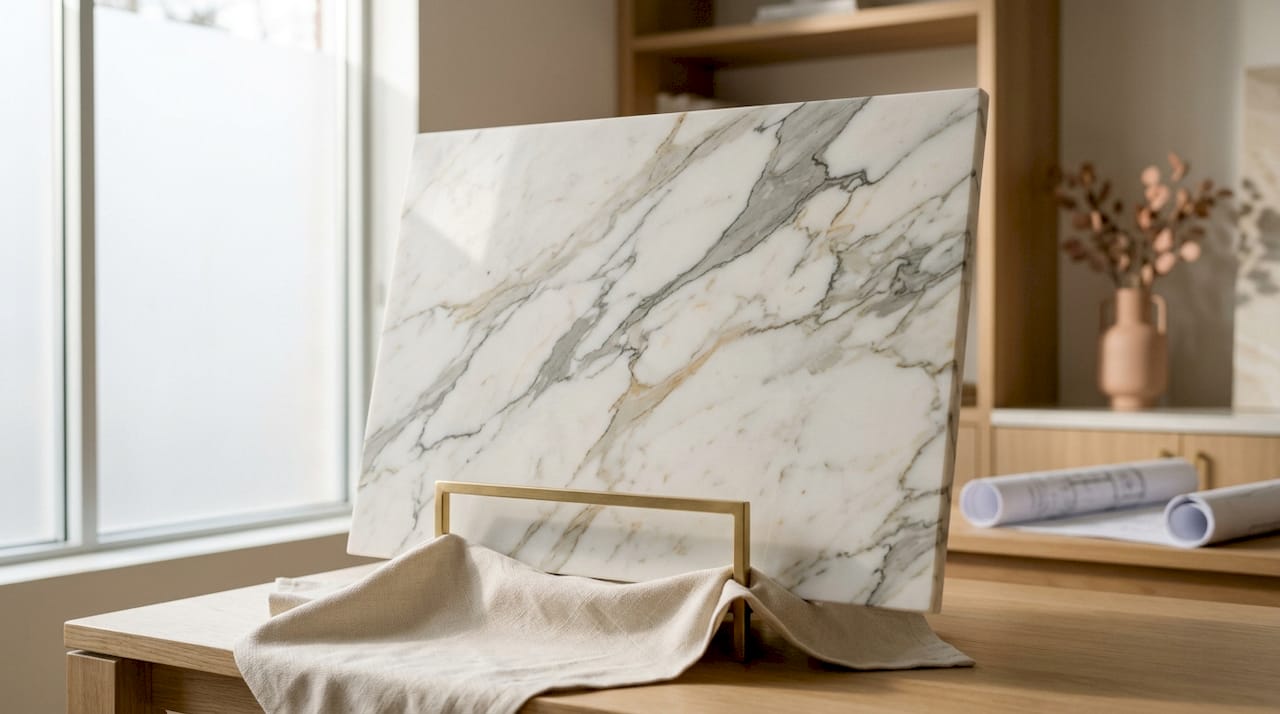
Calacatta Gold is the most widely recognized variety. It carries warm gold and amber veining against a bright white background, making it a natural fit for kitchen islands and bathroom vanities that need visual warmth.
Calacatta Borghini steps up the drama with thick gray veins that can branch extensively across the slab. It reads more graphic and bold, which works beautifully in modern and minimalist interiors.
Calacatta Viola is the rarest of the commonly available types. Its veining carries purple and lavender tones that make it genuinely one-of-a-kind. You won’t find it at every stone yard, and the price reflects that.
Calacatta Michelangelo features a slightly warmer white background with delicate gray veining. It sits between Calacatta and Carrara visually, offering a softer Calacatta look for those who find standard varieties too dramatic.
Because each Calacatta slab has unique veining, relying on stock photos when purchasing is a genuine mistake. The slab you see online and the slab that arrives at your home may share a product name but look completely different in pattern intensity and vein distribution.
Pro Tip: When specifying Calacatta for a large installation, ask your supplier to pull the exact slabs you’ll receive and photograph them side by side. For bookmatched applications like a kitchen island waterfall edge, you need consecutive slabs from the same block to mirror correctly.
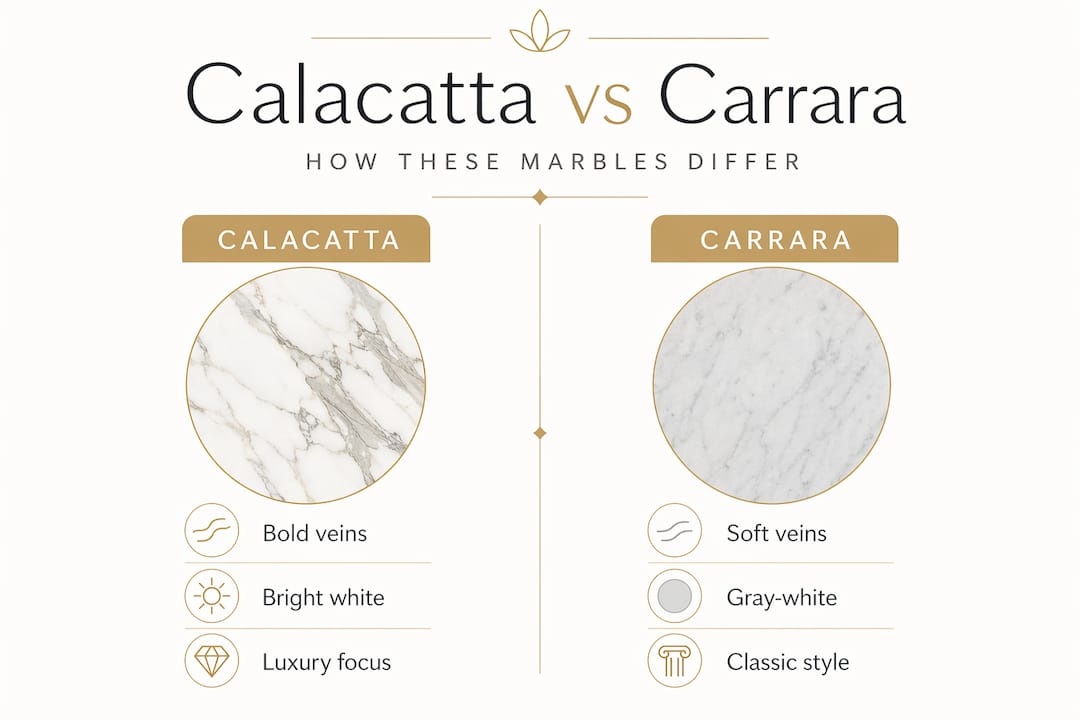
This is where most buyers get tripped up. Carrara is not Calacatta, and the difference matters a great deal when you’re designing a space around one of them.
| Feature | Calacatta marble | Carrara marble |
|---|---|---|
| Origin | Apuan Alps, Carrara region, Italy | Apuan Alps, Carrara region, Italy |
| Background color | Bright, crisp white | Softer white to light gray |
| Veining style | Bold, thick, high contrast | Fine, feathery, subtle |
| Veining colors | Gray, gold, brown, purple | Light gray, blue-gray |
| Price per sq. ft. | $100–$200 material cost | $40–$60 material cost |
| Rarity | Less common, limited quarries | More abundant, widely available |
| Best uses | Focal features, islands, vanities | Broader applications, subtler designs |
| Maintenance needs | Regular sealing, pH-neutral cleaning | Similar, slightly more forgiving |
The choosing between Carrara and Calacatta really comes down to aesthetic intent and budget. Calacatta’s boldness makes it the right choice for focal points where you want the stone to carry the room. Carrara works better when the stone needs to support the design rather than lead it.
What about look-alikes? Engineered quartz and sintered porcelain are both available in convincing Calacatta-inspired patterns. They offer better resistance to staining and etching, but they won’t have the natural depth, variation, or translucency of real marble. For a luxury interior where authenticity matters, there’s no real substitute.
Designers consistently reach for Calacatta when they need a stone that becomes the focal point of a room. Calacatta is used as a high-visibility hero stone on kitchen islands, vanity tops, feature walls, and fireplace surrounds precisely because its dramatic veining does the decorating for you.
The most impactful applications include:
When pairing Calacatta with other materials, restraint pays off. The stone is already doing a lot of visual work. Pair it with matte white cabinetry, warm wood tones, or brushed brass hardware rather than competing patterns or busy textures. The goal is to let the marble breathe.
For inspiration on using marble as a statement element in upscale interiors, the approach is almost always the same: one dominant stone, clean surroundings, and materials that complement without competing.
Here is where many homeowners get into trouble. Calacatta marble is porous and acid-sensitive, and understanding exactly what that means will save you from expensive repairs.
Kitchen Calacatta countertops require resealing every 6 to 12 months, while bathroom applications can typically go longer between treatments. Sealing reduces the rate at which liquids penetrate the stone’s pores, lowering your risk of staining from wine, coffee, or oil. But there’s a critical limit to what sealing can do.
Sealing does not prevent acid etching. Etching is a chemical reaction that occurs when acidic substances, including lemon juice, vinegar, tomato sauce, and even some cleaning products, make contact with calcium carbonate on the marble’s surface. The acid dissolves a microscopic layer of the stone, leaving a dull, lightened patch that looks like a watermark. It has nothing to do with absorption.
Practical maintenance steps that actually work:
Pro Tip: To check whether your sealer is still effective, place a few drops of water on the marble surface and wait 10 minutes. If the water beads up, your seal is holding. If it absorbs and darkens the stone, it’s time to reseal.
Maintenance is a continuous routine, not a one-time treatment. Homeowners who understand this from the start get decades of beauty from their Calacatta marble. Those who don’t often find themselves disappointed within the first year.
I’ve seen enough Calacatta installations to know that the biggest mistake people make isn’t about maintenance. It’s about slab selection. You can manage the care routine. What you cannot fix after installation is buying a slab based on a website photo and then being surprised by what you actually got.
In my experience, the most satisfied homeowners are the ones who visit the stone yard in person, pull the actual slabs that will be cut for their project, and spend time looking at them in different lighting conditions. Morning light and artificial light read very differently on white marble. A slab that looks crisp and dramatic under warehouse fluorescents can look almost creamy in a north-facing kitchen.
I’ve also watched people underestimate the maintenance commitment and then blame the stone. Calacatta marble is not low-maintenance. It never will be. But the reward for that commitment is a material that gets more beautiful and characterful over decades, not less. Patina on natural marble tells a story that engineered surfaces simply cannot replicate.
My honest recommendation: if your household is genuinely high-traffic with young children, acidic cooking habits, and limited time for upkeep, consider Calacatta for a bathroom vanity or a lower-traffic feature wall rather than the primary kitchen countertop. Use the stone where it will be protected and admired, not where it will be stressed daily.
— Nick
If this guide has clarified what makes Calacatta marble worth considering, the next step is seeing the real thing.
At Marmorique, we curate a collection of natural stone decor and furnishings that showcases Calacatta and other luxury marbles in their most refined forms, from statement table pieces to artisan bathroom accessories. Every item reflects the natural variation and craftsmanship that make genuine marble irreplaceable. Whether you’re sourcing for a single room refresh or a full interior project, our stone decor collection gives you direct access to premium pieces selected for quality and visual impact. Browse the collection, and if you have questions about material selection or pairing, our team is available to guide you toward the right choice for your space.
Calacatta marble is a luxury metamorphic stone quarried from the Apuan Alps in Italy, characterized by a bright white background and bold, dramatic veining in gray, gold, or brown tones. It is rarer and more visually striking than most other white marbles.
Calacatta has a brighter, crisper white background with thick, high-contrast veining, while Carrara typically has a softer white or light gray base with finer, subtler veining. Calacatta is also significantly more expensive, generally running $100 to $200 per square foot for material alone.
No. Sealing slows liquid absorption and reduces staining risk, but it does not prevent acid etching. Acidic substances like lemon juice or vinegar chemically react with the marble’s surface regardless of sealant, leaving dull patches that require professional polishing to correct.
Kitchen Calacatta countertops typically need resealing every 6 to 12 months. Bathroom applications and lower-traffic surfaces can often go longer between treatments, but you should always perform the water bead test periodically to check your seal’s effectiveness.
For homeowners who prioritize visual impact and are committed to proper maintenance, Calacatta marble delivers a level of beauty and long-term value that manufactured surfaces don’t match. The investment makes the most sense in high-visibility applications where the stone becomes the defining design element of the room.


