Your Cart (0)
Your cart is empty
Free express shipping

Drawer menu
Free express shipping

Most homeowners assume that luxury interiors are built on the latest engineered surfaces, sleek composites, or high-gloss synthetics. The truth is quieter and far more compelling. Natural stone has shaped the world’s most admired spaces for thousands of years, and its advantages go well beyond a beautiful surface. From the way it interacts with light to the way it supports your health, stone brings a depth of value that no manufactured material can fully replicate. This guide breaks down exactly why stone belongs in your home, with practical insights you can act on right away.
| Point | Details |
|---|---|
| Stone’s unparalleled elegance | Natural stone brings lasting beauty and a sense of luxury that’s hard to replicate. |
| Healthier interiors | Stone surfaces improve air quality and resist mold compared to synthetics. |
| Practical benefits | Stone offers durability, comfort, and energy efficiency for daily living. |
| Endless design flexibility | There are countless ways to use stone to personalize and elevate any room. |
Stone is not a trend. It is a material that has outlasted every design movement, every era of innovation, and every wave of synthetic alternatives. Walk through any historic palace, ancient bath, or centuries-old cathedral and you will find stone at the center of it. That is not coincidence.
As noted in natural stone decor, natural stone has been prized for centuries as a symbol of durability and luxury. There is a psychological reason for this. Authentic materials trigger a sense of permanence and trust that engineered surfaces simply cannot fake. When you touch real marble or travertine, your brain registers something genuine, something that took millions of years to form.
“Stone carries a visual and tactile weight that no synthetic can replicate. It grounds a room and gives it a sense of history and intention.”
Here is a quick look at the most popular natural stones and the moods they create:
Each stone type carries its own personality, and choosing the right one is the first step toward a space that feels intentional rather than assembled.
Here is something most people never consider: stone does not just sit in a room. It actively changes how the room looks and feels depending on the light around it. The impact of natural stone on ambiance is one of its most underrated qualities.
Stone’s mineral composition creates dynamic light play, enhancing spaciousness and mood throughout the day. A white marble surface in morning light looks entirely different at dusk. That constant, subtle shift keeps a room feeling alive.
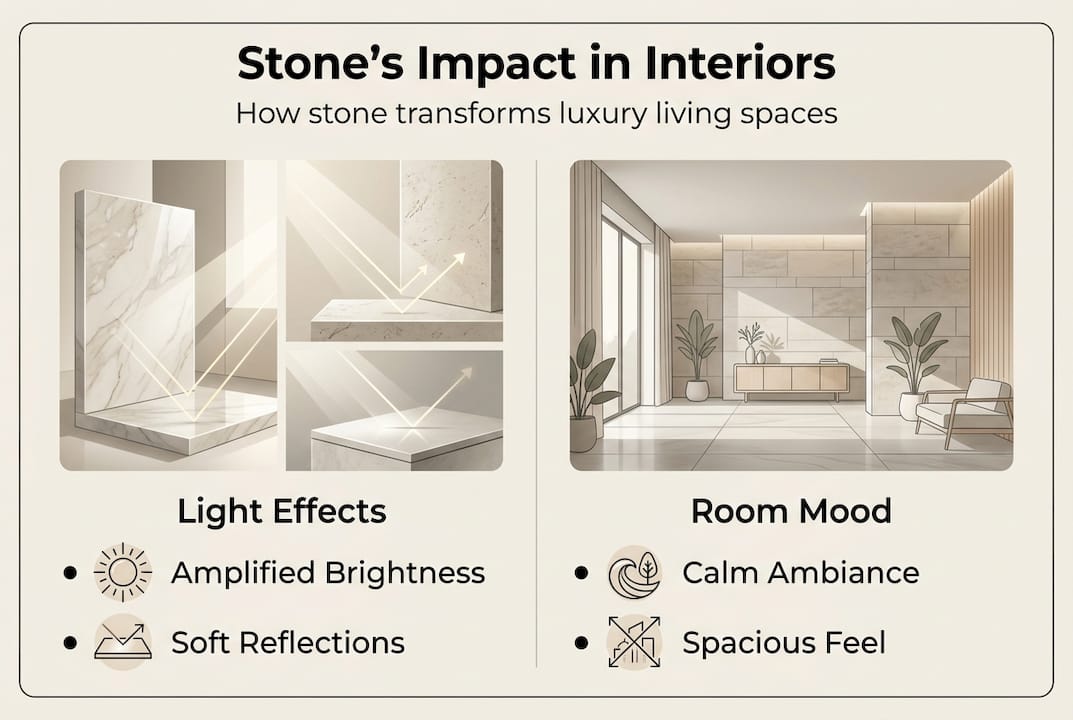
| Stone type | Light behavior | Mood effect |
|---|---|---|
| White marble | Reflects and amplifies light | Bright, airy, expansive |
| Travertine | Softens and diffuses light | Warm, relaxed, welcoming |
| Dark granite | Absorbs light, adds contrast | Dramatic, grounded, bold |
| Onyx (backlit) | Transmits light | Luxurious, glowing, artistic |
| Limestone | Neutral diffusion | Calm, clean, timeless |
Stone also plays a powerful role in how large or intimate a room feels. Light-colored stones with large, continuous slabs visually push walls outward. Smaller stone tiles or textured finishes draw a space inward, creating coziness.
Pro Tip: Place polished stone surfaces opposite windows to bounce natural light deeper into the room. In darker spaces, choose stones with warm undertones like travertine or honey onyx to compensate for limited sunlight.
Engineered quartz, laminate, and luxury vinyl are marketed heavily as the smart, modern choice. They are easier to install and often cheaper upfront. But when you look at the full picture, the comparison shifts significantly.
One of the most important factors is health. Natural stone improves indoor air quality as a VOC-free, non-toxic surface, unlike many synthetics that off-gas chemicals over time. VOCs, or volatile organic compounds, are invisible gases released by certain materials that can irritate airways and accumulate indoors.
“Homes with natural stone surfaces consistently show lower levels of airborne irritants compared to spaces finished with synthetic alternatives.”
Here is how the two categories compare across the factors that matter most:
| Factor | Natural stone | Synthetic/engineered |
|---|---|---|
| Appearance | Unique, one-of-a-kind | Uniform, repeated pattern |
| VOC emissions | None | Possible, varies by product |
| Lifespan | 50 to 100+ years | 10 to 25 years |
| Resale value | Increases home value | Minimal impact |
| Mold resistance | High (non-porous when sealed) | Varies |
| Repairability | Can be polished and restored | Often must be replaced |
When choosing stone over synthetics, follow these steps to make the right call for your lifestyle:
Beyond looks, stone earns its place in a home through sheer performance. It is one of the few materials that genuinely improves with age when cared for properly.
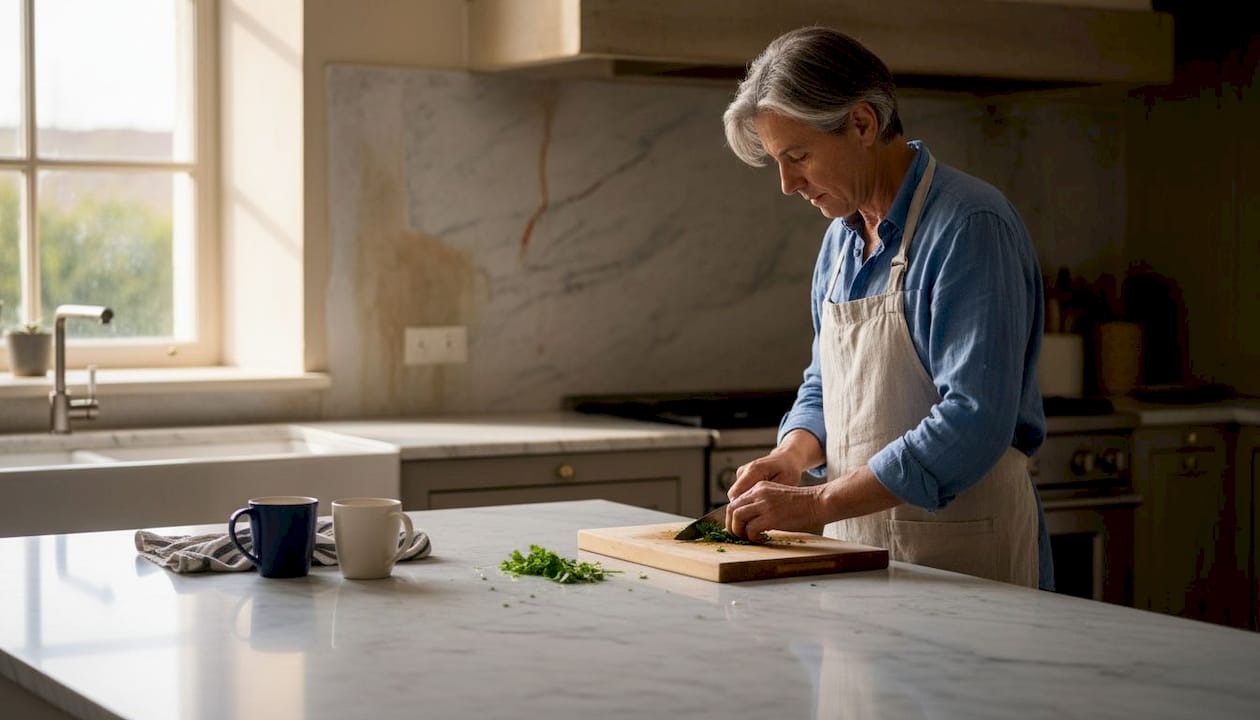
Natural stone resists mold and bacteria while providing thermal mass that aids energy efficiency. Thermal mass means stone absorbs heat during the day and releases it slowly at night, helping to stabilize indoor temperatures and reduce reliance on heating and cooling systems.
Here are the key functional advantages stone brings to any interior:
Pro Tip: Seal your stone surfaces once a year with a penetrating sealer designed for your specific stone type. Wipe up spills quickly, especially acidic liquids like lemon juice or wine on marble. This simple routine keeps stone looking pristine for decades.
Knowing stone’s benefits is one thing. Knowing where and how to use it is where the real transformation happens. Natural stone applications heighten the luxury and value of home interiors across every room.
Here is a room-by-room breakdown of where stone makes the biggest impact:
To elevate your space with stone, follow these steps:
Pro Tip: Mixing stone with natural wood, linen, or brushed metal creates a layered, organic look that feels curated rather than cold. Stone alone can feel stark; paired with softer textures, it feels intentional and warm.
If this guide has shown you anything, it is that stone is not just a surface choice. It is a long-term investment in beauty, health, and comfort. Whether you are planning a full renovation or simply looking for a meaningful accent piece, the right stone object can shift the entire energy of a room.
At Marmorique, every piece is crafted from genuine natural stone, selected for quality and character. The artisan marble soap dish is a perfect entry point, bringing solid stone luxury into your bathroom with zero renovation required. For a striking decorative accent, the marble grape cluster ornament adds sculptural beauty and natural weight to any shelf, table, or entryway. Explore the full collection and find the piece that speaks to your space.
Yes. Natural stone surfaces outlast most synthetics by decades when properly maintained, and they retain their visual appeal and market value throughout their lifespan.
Stone is VOC-free and non-toxic, meaning it does not release harmful gases into your home, and its resistance to mold makes it a healthier surface choice than many synthetic alternatives.
Not at all. With an annual sealant application and prompt cleanup of spills, stone stays beautiful for years with minimal effort compared to surfaces that need replacing.
Stone works well in kitchens, bathrooms, entryways, and living areas, and it also shines as decorative accessories that add luxury without requiring structural changes.


