Your Cart (0)
Your cart is empty
Free express shipping

Drawer menu
Free express shipping

TL;DR:
- Marble lamination offers a lightweight, cost-effective, and versatile alternative to solid marble.
- It provides high durability, moisture resistance, and design flexibility for various interior applications.
- Proper grade selection and placement ensure optimal performance in high-wear and moisture-prone areas.
Most people assume that if it isn’t solid stone, it isn’t truly luxurious. That assumption is costing homeowners and designers some of the most versatile, beautiful, and practical surface options available today. Marble lamination sits at the intersection of elegance and engineering, offering the visual richness of natural marble with a profile that’s lighter, more forgiving, and often more accessible. Whether you’re designing a high-end bathroom, a statement kitchen, or a boutique commercial space, understanding marble lamination gives you a serious creative and practical edge. This guide covers everything from how it’s made to how to choose the right type for your specific project.
| Point | Details |
|---|---|
| Definition clarified | Marble lamination combines real marble with advanced laminate technology for style and durability. |
| Best-fit applications | High-pressure marble laminate excels in kitchens, bathrooms, and feature walls due to its robust finish. |
| Expert selection tips | Choose your laminate grade based on wear, location, and design needs for lasting beauty. |
| Luxury on a budget | Marble lamination offers the premium look of stone for a fraction of the weight and cost. |
Marble lamination is a surface treatment process where a thin layer of real marble or a high-fidelity marble-patterned material is bonded to a composite base, then sealed with a protective topcoat. The result is a panel or sheet that delivers the look and feel of marble without the full weight, fragility, or cost of a solid slab.
The manufacturing process typically involves three layers working together. First, there’s the decorative face layer, which can be a genuine marble veneer sliced as thin as 3mm, or a photographic reproduction of marble grain printed onto resin-saturated paper. Second, a composite core, often made from MDF, particleboard, or fiber-reinforced material, provides structural stability. Third, a protective overlay, usually a melamine or resin coating, shields the surface from scratches, moisture, and UV exposure.
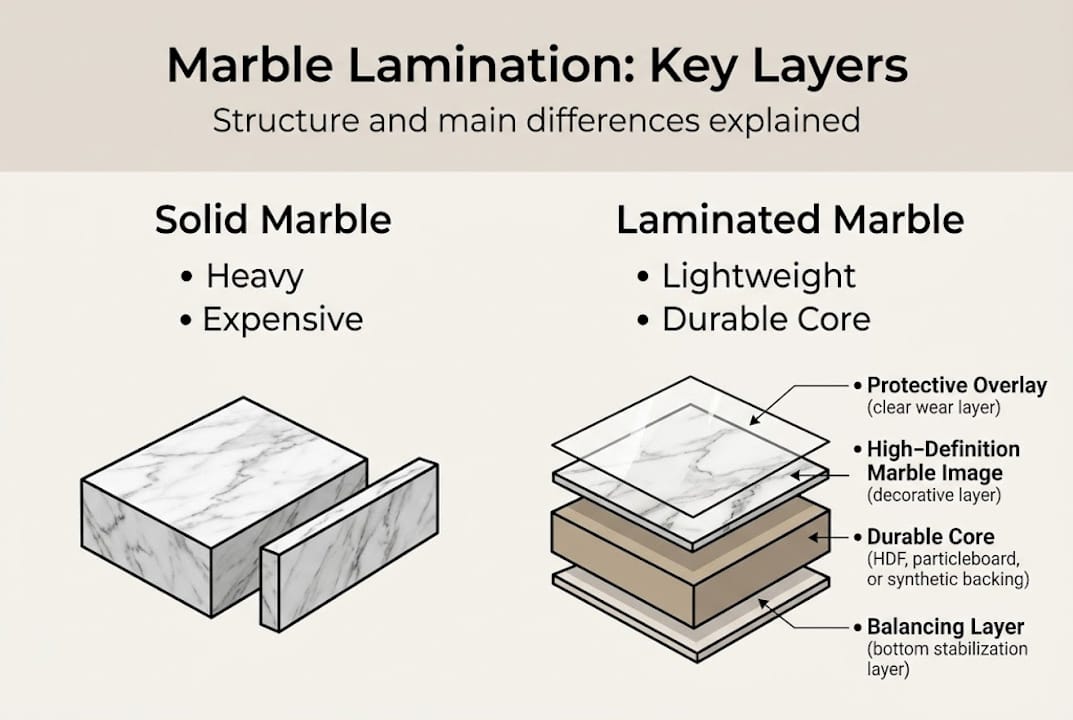
This is fundamentally different from solid marble, which is quarried as a single block and cut to size. Solid marble is heavier, more porous, and requires more intensive sealing and maintenance. It’s also different from basic decorative laminates, which use printed paper with no real stone content at all.
Marble lamination is used across a wide range of applications:
Within the laminate category, two major product types exist: High Pressure Laminate (HPL) and Low Pressure Laminate (LPL). HPL is produced under intense heat and pressure, making it significantly denser and harder. LPL, also called melamine laminate, is fused at lower pressure directly onto a board substrate. As HPL outperforms LPL in high-wear environments, it’s the preferred choice for surfaces that take daily punishment.
“The right laminate choice depends entirely on where it lives in your space. A bedroom wall panel has very different demands than a kitchen countertop.”
| Feature | Solid marble | Marble lamination |
|---|---|---|
| Weight | Very heavy | Lightweight |
| Cost | High | Moderate to low |
| Maintenance | Intensive | Minimal |
| Design flexibility | Limited | High |
| Moisture resistance | Moderate | High (HPL) |
Now that you know what marble lamination is, it’s essential to understand the types available for different needs. Choosing the wrong grade is one of the most common and costly mistakes in interior projects.
High Pressure Laminate (HPL) is manufactured by stacking multiple layers of resin-impregnated kraft paper beneath the decorative face, then pressing everything together at pressures exceeding 1,000 psi and temperatures above 120°C. This creates an extremely dense, rigid sheet that resists impact, abrasion, and moisture. HPL is sold as a standalone sheet and then bonded to a substrate during fabrication.
Low Pressure Laminate (LPL), often called melamine board, is produced by fusing a single decorative paper layer directly onto a particleboard or MDF core using lower heat and pressure. It’s faster to produce and less expensive, but it sacrifices durability. LPL works well for vertical surfaces in low-traffic areas, like wardrobe interiors or display shelving.
Post-forming grades are a specialty subset of HPL. They’re engineered to bend around curves and edges without cracking, which makes them ideal for rounded countertop edges, column wraps, and furniture with organic shapes. Standard HPL would snap under the same bending radius.
Here’s how each type fits different applications:
Pro Tip: If you’re planning a bathroom renovation, always specify HPL over LPL. Bathrooms combine humidity, temperature swings, and daily contact, which will degrade LPL much faster. You can find detailed guidance on marble selection for bathrooms to pair the right laminate grade with the right design choices.
| Type | Pressure used | Best for | Durability |
|---|---|---|---|
| HPL | High (1,000+ psi) | Countertops, wet areas | Excellent |
| LPL | Low | Furniture, low-traffic walls | Moderate |
| Post-forming HPL | High + flexible | Curves, edges, columns | Excellent |
| Compact HPL | Very high | Exterior, wet rooms | Superior |
The grade distinction between HPL and LPL is one of the most important specs to confirm with any supplier before committing to a purchase.
With the main types detailed, let’s explore why marble lamination is increasingly chosen for upscale décor. The reasons go well beyond cost savings.

The most immediate benefit is visual impact. Modern marble laminates reproduce the natural veining, depth, and variation of stones like Calacatta, Statuario, and Emperador with remarkable accuracy. High-gloss finishes amplify the drama of white and gold veining. Matte finishes soften the look for contemporary minimalist spaces. You get the aesthetic result you want without being locked into whatever slab the quarry produced that season.
Functionally, marble lamination solves several real problems that solid stone creates:
The environmental angle matters too. Using a thin veneer of real stone over a composite core means significantly less quarrying. The use of natural materials in architecture is increasingly evaluated through a sustainability lens, and laminated products often score better on material efficiency metrics.
Pro Tip: For maximum design flexibility, combine HPL marble panels on vertical surfaces with a genuine marble accent piece, like a tabletop or lamp base, on the same palette. The contrast between the two adds authenticity without the cost of fully outfitting a room in solid stone. Explore bathroom marble lamination tips for room-specific ideas.
The durability advantage of HPL in high-wear settings is one reason why hospitality designers have adopted marble lamination so widely in hotel lobbies and spa environments.
While the benefits are numerous, smart homeowners and designers must also recognize the limitations and best practices for marble lamination.
The most important limitation is structural. Marble lamination is a surface material, not a load-bearing one. It cannot replace solid stone in applications where compressive strength or heavy impact resistance is needed. Flooring is a gray area: some compact HPL grades are rated for floor use, but most standard laminated panels are not designed to handle foot traffic over time.
Humidity and heat are also factors. While HPL handles moisture well, prolonged exposure to standing water at seams or edges can cause delamination over time. Edges must be properly sealed or finished with edge banding. Direct heat from pots and pans can damage the protective overlay on countertop-grade laminates, so always use trivets.
Here’s a checklist of what to ask any supplier before purchasing:
“A laminate that performs beautifully in a showroom can fail within a year if the wrong grade is specified for the actual use environment.”
For pairing with décor, marble laminates in cool white and gray tones work best with brushed brass or matte black hardware. Warmer beige and cream marble patterns pair naturally with unlacquered brass and warm wood tones. Avoid mixing too many veining styles in a single room, as it reads as busy rather than layered.
The HPL vs. LPL performance gap becomes especially clear in bathrooms and kitchens, where humidity cycles are constant. For inspiration on how to select the best marble finish for your space, the right reference points make a real difference. You can also browse bathroom accessories inspiration to see how laminated surfaces pair with fixtures in real settings.
There’s a persistent snobbery in high-end design circles around anything that isn’t solid, quarried stone. We understand where it comes from. For decades, laminates were genuinely inferior products that fooled no one. That era is over.
What we’ve seen working with real projects is that experienced designers are now using marble lamination not as a compromise, but as a deliberate tool. Curved feature walls that would be structurally impossible with solid stone become achievable. Spaces with weight restrictions, like upper-floor renovations in older buildings, can finally get the marble aesthetic they deserve.
The more interesting shift is how lamination enables designers to use authentic stone pieces more strategically. A single genuine marble lamp or table becomes more powerful when it sits against a laminated marble backdrop that echoes its veining. The real piece anchors the room. The laminated surface amplifies it. That interplay, between authentic and engineered, is where the most sophisticated interiors live right now. Getting expert marble advice early in your project helps you plan that balance intentionally rather than accidentally.
If this guide has shown you anything, it’s that marble lamination isn’t a shortcut. It’s a smarter way to achieve the luxury aesthetic you want, with the performance your space actually needs.
At Marmorique, we curate premium marble laminates alongside genuine marble and travertine pieces, so you can design spaces where both work together beautifully. Whether you’re outfitting a bathroom, a living room feature wall, or a full commercial interior, our collection gives you the quality and variety to get it right. Browse our catalog and find the marble laminated products that match your vision, your budget, and your design standards.
Marble lamination is extremely durable for most interior applications, especially when HPL is used, but heavy structural loads should still rely on solid marble.
Yes, marble lamination is ideal for moisture-prone areas when properly sealed, making it an excellent choice for both bathrooms and kitchens.
Most shapes and layouts are achievable, but extreme curves and load-heavy uses may require post-forming specialty grades or solid marble instead.
Marble laminated surfaces clean up easily with mild soap and water, requiring far less intensive care than solid marble, which needs regular sealing.
Marble lamination has a lower environmental impact than solid marble because it uses significantly less raw stone and reduces transportation weight.


