Your Cart (0)
Your cart is empty
Free express shipping

Drawer menu
Free express shipping

TL;DR:
- Marble inlays are seamless, embedded decorative stones with functional uses in luxury interiors.
- Skilled artisans create them through precise cutting, fitting, and polishing, requiring professional installation.
- They offer lasting value, authenticity, and enhance property appeal, but require careful maintenance.
Marble inlays carry a reputation for being purely ornamental, reserved for palaces and five-star hotels. That reputation undersells them badly. These stone artworks serve real functional purposes in modern luxury homes, from high-traffic entryways to fireplace surrounds, and they hold their value in ways synthetic alternatives simply cannot match. Whether you’re a homeowner planning a renovation or an interior designer sourcing statement pieces for a client, understanding what marble inlays actually are, how they’re made, and what they cost will save you from expensive mistakes and open up design possibilities you may not have considered.
| Point | Details |
|---|---|
| Custom stone artistry | Marble inlays offer intricate, bespoke decoration for luxury spaces. |
| Professional installation needed | Only skilled experts should install marble inlays to ensure quality and durability. |
| High investment, lasting value | Costs can exceed $5,000 per square meter, but authentic materials and design reap long-term rewards. |
| Ongoing care essential | Regular maintenance and sealing preserve marble inlays in high-traffic and wet areas. |
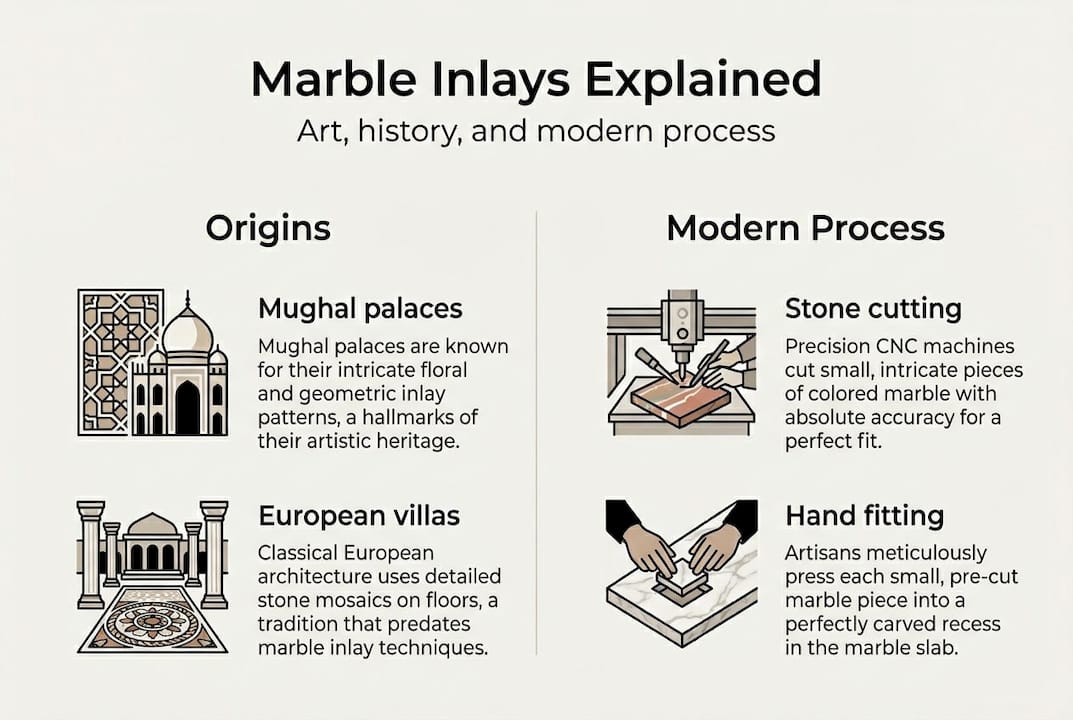
A marble inlay is a decorative technique where pieces of cut stone are set into a base material to form a pattern, image, or geometric design flush with the surface. The result looks seamless, as if the design grew from within the stone itself. This is what separates inlays from mosaics, where tiles sit on top of a surface, or veneers, which are thin stone sheets bonded over another material. Inlays are embedded, precise, and permanent.
The art of marble inlay traces back to ancient palaces and continues to evolve in luxury design. The Mughal Empire made it iconic, most famously in the Taj Mahal, where semi-precious stones were inlaid into white marble with extraordinary precision. European craftsmen adopted and adapted the technique during the Renaissance, and today it lives on in high-end residential and commercial interiors worldwide. Understanding the natural stone benefits behind this tradition helps explain why the technique has never gone out of style.
| Inlay type | Common pattern | Typical application |
|---|---|---|
| Geometric | Repeating shapes, borders | Floors, entryways |
| Floral | Botanical motifs | Table tops, wall panels |
| Pictorial | Scenes or portraits | Feature walls, medallions |
Marble inlays appear across a wide range of surfaces:
The key distinction worth remembering: mosaics use small uniform tiles arranged on the surface, while inlays are cut and fitted into recesses in the base stone. That flush finish is what gives inlays their refined, high-end look.
Skilled artisans bring marble inlays to life through a process that combines old-world patience with modern precision tools. There is no shortcut here. The quality of the final piece depends entirely on the expertise of the hands doing the work.
Here is how the process unfolds:
Modern CNC (computer numerical control) machines have made cutting more precise, but the fitting, inlaying, and finishing still require skilled human hands. Custom designs add significant time to the process, sometimes weeks, but the result is a one-of-a-kind piece that no factory can replicate.
Pro Tip: Before installation begins, have your subfloor assessed by a structural specialist. Professional installation is critical to avoid misalignment, and an uneven or weak subfloor is one of the most common causes of cracking after the work is done.
The case for marble inlays goes well beyond aesthetics. Yes, they look extraordinary. But they also perform.
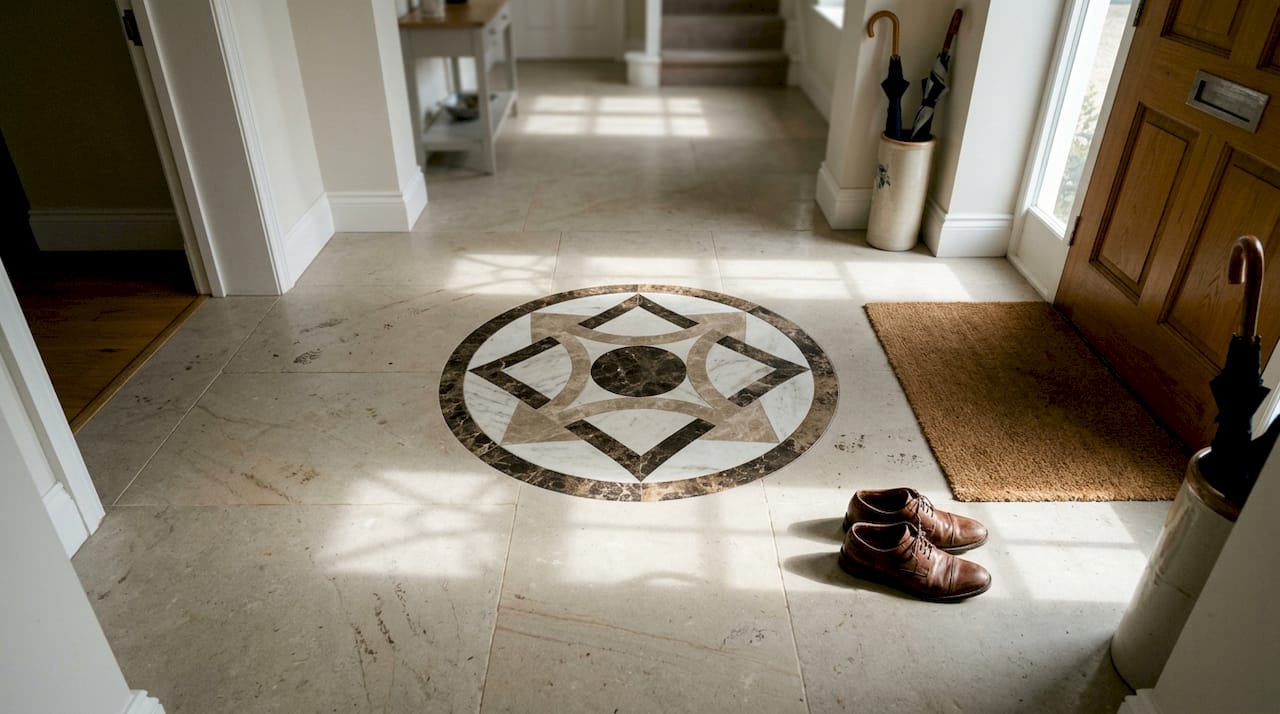
Bespoke marble inlay installations can exceed $5,000 per square meter depending on design complexity, stone rarity, and the level of artisan skill involved. That figure reflects real value: longevity, uniqueness, and the kind of material quality that holds up in high-traffic environments for decades.
Natural stones are preferred over synthetics for authenticity and long-term value in high-end interiors. Here is how they compare:
| Feature | Marble inlay | Synthetic alternative |
|---|---|---|
| Authenticity | Unique, natural variation | Uniform, manufactured |
| Longevity | Decades with proper care | 10-15 years typically |
| Customizability | Fully bespoke | Limited design options |
| Resale value | Adds significant value | Minimal impact |
| Price | Premium investment | Lower upfront cost |
The natural stone advantages become especially clear in spaces where first impressions matter most. Common applications include:
From a resale perspective, a well-executed marble inlay in a primary living area or entryway can meaningfully increase a property’s perceived and actual value. Buyers in the luxury market recognize the investment.
Luxury comes with its own set of challenges. Before you commit to a marble inlay project, work through this checklist:
“Potential for cracks if subfloor is uneven; not DIY — professional installation is essential to achieve the precision and longevity that marble inlays demand.”
Maintenance is an ongoing commitment. Marble requires sealing every one to three years depending on traffic and exposure. Cleaning should use pH-neutral products only. Acidic cleaners, even mild ones like vinegar, will etch the surface permanently. Review a solid marble inlay maintenance guide before your installation is complete so you know exactly what you’re signing up for.
Pro Tip: Schedule a professional maintenance check every two years, not just when something looks wrong. Early detection of micro-cracks or sealant breakdown prevents costly repairs later.
The elegance of a marble inlay is not self-sustaining. It requires consistent, informed care. The good news is that a simple routine keeps these surfaces looking exceptional for generations.
Follow these steps for ongoing care:
In kitchens and wet areas, proper maintenance preserves marble inlays particularly well when sealing is prioritized. Bathrooms need more frequent attention because moisture and cleaning products are constant factors. Entryways benefit from quality door mats that catch grit before it reaches the stone surface.
The most common mistake homeowners make is using generic household cleaners. Most contain acids or harsh detergents that strip sealant and dull the finish. Stick to products specifically formulated for natural stone. Following a proven marble care basics routine protects your investment and keeps the surface looking as sharp as the day it was installed.
Most design articles treat marble inlays as a trend, something to feature in a mood board and move on from. That framing misses the point entirely.
The real value of a marble inlay is not visual. It is the combination of authentic material, skilled craftsmanship, and long-term thinking that produces something genuinely irreplaceable. When you choose a synthetic alternative to save money upfront, you are not just compromising on looks. You are giving up decades of usable life and the kind of character that only natural stone develops over time.
Custom, authentic materials with professional installation deliver lasting results, not just trend-focused choices. We have seen homeowners invest in lower-cost alternatives only to replace them within a decade, spending more in total than a proper marble inlay would have cost from the start.
The other thing most guides skip is the planning phase. A marble inlay is not something you order and install in a weekend. The design process, stone sourcing, and installation timeline require coordination. Rushing any part of it introduces risk. Understanding why authentic stone matters before you budget is the difference between a regret and a legacy piece.
If this guide has shown you anything, it is that marble inlays reward careful planning and quality sourcing. The right stone, the right artisan, and the right design brief produce something that genuinely elevates a space for decades.
At Marmorique, we specialize in natural stone pieces that bring exactly this kind of quality into your home. From curated marble table tops to decorative stone accessories, our collection is built around craftsmanship and lasting beauty. If you are ready to explore custom marble inlay solutions or simply want to see what high-quality natural stone looks like in a real context, browse our collection and take the first step toward a space that truly reflects your vision.
Marble inlays are used for decorative and functional flooring in luxury interiors, including entryways, table tops, fireplace surrounds, and hotel lobbies. They serve both aesthetic and practical purposes in high-end spaces.
With the right routine, maintenance is straightforward. Regular sealing preserves longevity and following expert guidance on pH-neutral cleaning keeps marble inlays looking sharp for decades.
No. Marble inlays require professional installation due to the precision required for cutting, fitting, and subfloor preparation. DIY attempts typically result in misalignment or cracking.
Bespoke marble inlays can exceed $5,000 per sqm for custom work, depending on design complexity, stone selection, and artisan expertise.
Natural stones offer greater authenticity and lasting value. Synthetics may cost less upfront but lack the character, longevity, and resale impact of genuine marble.


