Your Cart (0)
Your cart is empty
Free express shipping

Drawer menu
Free express shipping

TL;DR:
- Natural stone has become a hallmark of luxurious contemporary interiors due to its unique veining and natural variation, building entire spaces around its authentic character. It offers tactile and visual warmth, providing sensory calm and emotional resonance in areas such as bedrooms, bathrooms, and social spaces, especially with matte or leathered finishes. When properly selected, sealed, and maintained, stone is a durable, timeless material that enhances interior longevity and environmentally conscious design.
Step inside almost any high-end home today and you’ll notice something unexpected. The interiors are warm, textured, and quietly confident. Not cold. Not clinical. Stone is doing that work. Natural marble, travertine, and granite have moved far beyond countertops and bathroom tiles to become the defining signature of genuinely luxurious contemporary spaces. This guide explains why leading designers are specifying stone across entire rooms, how to choose the right type for your needs, and what makes this material one of the most enduring investments you can make in your home.
| Point | Details |
|---|---|
| Stone brings warmth | Natural stone adds unique character and lived-in beauty to contemporary spaces. |
| Sensory grounding | Stone delivers tactile calm and quiet luxury, anchoring modern interiors emotionally. |
| Performance matters | Choose the right stone and finish for desired durability, maintenance, and look. |
| Modern finishes excel | Innovative finishes give stone depth, light play, and energy-saving properties. |
| Wise choices last | Expert selection and care ensure stone’s beauty and utility endure for years. |
There’s a persistent idea that contemporary interiors are all hard edges, polished chrome, and white walls. Stone is quietly dismantling that idea, one feature wall at a time. The shift happening in luxury design right now isn’t about adding stone as an afterthought. It’s about building entire rooms around its natural character.
The growing appeal comes from what makes each slab genuinely unique. Visible veining, mineral deposits, and tonal shifts that vary from one piece to the next mean no two stone surfaces are identical. As one design publication puts it, stone creates a more “lived-in” look through natural variation rather than aiming for uniform perfection. This is a direct counter to the sterile aesthetic that dominated interiors for much of the early 2000s.
“Stone doesn’t try to be perfect. That’s exactly what makes it perfect for contemporary design.” — A sentiment increasingly echoed by interior designers working with premium residential clients.
What’s particularly interesting is where designers are now placing stone. The conversation has moved well beyond countertops:
Understanding stone’s role in luxury interiors means recognizing that this is a design language, not just a surface material. The stone participates in the home over time, developing a subtle patina that actually increases its character. Designers who embrace this are offering clients something genuinely irreplaceable. Explore modern stone applications to see how this translates into specific interior scenarios.
Visual impact is only half the story. What sets stone apart in a contemporary interior is how it feels, both literally under your fingertips and emotionally as you move through a room.
Stone carries a coolness at the touch that is immediately distinctive. On a warm afternoon, a marble tabletop or travertine floor offers a grounding, calming sensation that no synthetic material can genuinely replicate. This isn’t accidental. It’s why stone functions as an experiential design material in luxury interiors, delivering sensory calm and what designers increasingly call “quiet luxury” through weight and restraint rather than shine or excess.
Pro Tip: When selecting stone for living areas, choose a matte or leathered finish rather than a high-gloss polish. This reduces light reflection and creates a more grounded, restful atmosphere that supports the emotional quality of the room.
The sensory benefits extend beyond touch. Stone has a visual warmth that comes from its organic origin. The gentle veining in white marble or the honeyed tones of unfilled travertine create depth that a painted wall simply cannot achieve. Your eye keeps finding new detail, which is why a stone wall never feels boring over time.
Here’s what stone does particularly well in specific sensory contexts:
For more on creating calm with stone, the relationship between material choice and emotional atmosphere is explored in depth.
Choosing between natural and engineered stone is one of the most consequential decisions in any stone specification. Both have genuine strengths. Neither is universally superior. The right choice depends entirely on where the stone will be used, how much traffic it will see, and what kind of maintenance routine is realistic.
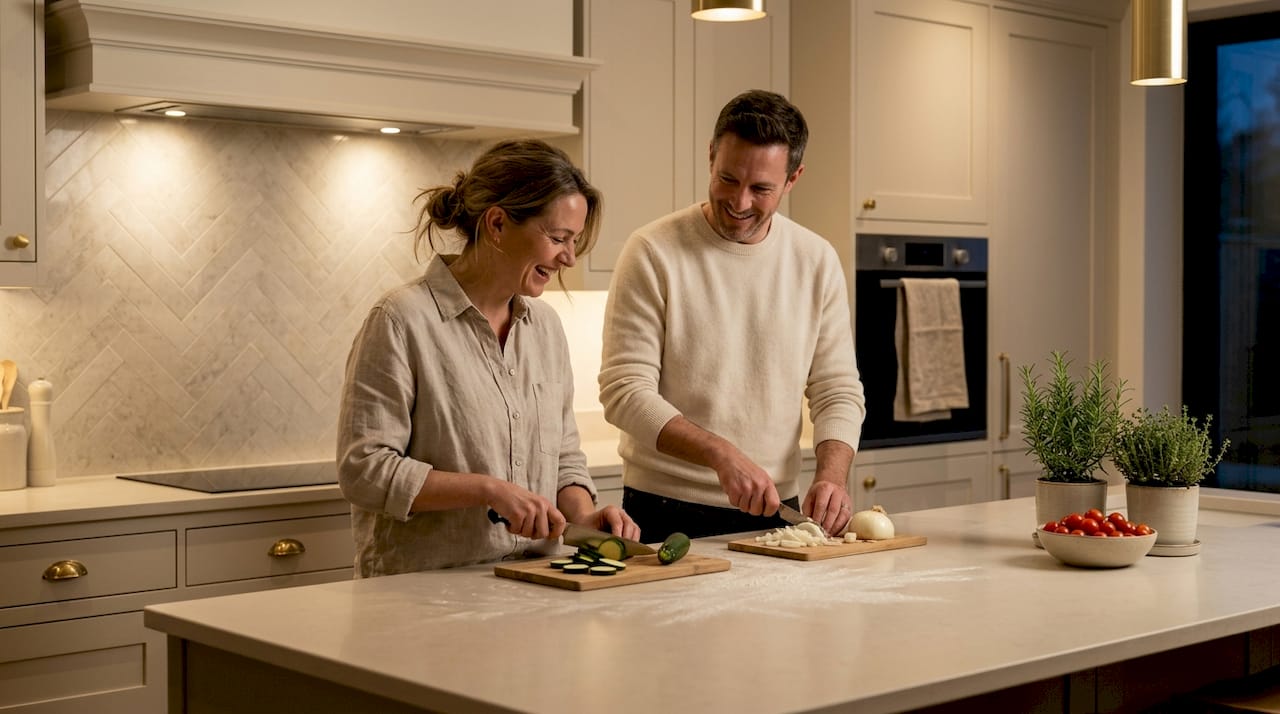
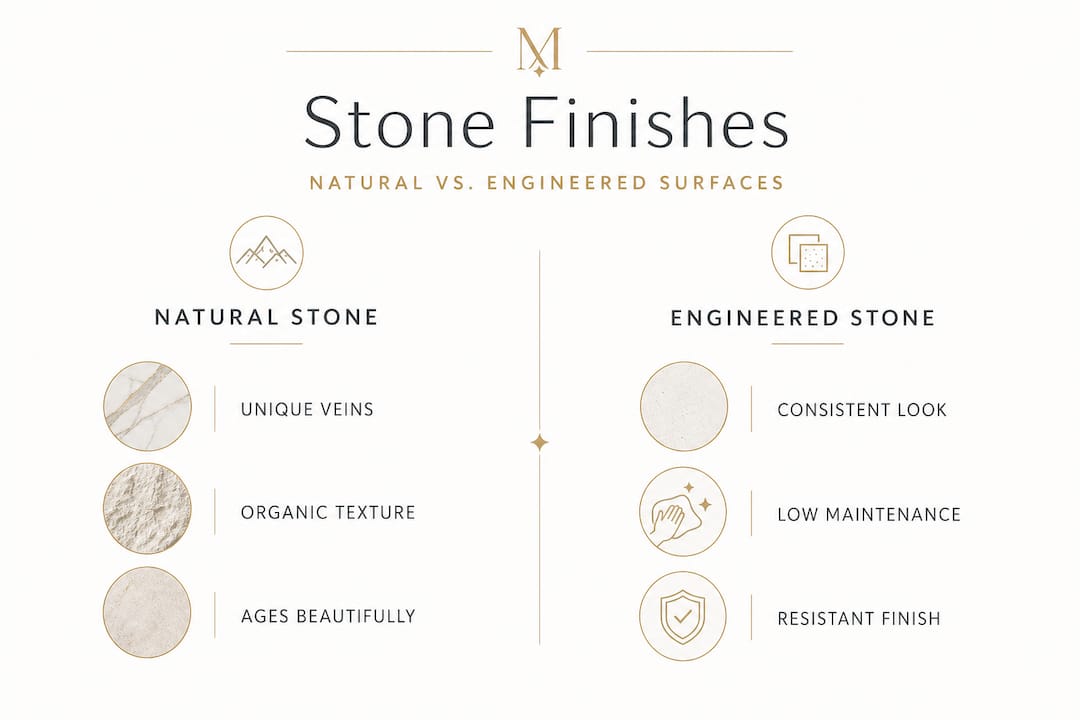
Natural stone delivers long-term durability and the ability to use modern cutting and fabrication methods, including thin large-format panels, to suit contemporary detailing. Engineered stone, typically composed of crushed quartz bound with resin, offers a more consistent appearance and often requires less ongoing care. The tradeoff is in feel and character. Engineered surfaces look precise and controlled. Natural stone feels alive.
Here’s a direct comparison across the most relevant practical factors:
| Factor | Natural stone | Engineered stone |
|---|---|---|
| Appearance | Unique veining, organic variation | Consistent, uniform pattern |
| Porosity | Variable; many types need sealing | Low porosity, generally more resistant |
| Maintenance | Periodic sealing, careful cleaning | Simpler cleaning, less sealing required |
| Durability | Very high when properly sealed | High, but resin content can be sensitive to heat |
| Longevity | Centuries with correct care | Decades with standard care |
| Environmental feel | Warm, organic, irreplaceable | Controlled, precise, predictable |
The performance differences based on porosity are important to understand. Porous stones like limestone and travertine need regular sealing and attentive cleaning, while lower-porosity stones like granite and quartzite are more forgiving. This matters enormously for rooms with moisture or heavy use.
A practical decision process for choosing stone by room:
Pro Tip: When sourcing stone for a high-traffic entryway, ask your supplier for the stone’s Mohs hardness rating. Anything below 5 (such as softer limestones) will show wear relatively quickly in heavily used spaces. For maintenance tips on stone surfaces, regular sealing and appropriate cleaning products are the two factors that most extend a stone surface’s life.
Stone’s technical advantages go well beyond aesthetics. The way a stone is finished dramatically changes its behavior in a space, from how it interacts with light to how slip-resistant it is underfoot. And stone’s physical properties have measurable benefits for a home’s energy performance that are often overlooked.
Modern finish approaches including flamed, leathered, and sandblasted surfaces give designers precise control over texture, light and shadow behavior, and grip. Each finish creates a fundamentally different experience:
| Finish | Texture | Best application | Light behavior |
|---|---|---|---|
| Polished | Smooth, reflective | Feature walls, tabletops | Amplifies light, shows veining clearly |
| Honed | Smooth, matte | Floors, kitchen surfaces | Soft, diffused reflection |
| Leathered | Textured, tactile | Countertops, decorative panels | Absorbs light, rich visual depth |
| Flamed | Rough, gritty | Outdoor paving, entryways | Minimal reflection, hides marks well |
| Sandblasted | Medium texture, uniform | Feature walls, bathroom floors | Even, non-directional light diffusion |
Pairing the right finish with the right contemporary lighting is one of the most effective ways to maximize a stone’s visual impact. A leathered marble panel under warm directional lighting creates an entirely different atmosphere than the same stone with a polished finish under cool overhead light.
Stone also has a measurable energy benefit. Stone masonry demonstrates high thermal mass and meaningful energy and comfort advantages in residential buildings. Thermal mass means the material absorbs heat during warm periods and releases it slowly, moderating temperature swings. In practical terms, a stone floor keeps a room cooler in summer and reduces the energy needed for heating by retaining warmth in cooler months. This isn’t a minor benefit. In high-end homes with large stone surfaces, the passive thermal regulation can be a meaningful part of an overall sustainable design strategy.
Key technical takeaways for stone specification:
The appeal of stone is its permanence. But that permanence only materializes with the right stone, in the right location, cared for correctly. Many expensive stone installations fail not because of the material itself but because of mismatched expectations or overlooked maintenance.
The key nuance around stone’s permanence is that it must be matched to the stone type and finish, considering sealing needs, vulnerability to staining or etching on more porous or softer stones, and the importance of selecting the right material for high-traffic or high-use zones. Marble, for example, is breathtaking in a bathroom but will etch if exposed to citrus or vinegar without sealing. The fix isn’t to avoid marble. It’s to seal it correctly and use appropriate cleaning products.
Practical maintenance framework:
Pro Tip: The single most common oversight in stone specification is treating all marble as equal. Calacatta marble is harder and denser than many Carrara varieties. Specify not just the stone type but the origin and density rating to ensure the material genuinely suits the intended application.
What most specifiers underestimate is how stone’s aging process adds rather than detracts from value. A properly cared-for travertine floor in a 30-year-old home tells a story that no modern reproduction can match. For comprehensive stone care guidance on matching materials to location and establishing smart routines, start with your supplier and be specific about the application before making a final selection.
Here’s an uncomfortable truth that the design industry doesn’t say loudly enough: most luxury interiors age badly. Trendy finishes look dated within five years. Fashionable colors become oppressive. The materials that seemed cutting-edge become visual clichés. Stone is the exception, and the reason is almost counterintuitive.
Stone’s luxury isn’t about looking expensive. It’s about feeling permanent. When you walk into a room with a natural stone feature wall or a travertine table, the material communicates something that no digital rendering or engineered surface can replicate. It says: this was here before this trend, and it will be here after the next one. That quality is extraordinarily rare in contemporary design.
The real opportunity for designers and homeowners right now is in resisting the urge to make stone perform. The best stone interiors we’ve seen are ones where the material was allowed to simply be. No forced drama. No over-lighting to make the veins pop. Just the stone, in good proportion, doing what stone does naturally. Like good reinterpretations of luxury with stone, the most compelling spaces treat stone as a foundation rather than a feature.
There’s also an environmental argument that deserves more prominence. Stone is extracted, shaped, and placed. No petrochemicals. No off-gassing. No replacement cycles. The same slab of travertine that’s in your bathroom today could still be there when your grandchildren are making design decisions. That’s not just sustainability. That’s a genuinely different relationship with materials, one that most of the modern interior industry has forgotten how to have.
The shift toward stone in contemporary interiors isn’t a trend. It’s a correction. After decades of chasing newness, the most sophisticated designers are returning to materials that don’t need justifying.
The difference between a good stone interior and an exceptional one often comes down to the objects within it. A beautiful marble lamp base on a travertine side table creates the kind of material coherence that makes a room feel intentional from every angle. That level of detail is where genuine luxury lives.
At Marmorique, we curate stone decor and furnishings specifically for contemporary interiors that take material quality seriously. From hand-finished marble table lamps to travertine bathroom accessories and stone side tables, every piece is selected for its craftsmanship and natural character. Whether you’re specifying an entire room or sourcing a single statement piece, our collection offers the tactile and visual quality that mass-produced alternatives simply cannot match. Browse the full collection at Marmorique and find the stone pieces that your space has been waiting for.
Flamed, leathered, and sandblasted finishes are popular for adding tactile dimension and controlled texture in contemporary spaces, while honed finishes offer a softer, matte quality suited to living areas and bedrooms.
Natural stone typically requires periodic sealing and careful cleaning, while engineered stone’s lower porosity makes it more stain-resistant and generally easier to maintain in high-use areas.
Stone’s high thermal mass allows it to absorb heat during warm periods and release it slowly, helping regulate indoor temperatures and reducing reliance on heating and cooling systems.
Prioritize a harder, denser stone with a lower porosity rating and select a finish that resists showing marks. As stone’s performance varies by type, matching the specific stone to the use case is more important than simply choosing “natural stone” as a category.


