Your Cart (0)
Your cart is empty
Free express shipping

Drawer menu
Free express shipping

TL;DR:
- Marble has a lower life-cycle carbon footprint than engineered and ceramic materials.
- Its durability allows it to last over a century, reducing the need for replacement.
- Proper sourcing, maintenance, and end-of-life reuse enhance its sustainability advantages.
Marble has long carried the reputation of being a lavish, resource-heavy choice, the kind of material that comes at a steep environmental cost. That assumption is largely wrong. Lifecycle data shows marble averages just ~12.5 kg CO2 eq/m², far below engineered quartz at 46–102 kg CO2 eq/m². For eco-conscious homeowners and designers, this changes everything. Understanding where marble really stands in the sustainability picture, and how to separate fact from marketing hype, is exactly what this guide covers.
| Point | Details |
|---|---|
| Lower embodied carbon | Marble’s production results in lower CO2 emissions than popular synthetic alternatives over its lifecycle. |
| Extreme longevity | When cared for, marble surfaces can last for decades, cutting down on waste and repeat manufacturing. |
| Critical sourcing matters | Eco-conscious buyers should verify sustainable quarrying and real supplier transparency when choosing marble. |
| Potential for reuse | Marble slabs can often be repurposed, further increasing their sustainability footprint compared to single-use synthetics. |
Sustainability in building materials is not just about whether something comes from the ground or a factory. It involves three core pillars: renewable or responsible sourcing, low embodied carbon, and longevity. A material that lasts 200 years and needs no replacement is almost always better for the planet than one replaced every 15 years, even if the first has a higher upfront energy cost.
The most reliable tool for measuring all of this is a life-cycle assessment, or LCA. An LCA tracks a material from raw extraction through production, transport, installation, use, and eventual disposal. It gives designers and homeowners a real picture rather than a gut feeling. The key metric within an LCA is global warming potential, or GWP, which measures how many kilograms of carbon dioxide equivalent a material releases across its life. Lower GWP means a lighter climate footprint.
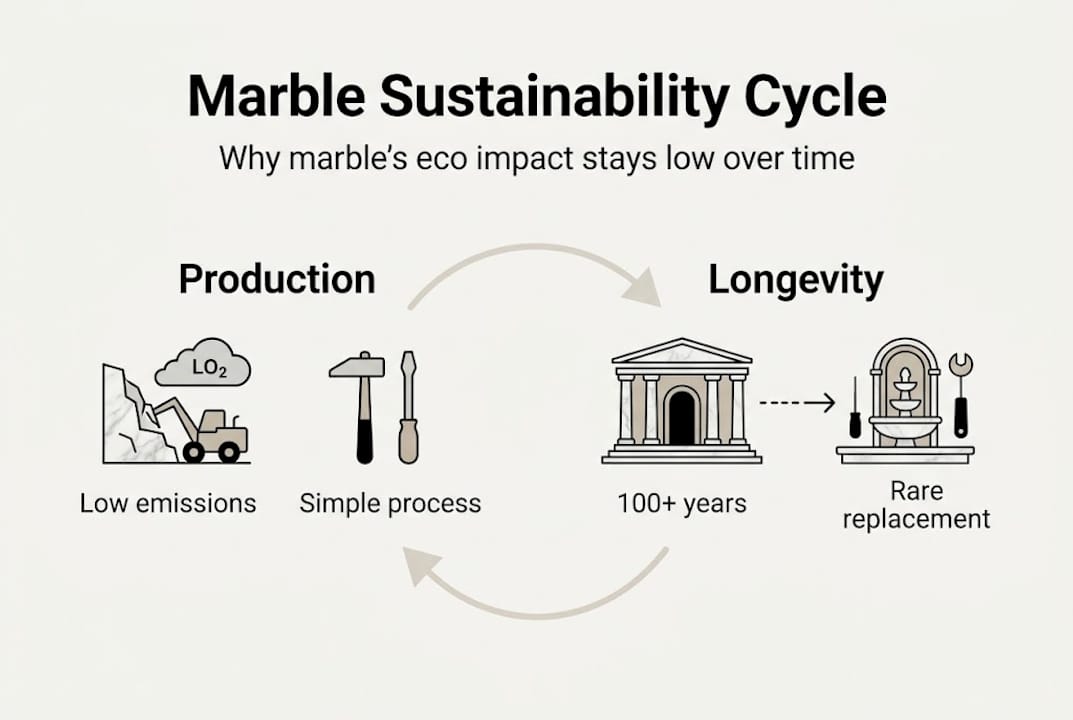
When you apply LCA thinking to marble in modern architecture, the results are striking. Engineered materials like quartz composites involve energy-intensive resin binding, chemical processing, and shorter usable lifespans. Natural stone, by contrast, requires relatively little transformation between quarry and finished product.
Here is a quick summary of how natural stone stacks up across core sustainability dimensions:
“When embodied carbon is amortized over actual product lifespans, empirical data consistently shows lower global warming potential for marble than for alternative surfacing materials.”
This framing matters. A material that looks “clean” in a catalog but requires replacement twice in your lifetime has a hidden footprint that rarely shows up on spec sheets.
With that framework in place, the numbers for marble speak clearly. According to LCA research, natural stone averages ~12.5 kg CO2 eq/m², while engineered quartz ranges from 46 to 102 kg CO2 eq/m². Ceramics fall in between but still significantly exceed marble’s footprint.
| Material | CO2 eq/m² (approx.) | Average lifespan | Replacement needed? |
|---|---|---|---|
| Natural marble | ~12.5 kg | 100+ years | Rarely |
| Ceramic tile | ~35–55 kg | 20–30 years | Often |
| Engineered quartz | ~46–102 kg | 15–25 years | Yes |
Where do marble’s lower emissions come from? The production process is comparatively simple. Stone is cut, sometimes polished, and shipped. There is no resin bonding, no ceramic firing at extreme temperatures, and no complex chemical treatment. Ceramics require kiln firing above 1,000°C. Engineered quartz binds crushed stone with polymer resins, a process that is both energy-intensive and fossil-fuel-dependent.
Marble’s numbers also get better over time. Because it rarely needs replacing, the initial carbon cost is spread across a much longer usable life. Marble’s impact in modern homes is not just aesthetic; it is a genuine long-term investment in lower total material consumption.
Pro Tip: When sourcing marble for a project, opt for larger format slabs over mosaic or small-tile configurations. Fewer cuts and joins mean less material waste during installation, and fewer individual pieces to eventually replace or repair.
The bottom line is simple. If you are comparing materials by their full carbon story rather than just their upfront extraction, marble comes out ahead in almost every realistic comparison.
Beyond the raw numbers, marble’s real-world sustainability advantage shows up most clearly over decades of actual use. This is where the comparison to engineered or ceramic alternatives becomes almost unfair.
Consider the full lifecycle of a marble kitchen countertop versus an engineered quartz surface:
Industry analysis consistently identifies durability as a central reason marble’s lifetime environmental impact is lower than alternatives, even accounting for its heavier extraction energy.
The numbers back this up clearly. Marble surfaces regularly last over 100 years. Engineered stone typically needs replacement within 20 years. That means one marble installation can equal five or more synthetic surface replacements across the same timeframe, multiplying those 46 to 102 kg CO2 figures with every new installation cycle.
Proper care matters here too. Sealing marble every one to three years, cleaning with pH-neutral products, and avoiding harsh chemicals keeps the surface intact for far longer. This is not high maintenance; it is smart stewardship of a material that rewards attention. You can learn more about stone durability in architecture to understand why these properties made marble the material of choice for buildings still standing thousands of years later.
Sustainability is rarely a clean story, and marble is no exception. The genuine concerns worth understanding relate to extraction energy and transport distances. Quarrying marble requires heavy machinery, diesel equipment, and significant land disturbance. Shipping heavy stone internationally adds to its transport footprint. These are real factors.
But context matters. When extraction energy is amortized across marble’s full usable life, the per-year GWP falls well below that of shorter-lived synthetic materials. A 100-year stone surface divided by its carbon cost looks very different from a 20-year synthetic surface divided by the same math.
“The mistake is treating extraction energy as the whole story. Amortized over a genuine lifetime of use, marble’s environmental cost per year is dramatically lower than most engineered alternatives.”
Here is what to look for when evaluating a supplier’s sustainability claims:
And here is what to avoid:
Pro Tip: When talking to a marble supplier, ask directly: “Can you provide a lifecycle assessment or environmental product declaration for this stone?” Reputable suppliers will have this. Those who cannot answer the question are worth approaching with caution. You can also ask about marble extraction impact through trusted resources before committing to a purchase.
Most sustainability comparisons focus almost entirely on extraction. That is the wrong lens. The question that matters is not “how much energy did it take to get this out of the ground?” but “how long will this material serve before it becomes waste?”
Marble is almost unique in how rarely it needs to be replaced. We have worked with homeowners who installed marble floors in the 1980s and have never once considered replacing them. That is decades of avoided production, avoided shipping, and avoided landfill. No engineered surface on the market can make that claim with a straight face.
What also gets missed is reusability. Marble slabs can be repurposed across projects. A kitchen countertop becomes a bathroom vanity. A floor slab becomes garden paving. This kind of material lifecycle is practically impossible with resin-bound composites, which cannot be cut and re-edged without degrading. Modern uses for sustainable marble are expanding precisely because designers are recognizing this long-view advantage. If eco-conscious design is your goal, the material that lasts a lifetime and can be passed down or repurposed is always the more ethical choice.
The data in this guide points clearly in one direction: marble is not just a luxury choice, it is one of the most defensible environmental choices available for interior surfaces and decor.
At Marmorique, we curate natural marble and stone pieces with exactly this thinking in mind. From explore sustainable marble collections to individual statement pieces, every item is selected for its craftsmanship, longevity, and natural beauty. When you invest in a marble lamp, table, or bathroom set from our collection, you are choosing a material that will serve your home beautifully for decades, not years. Sustainability and luxury do not have to be in conflict. With the right stone, they are the same thing.
Yes. Lifecycle assessments show marble has an embodied carbon footprint of ~12.5 kg CO2 eq/m², compared to 46–102 kg CO2 eq/m² for engineered quartz, making it significantly more sustainable when durability is factored in.
Look for third-party environmental product declarations or quarry certifications that document land restoration, worker safety standards, and responsible extraction practices from your supplier.
Extraction does require upfront energy, but when amortized over marble’s lifetime, the GWP per year is far lower than materials that need replacement every 15 to 25 years.
Seal marble every one to three years using a penetrating sealer and clean it with pH-neutral products to protect the surface, extend its life, and avoid the environmental cost of early replacement.


