Your Cart (0)
Your cart is empty
Free express shipping

Drawer menu
Free express shipping

TL;DR:
- Understanding natural stone distinctions like marble and travertine enhances specification accuracy and project durability. Mastery of grading, finishes, and edge profiles enables precise material selection, reducing costly mistakes and client disappointment. Applying technical vocabulary throughout design and fabrication processes ensures interiors remain luxurious and resilient over time.
Reaching for the wrong stone because a supplier called travertine “marble” is one of the most common and costly mistakes in high-end residential projects. The vocabulary around natural stone is dense, occasionally inconsistent, and full of trade shortcuts that blur real geological and performance differences. When your client is spending thousands on custom surfaces, you cannot afford to specify on guesswork. This guide unpacks the essential terminology for marble and travertine, walking through definitions, grading, finishes, edge profiles, and maintenance language so every specification you write reflects expert knowledge and precise intent.
| Point | Details |
|---|---|
| Know your stone | Understanding whether you’re specifying marble or travertine prevents costly mistakes in high-end interiors. |
| Grading matters | Marble and travertine grades influence both design potential and application safety. |
| Finish shapes function | Choices like honed, polished, or tumbled finishes change both aesthetics and maintenance. |
| Don’t skip edge details | Edge profiles are critical for safety, longevity, and overall luxury appeal. |
| Terminology empowers sourcing | Using the right vocabulary equips you to communicate with suppliers and deliver the highest quality interior results. |
Having set the stage for why terminology matters, let’s clarify exactly what these stones are and why designers need to differentiate them.
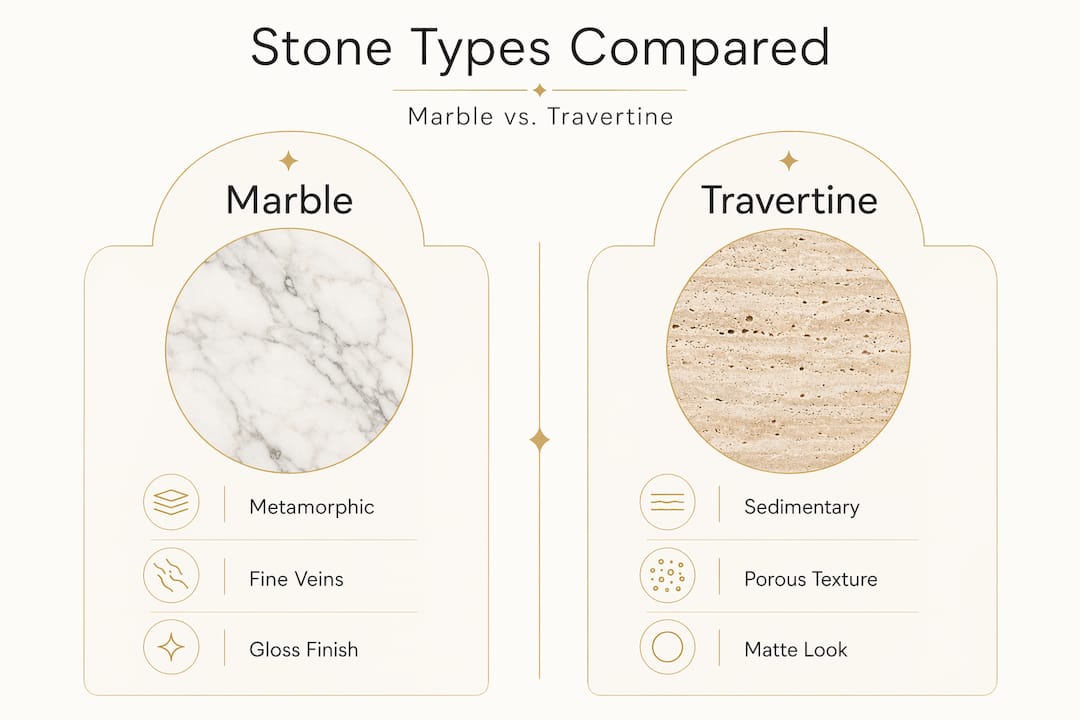
Marble and travertine are regularly grouped together in commercial catalogs, showroom tags, and even contractor quotes. That shortcut causes real problems when projects hit installation. Understanding them as distinct materials means better specs and fewer surprises.
Marble is a metamorphic rock that forms when limestone is exposed to intense heat and pressure deep within the earth. The recrystallization of calcite, dolomite, or serpentine produces that characteristic crystalline structure and the ability to take a mirror-like polish. According to stone industry data, marble has a Mohs hardness of 3 to 4, making it softer and more workable than granite but also more vulnerable to scratching and acidic damage.

Travertine, by contrast, is a sedimentary stone. It forms from the rapid precipitation of calcium carbonate around hot springs and mineral-rich water sources. The resulting material contains natural voids and pits throughout its body, and travertine is classified as a type of limestone or marble under ASTM C119, the industry standard for natural stone definitions. That classification is where commercial confusion begins: labeling travertine as marble is technically permissible in certain trade contexts, even though the two stones behave very differently in use.
Here is a quick reference for the core distinctions:
| Property | Marble | Travertine |
|---|---|---|
| Formation | Metamorphic (heat/pressure) | Sedimentary (mineral spring deposits) |
| Surface | Dense, crystalline, polishable | Porous, natural voids present |
| Mohs Hardness | 3 to 4 | 3 to 4 |
| Best use | Polished luxury surfaces | Textured floors, wall cladding |
| Maintenance | Seal regularly | Fill and seal for cleanability |
Key reasons designers need to separate these materials:
You can explore how both materials are currently influencing natural stone decor trends in contemporary luxury interiors, and you will see why the terminology distinction translates directly to commercial and residential design decisions. Stone is also increasingly being considered alongside creative material options in broader interior schemes, making category fluency even more important.
Once you understand the fundamental differences, the next step is to choose the right grade and finish for your project.
Stone grading is one of the most misunderstood aspects of luxury specification. Walk into a slab yard without knowing the grading system and you are essentially shopping blind. Marble grades and travertine types each carry specific structural and aesthetic implications.
Marble grading follows a system developed by the Natural Stone Institute. NSI grades marble from A to D, where Grade A stone has minimal fissures and requires little filler, while Grade D has significant natural faults and is typically reserved for vertical applications like wall cladding where structural load is not a concern. Grade B and C stones fall in between, offering varying degrees of natural character that can actually be desirable in certain design contexts but need careful assessment before specifying for countertops or floors.
Travertine grading works differently because the material’s defining characteristic is the presence of natural voids. The primary distinctions your clients and fabricators will discuss are:
Knowing these distinctions before client conversations means you can steer material choices toward structural reality, not just visual preference. A cross-cut travertine that looks stunning in a sample chip can behave unpredictably on a large kitchen floor if it was not graded and filled for that use.
You can find detailed guidance on using travertine in interiors for specific room applications that align with these grading decisions.
Pro Tip: For filled travertine in high-traffic areas, ask your fabricator about the fill material specifically. Cement-filled travertine is more durable underfoot and resists staining better than resin-filled options. Over years of heavy use, resin fills can discolor differently from the surrounding stone.
After grading and quality, the finish determines both subtle aesthetics and everyday performance.
The finish applied to a stone slab is one of the highest-leverage decisions in a luxury interior project. It affects light reflection, tactile quality, maintenance burden, and long-term wear resistance. Here is a breakdown of the finishes you will encounter:
As noted across common stone finish categories, each finish category serves a distinct performance and aesthetic function. Knowing which finish you are specifying is not a stylistic footnote. It is a core technical decision.
“The shift toward honed and matte stone finishes in 2026 luxury design is not a trend in the superficial sense. It reflects a deeper preference for materials that wear gracefully and feel warmer underfoot and to the touch.”
Honed and matte finishes are leading luxury interiors in 2026, preferred over polished surfaces for their warmth, improved slip resistance, and ability to hide the kind of wear that polished marble makes impossible to ignore. For bathrooms, kitchen islands, and residential staircases in particular, this is a shift worth building into your default specification toolkit.
For a curated overview of how different marble finishes for luxury design translate into room-level impact, that resource covers the most relevant applications in detail.
You can also find relevant crossover ideas in sustainable stone finish ideas that combine material longevity with contemporary aesthetics.
Pro Tip: When specifying marble for a client who is not prepared for regular maintenance, honed is almost always the better choice. Etching, which is chemical surface dulling from acids like lemon juice or wine, is far less visible on a honed surface than on a polished one. You are not sacrificing luxury. You are making it practical.
Understanding finishes is fundamental, but true mastery requires a grasp of specialized terms that affect installation and long-term maintenance.
Edge profiles are the shape given to the visible edge of a stone slab, typically on countertops, table tops, and stair treads. They are functional, structural, and deeply aesthetic all at once. Here are the most common profiles you will encounter in fabrication discussions:
According to edge profile guides in the fabrication industry, softer stones like marble risk fracture when complex profiles like ogee or intricate double-bullnose are cut. Specifying an ogee edge on a Grade C marble for a high-use kitchen countertop is a recipe for a chipped edge within a year.
Porosity is another term that gets minimal attention in design conversations but has enormous maintenance implications. Marble’s porosity ranges from 0.5 to 2.0 percent, meaning it will absorb liquids without proper sealing. Penetrating sealers fill the pores temporarily, and the sealing frequency depends on finish type, use intensity, and stone grade. Honed finishes require more frequent sealing than polished ones because the open pore structure is exposed rather than partially closed by the polishing process.
Etching is often confused with staining, and that confusion leads to incorrect treatment. Etching is acid-induced surface damage specific to calcium-carbonate stones like marble and travertine. It produces dull spots or cloudy marks where acid has chemically reacted with the calcite in the stone. It is not a color stain that can be lifted with cleaning products. Etching requires mechanical correction, re-honing, and polishing, handled by a professional stone restoration specialist.
“Knowing that an etch is not a stain could save a client from replacing an entire countertop. That one word, correctly understood, is worth the entire vocabulary lesson.”
Reviewing marble edge profiles within the context of your finish selection rounds out the picture from both aesthetic and technical perspectives.
Most stone vocabulary guides stop at definitions. They hand you the terms and send you back to the showroom. What they miss is the actual leverage those terms give you across the entire project workflow, from sourcing to installation to client handover.
When you can ask a slab yard whether a piece is vein-cut or cross-cut, Grade A or Grade B, filled or unfilled, honed or brushed, you compress the selection process dramatically. You eliminate slabs before they are templated. You prevent expensive change orders at fabrication.
The same vocabulary changes client conversations. When a client says they want “white marble,” you can respond with specifics: Do they want a polished Calacatta with bold gray veining or a honed Thassos with minimal movement? Do they want the drama of an ogee edge or the restraint of an eased profile? These are not upsell questions. They are precision tools that prevent disappointment.
Fabrication itself rewards this knowledge. Digital templating, slab layout for veining, CNC edging, and progressive diamond polishing from 60 to 3000 grit are all steps in a sophisticated manufacturing chain. When you understand what CNC edging can and cannot do with a soft stone, you will not specify a profile that the stone cannot physically support. When you know that polishing goes through multiple grit stages, you understand why rushing that process produces an inferior surface.
Trend-chasing in stone selection is one of the costliest habits in luxury design. A finish or stone type chosen because it appeared in a design magazine last season may not align with the structural demands of your project, the maintenance habits of your client, or the long-term durability that luxury work demands. Evidence-based selection, grounded in terminology and material science, produces interiors that remain exceptional for decades.
That is the real value of this vocabulary. Not impressing fabricators. Not speaking trade language. Using stone terms for stone trends and sourcing insights that hold up under real-world conditions.
You now have the terminology, the grading logic, the finish distinctions, and the edge profile knowledge to specify natural stone with real precision. The next step is finding materials that match that level of care.
Marmorique offers a curated collection of premium marble and travertine pieces, from statement lamps and artisan tables to bathroom sets and decorative accessories, all crafted from natural stone selected for quality, character, and craftsmanship. Whether you are sourcing for a residential commission or looking for inspiration for your own space, the premium marble and travertine selection at Marmorique is designed for designers and collectors who know exactly what they are looking for and refuse to settle for anything less.
Marble is a metamorphic rock capable of a high polish and ideal for refined luxury surfaces, while travertine is sedimentary with natural voids that give it a more textured, tactile character suited to relaxed or transitional luxury.
Honed and matte finishes are leading in 2026 because they deliver modern warmth, hide everyday wear far better than polished stone, and offer improved slip resistance in bathrooms and high-traffic areas.
Filled travertine has its natural voids packed with resin or cement for a smoother, more cleanable surface, while unfilled travertine retains its original pits for an organic, rustic aesthetic.
Etching is not a stain but rather acid-induced surface dulling that requires professional re-honing and polishing to correct, particularly on polished finishes where it is most visible.
Understanding edge profiles for stone helps you match the decorative complexity of a profile to the structural strength of the stone, preventing chips and cracks on softer materials like marble over time.


