Your Cart (0)
Your cart is empty
Free express shipping

Drawer menu
Free express shipping

TL;DR:
- Natural stone is valued for its unique patterns, authenticity, and ability to evoke a sense of permanence in luxury interiors.
- Choosing the right stone type and application enhances space aesthetics, durability, and long-term value.
- Incorporating stone thoughtfully through feature walls, flooring, or accessories creates impactful, biophilic, and timeless design.
Not all stone surfaces are created equal, and the designers who know this have a distinct edge. Walk into any truly memorable luxury interior and you will almost always find natural stone playing a central role, not just as a practical surface but as the visual anchor for the entire space. Yet a surprising number of homeowners and even some designers treat stone as an afterthought, selecting it purely for durability rather than for its extraordinary capacity to shift the mood, scale, and soul of a room. This guide breaks down exactly how stone works in high-end design, which types to use, and how to place them for the greatest effect.
| Point | Details |
|---|---|
| Stone defines luxury | The right stone instantly elevates interiors with timeless elegance and authenticity. |
| Natural vs. engineered | Natural stone offers unique character while engineered stone provides convenience and consistency. |
| Purposeful placement matters | Choosing the right stone for each space maximizes both aesthetic impact and long-term value. |
| Biophilic benefits | Integrating stone materials connects spaces to nature, enhancing wellness and atmosphere. |
Stone has been used in elite architecture for thousands of years, from the marble halls of ancient Rome to the travertine facades of Renaissance palazzi. That legacy is not purely sentimental. It reflects something deeply human: our instinct to trust and value materials that come directly from the earth. In contemporary interior design, this instinct has been formalized under the concept of biophilic design, which is the practice of connecting built environments to nature to improve the well-being of the people who live and work in them.
What makes stone genuinely different from wood, metal, or glass comes down to a combination of visual weight, tactile richness, and organic pattern. Wood offers warmth, but its grain is predictable. Glass reflects and opens a space, but it has no mass. Metal is sleek, but it reads as industrial unless used sparingly. Stone, by contrast, carries a sense of permanence and geological time that no manufactured material can replicate. A slab of book-matched marble on a feature wall does not just look beautiful. It changes the emotional register of the entire room.
Here is what happens, from a sensory standpoint, when natural stone enters a space:
“Natural stone is preferred for luxury and timeless appeal precisely because its unique patterns and authentic origins cannot be replicated by engineered alternatives, no matter how advanced the manufacturing process becomes.”
For anyone looking to understand more about how stone enhances interiors, the conversation starts with recognizing that stone is not a passive background material. It is an active design decision that shapes everything around it.
Understanding what stone can do is just the beginning. Deciding between natural and engineered options shapes the project’s outcome in ways that affect both aesthetics and long-term investment.
The market offers two broad categories: natural stone quarried from the earth, including marble, travertine, limestone, granite, and quartzite; and engineered stone, which is a manufactured composite typically made from crushed quartz bound with resins and pigments. Both have genuine merits, but they serve very different design ambitions.
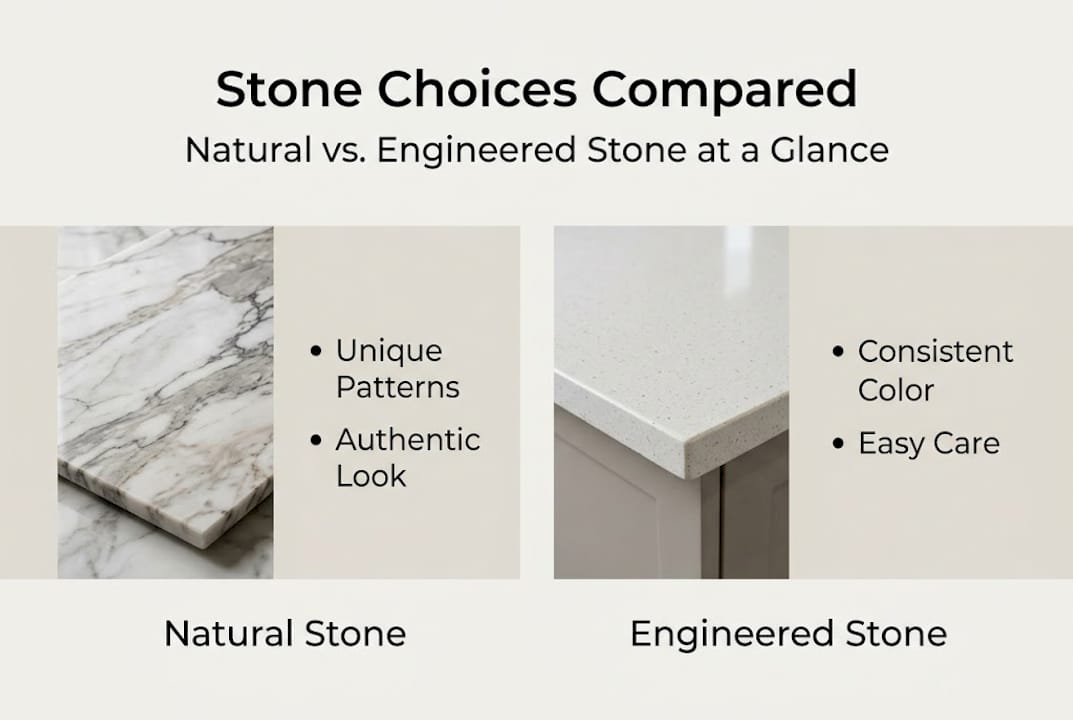
| Feature | Natural stone | Engineered stone |
|---|---|---|
| Pattern uniqueness | Every slab is one of a kind | Consistent, repeatable patterns |
| Authenticity | Geological origin, centuries of formation | Man-made composite |
| Maintenance | Requires periodic sealing | Low maintenance, stain resistant |
| Cost | Higher, varies by rarity | More predictable pricing |
| Resale appeal | Adds significant property value | Moderate uplift |
| Sustainability | Quarried with land impact | Uses recycled content in some lines |
| Aesthetic depth | Unmatched visual complexity | Clean, uniform look |
The evidence is clear that natural stone is superior for unique patterns and authenticity, while engineered stone delivers uniformity and low maintenance. For high-ROI spaces like primary bathrooms, kitchen islands, and statement living areas, designers consistently reach for natural stone because the uniqueness justifies the investment. A client who installs genuine Calacatta marble is not just buying a surface. They are buying a story, a provenance, and an irreplaceable visual asset.
That said, stone in luxury spaces does not always mean natural stone in every single application. While natural stone’s uniqueness justifies high-end ROI and biophilic benefits, engineered alternatives can play a smart supporting role in secondary spaces or high-traffic utility zones where maintenance is a genuine daily concern.
Pro Tip: Use natural stone for your statement surfaces and focal points, where its uniqueness will be noticed and appreciated. Reserve engineered stone for secondary spaces like laundry rooms, mudrooms, or commercial restrooms where consistent upkeep is a practical priority. This hybrid approach gives you the prestige of natural stone where it counts, without overextending your maintenance budget.
Now that you know the differences in stone types, matching the material to your space is the secret to a cohesive, luxurious design.
Different stones have very different personalities, and understanding those personalities is what separates a thoughtful designer from someone who simply picked a slab they liked in the showroom. Here is a practical breakdown of the most popular natural stones and where they shine.
| Stone type | Best applications | Aesthetic character |
|---|---|---|
| Marble | Feature walls, bathrooms, fireplace surrounds | Soft veining, refined elegance, classic luxury |
| Granite | Kitchen countertops, outdoor surfaces | Bold crystalline pattern, extremely durable |
| Limestone | Flooring, wall cladding, spa spaces | Muted tones, organic texture, calm and grounded |
| Travertine | Floors, bathroom tiles, decorative accessories | Warm beige to ivory tones, natural pitting, rustic yet refined |
| Quartzite | Kitchen and bathroom surfaces, high-traffic floors | Marble-like appearance with greater hardness |
Because natural stone requires sealing and specific care depending on its porosity, selecting the right stone for the right application is not just an aesthetic decision. It is a practical one that determines how well the material performs over decades.
Here is a step-by-step process for choosing the right stone for your next project:
Pro Tip: Do not be afraid to mix stone types and finishes within a single project. A honed travertine floor paired with a polished marble vanity and a brushed limestone accent wall creates far more visual depth and tactile interest than using the same stone everywhere. The contrast between finishes is what makes each surface read more clearly.
Finally, applying what you have learned to create truly stunning and enduring interiors is all about intentional design choices. Knowing which stone to use is only half the equation. How you place it determines whether a space feels like a gallery or a showroom.
Stone can enter a room in many ways, from full architectural installations to small, deliberate accessories. Each approach creates a different kind of impact.
The psychological and wellness angle here is worth taking seriously. Biophilic design research consistently shows that natural materials in interiors reduce stress, improve focus, and increase the perceived quality of a space. Stone is one of the most potent biophilic materials available because it carries the unmistakable character of the natural world. Its weight, texture, and color variation signal to the human nervous system that we are in a grounded, stable environment.
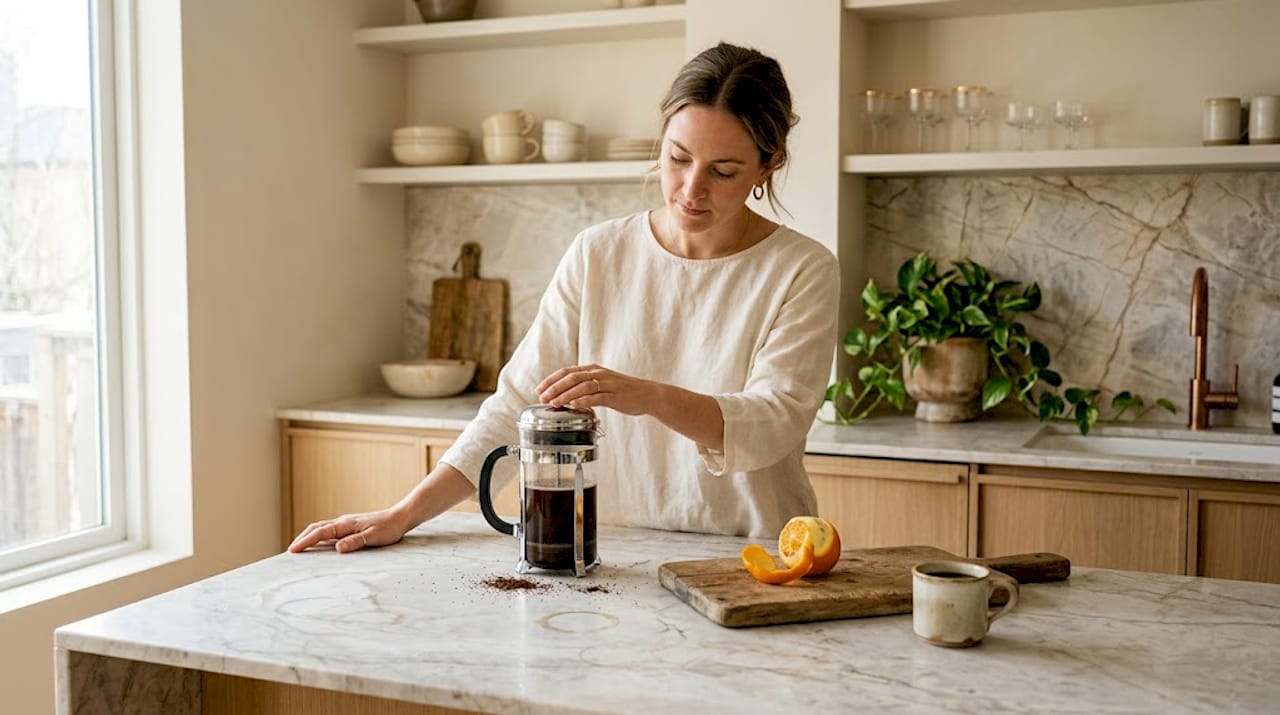
From a financial standpoint, the argument for stone is equally strong. While stone’s uniqueness justifies a higher upfront investment compared to engineered alternatives, properties featuring natural stone consistently command stronger resale premiums. A primary bathroom clad in genuine marble or a kitchen with a quartzite island does not just look more expensive. It is more valuable, and buyers recognize that instantly.
The key to maximizing impact without overwhelming a space is contrast and restraint. A single wall of dramatic veined marble reads more powerfully in a room that is otherwise calm and neutral. A travertine floor gains its full character when the furnishings above it are clean-lined and understated. Stone does not need competition. It needs breathing room.
There is one argument we hear constantly that we think deserves to be challenged directly: the idea that natural stone is simply “too much maintenance” for most clients. In our experience, this objection is almost always overstated, and it often leads designers and homeowners toward choices they later regret.
Yes, a Calacatta marble countertop needs sealing once a year. That is roughly the same time commitment as cleaning a glass shower door monthly. The perception of maintenance difficulty is far larger than the actual effort involved. High-end clients who invest in natural stone are almost universally willing to follow simple care protocols once they understand what is involved.
What we find far more overlooked is the creative power of designing with stone as a layered, mixed-material strategy. The designers producing truly extraordinary interiors are not picking one stone and repeating it everywhere. They are combining a honed finish with a polished one, pairing warm travertine with cooler marble, and using stone accessories to carry the material language into every corner of a room without turning the space into a quarry showroom.
Stone is a foundation for creative expression, not a constraint. The designers and homeowners who get the most from it are the ones who treat it that way.
Ready to bring the weight and beauty of natural stone into your home or project without committing to a full renovation? Marmorique offers a carefully curated collection of artisan stone accessories that make it easier than ever to introduce this material into any interior.
From handcrafted marble lamps that cast warm light through veined stone to travertine tabletops that become the sculptural centerpiece of a living room, every piece in our collection is chosen for its craftsmanship and its ability to elevate a space. Whether you are designing a complete luxury interior or simply looking for one statement piece that changes the room, explore stone collections to find accessories that bring timeless elegance within reach. Our pieces work equally well as standalone accents and as part of a broader stone design strategy.
Natural stone offers unique patterns and authenticity that cannot be replicated by manufactured alternatives, making it the clear preference for designers working on timeless, high-value interiors.
Most natural stone requires periodic sealing once or twice a year combined with gentle, pH-neutral cleaning to resist stains and maintain its surface. The process is straightforward and far less demanding than most clients initially assume, especially given that natural stone requires sealing as its primary maintenance task rather than any complex treatment.
Absolutely. Stone works beautifully as both a major architectural material and in smaller decorative pieces like lamps, trays, and tabletop accessories, allowing you to build a cohesive material language throughout a space at varying investment levels.
Marble, granite, and limestone are the most enduring favorites for luxury spaces, each bringing distinct pattern and character. As noted by The Natural Choice, these materials are preferred for their authenticity and timeless visual appeal over engineered alternatives.
Stone introduces natural texture, geological pattern, and grounding qualities into built environments, which research shows reduces stress and improves well-being. Its high-end ROI and biophilic benefits make it one of the most justified investments in luxury interior design.


