Your Cart (0)
Your cart is empty
Free express shipping

Drawer menu
Free express shipping

TL;DR:
- Carrara marble is a specific natural metamorphic stone quarried exclusively from the Apuan Alps in Tuscany, Italy, known for its white to blue-gray base and delicate gray veining. Its formation from limestone under heat and pressure gives it a unique character, with provenance and physical features crucial for proper selection and application in luxury designs. Regular sealing, careful maintenance, and collaborative slab matching are essential for preserving its beauty and ensuring long-lasting, high-end results.
Most people use “white marble” as a catch-all term, but Carrara marble is something far more specific. It is a natural metamorphic stone quarried exclusively from the Apuan Alps in Tuscany, Italy, recognized by its cool white to blue-gray base and the delicate gray veining that runs through it like brushstrokes. If you are specifying stone for a luxury home or high-end interior project, understanding what is Carrara marble, where it comes from, and how it behaves is the difference between a result you love for decades and one that disappoints within a year.
| Point | Details |
|---|---|
| Authentic provenance | Carrara marble is a genuine natural marble quarried only in Tuscany’s Apuan Alps, prized for its origin. |
| Subtle veining | It features soft, fine grey veining on a cool white to blue-grey base, offering understated elegance. |
| High-end applications | Widely used in luxury interiors for countertops, walls, and floors due to its refined aesthetic. |
| Maintenance needs | Requires regular sealing and gentle cleaning to protect its porous, softer surface. |
| Expert selection | High-value projects benefit from careful slab matching and customized sealing plans. |
Carrara marble does not just happen to be beautiful. Its beauty is a direct product of geology, time, and a very specific place on Earth. The stone has been quarried since Roman times from the Apuan Alps near the city of Carrara in Tuscany. Michelangelo selected it for his sculptures. The Pantheon in Rome features it. That is not marketing. That is a material with a documented legacy spanning over two thousand years.
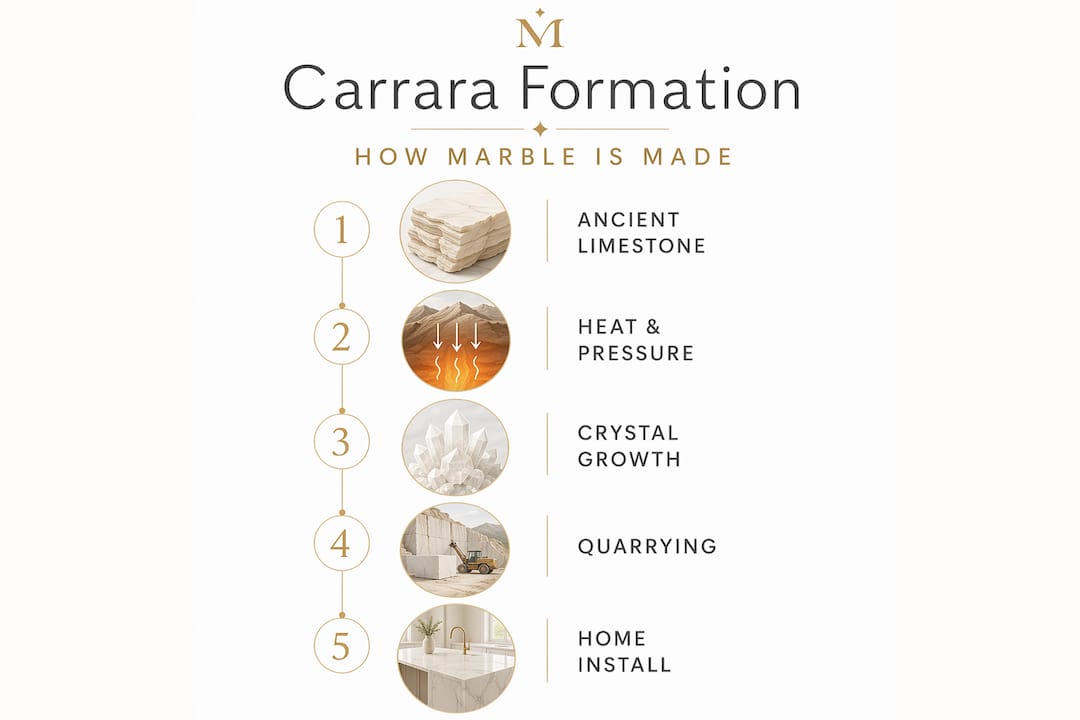
The formation process is what gives Carrara its character. Marble forms when limestone is subjected to intense heat and pressure deep within the Earth, forcing a recrystallization of the calcite minerals into the dense, interlocked crystalline structure you see and feel in a finished slab. The gray veining, so central to Carrara’s identity, comes from mineral impurities, primarily graphite and clay, that were present in the original limestone and became embedded in the matrix during that transformation.
Understanding this origin matters for one practical reason: it separates genuine Carrara from the flood of look-alike stones on the market. Quartzite, engineered stone, and even other Italian marbles are frequently marketed with Carrara-adjacent names. Knowing that authentic Carrara comes from a single geographic region, and carries verifiable provenance, gives you the foundation you need to select marble furnishings with confidence rather than guesswork.
Key facts about Carrara’s origin:
Now that you know what Carrara marble is and where it comes from, let’s look at the visual and physical features that make it instantly recognizable.
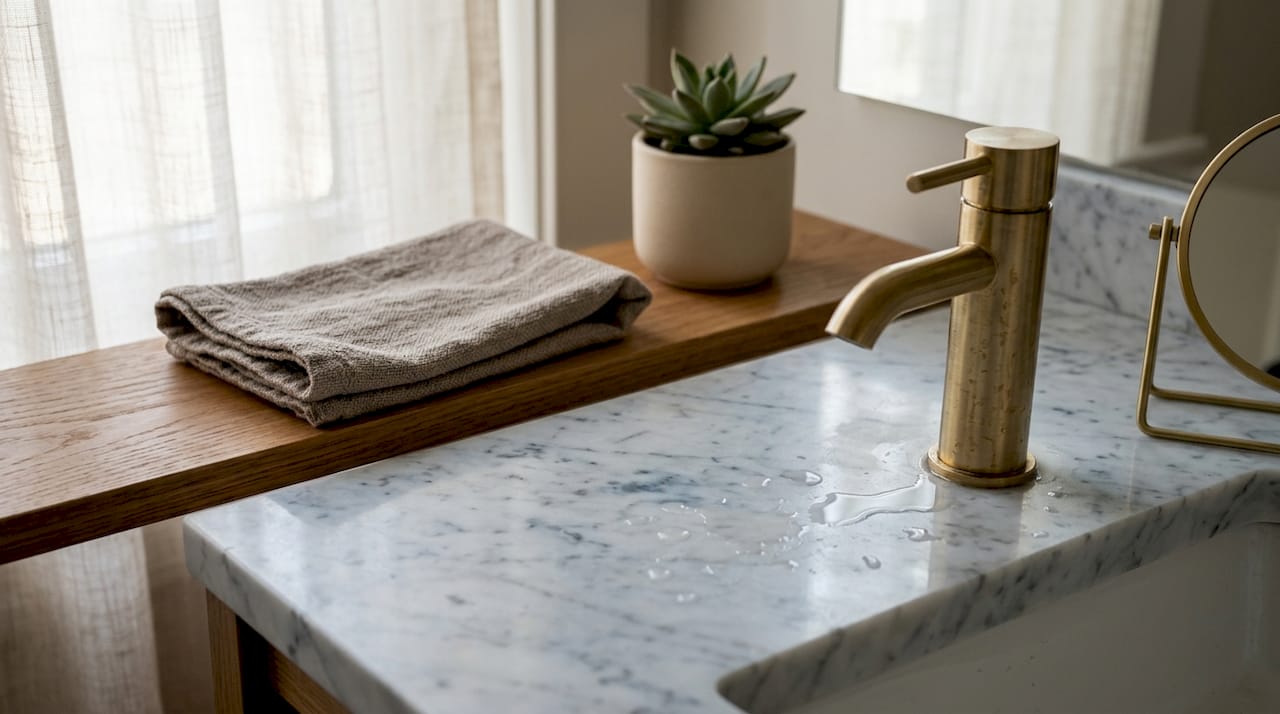
Not every white marble with gray veins is Carrara. But if you know what you are looking at, Carrara is unmistakable. The stone typically features a soft white to blue-gray background with fine, feathery gray veining that flows across the surface in loose, organic patterns. The veins are never harsh or high-contrast. They suggest movement rather than demanding attention.
This is the key aesthetic distinction. Compared to Calacatta and Statuario, which are also Italian marbles, Carrara’s veining is subtler and softer, making it the more versatile choice for spaces where you want the stone to support the overall design rather than dominate it. Calacatta, by contrast, has bold, chunky veining with stronger contrast and commands the room. Statuario sits between the two. If your client wants drama, Calacatta is the answer. If they want quiet luxury, Carrara delivers.
Within the Carrara family, there are meaningful variations. Grades range from Carrara C (commercial grade, more variation and visible impurities) to Carrara CD and higher grades used in premium residential and hospitality work. The grain structure, background tone, and vein intensity shift noticeably between slabs, which makes slab selection a real design task, not a formality.
| Feature | Carrara marble | Calacatta marble | Statuario marble |
|---|---|---|---|
| Background tone | White to blue-gray | Bright white | Pure white |
| Veining style | Fine, feathery gray | Bold, thick, brown or gold | Strong, dramatic gray |
| Visual contrast | Low to moderate | High | High |
| Availability | Widely available | Limited, rarer | Very rare |
| Price range | Moderate to premium | Premium to very high | Very high |
| Best use case | Understated luxury | Statement pieces | Showpiece surfaces |
Pro Tip: When sourcing Carrara for a large installation like a kitchen countertop or feature wall, view slabs in person rather than from samples. The way veins travel across adjacent slabs determines whether the finished surface feels like one continuous composition or a patchwork. Bookmatching, where two mirror-image slabs are opened like a book and installed side by side, is one of the most effective ways to create that sense of deliberate visual rhythm designers call “flow.” Learn more about specifying marble finishes to apply this at the specification stage.
Carrara also has a well-documented cultural pedigree that elevates its value beyond aesthetics alone. Specifying it in a luxury project is a statement about permanence and taste, not just surface selection.
Having defined what makes Carrara visually unique, let’s examine where it actually performs best in upscale homes.
Carrara marble’s restraint is its strength in residential design. Because the veining does not overpower, it works across a wide range of applications without creating visual fatigue. Its most common high-end uses include kitchen countertops, bathroom vanities, wall cladding, feature walls, and large-format flooring.
In kitchens, Carrara countertops pair naturally with custom cabinetry in deep blues, forest greens, and warm whites. The stone grounds the kitchen with a sense of permanence that engineered surfaces simply cannot replicate. The caveat is real, though: a kitchen countertop takes significant daily abuse, and Carrara, being softer and more porous than granite or quartz, requires genuine commitment to maintenance. If your client is not willing to seal the stone and clean up acidic spills promptly, a honed Carrara in the kitchen is the wrong call.
Bathrooms are where Carrara genuinely shines. The low-contrast veining works beautifully in wet-room floor tiles, vanity tops, and shower surrounds. A floor-to-ceiling Carrara wall behind a freestanding tub is one of the most photographed moments in luxury residential design for good reason. The stone reads as naturally calm in a space designed for restoration.
Wall cladding in living areas and entryways is a growing application. A full-height Carrara wall panel behind a fireplace or along a hallway introduces texture and depth without the visual aggression of more heavily veined stones. Combined with thoughtful interior design workflow planning, these installations feel effortless.
Where Carrara marble performs best in luxury homes:
Understanding where Carrara marble fits in home design, it is essential to address how to care for and maintain this material properly.
Carrara marble is softer and more porous than most countertop alternatives. That physical reality shapes everything about how you care for it, and the standard advice to seal it every six to twelve months, while reasonable as a starting point, is not a universal rule.
The smarter approach, recommended by stone restoration professionals, is to test actual porosity using a water absorption test before setting a sealing schedule. The principle is straightforward: sealing strategy should be based on absorption tests and real use conditions rather than fixed timelines. Place a few drops of water on the surface, wait ten minutes, and observe. If the water darkens the stone, it is absorbing moisture and needs sealing. If it beads cleanly, the existing sealer is holding. This test takes two minutes and removes all guesswork.
Step-by-step daily and weekly maintenance for Carrara marble:
Pro Tip: Honed finishes, which have a matte surface rather than a mirror polish, are more popular than ever in contemporary luxury interiors, but they are also more porous and absorb liquids faster than polished surfaces. If your designer recommends a honed Carrara for a high-use area, factor in a more attentive sealing schedule, not because honed is inferior, but because it requires more care to stay pristine. You can also explore guidance on selecting marble furnishings to match finish choices with use contexts.
Here is what most buying guides do not tell you: the biggest errors in Carrara marble projects happen long before installation. They happen at the specification stage, when decisions about slab grades, finish types, and sealing protocols are either locked in or left vague.
The brightness and appearance of Carrara depend far more on finish and slab matching than on grade alone. A mid-grade slab, well-matched and properly specified, will outperform a premium grade slab installed without attention to flow and vein direction. Designers who work with this stone consistently emphasize that they are curating a composition, not just selecting a material.
“The most successful Carrara installations we see are not the ones with the most expensive slabs. They are the ones where the design team reviewed the actual slabs together, agreed on a vein direction, and approved a sealing plan before the first piece was cut.”
That collaborative review process is not precious. It is practical. Once Carrara is cut and installed, correcting a mismatch or an unsealed surface is expensive and disruptive. Front-loading those decisions is what separates projects that photograph beautifully from those that age gracefully too.
The sealing conversation deserves specific attention. Sealing strategy must be customized to actual stone behavior, not product marketing schedules. Two slabs from the same quarry batch can have different porosity profiles depending on their position in the block and the density of crystallization in that zone. The water-drop test resolves this in minutes and should be part of every post-installation handoff to the client.
For high-value projects, the expert advice on marble selection consistently points to one priority: lock specifications early, review physical samples against the actual installation context, and document the maintenance plan in writing before the project closes. These expert insights bridge foundational knowledge with real-world application, setting you up to source and specify genuine Carrara marble with genuine confidence.
If this guide has clarified your thinking, the next step is finding a source you can actually trust for the real thing.
At Marmorique, every piece in our marble collection is sourced with verified provenance and curated for the level of quality that luxury residential and commercial projects demand. From statement table tops to bathroom accessories and sculptural decor, the selection is built around the principle that the stone should do the work. Whether you are an interior designer narrowing down finishes or a homeowner ready to invest in a material that lasts generations, our team and our marble finish resources are here to support every stage of the decision. Explore the collection and find what your project has been missing.
Yes, Carrara marble is a natural metamorphic marble quarried exclusively from the Apuan Alps near Carrara in Tuscany, Italy, not an engineered or synthetic product.
Carrara has softer, more subtle gray veining and is more widely available and affordable than Calacatta, which features bolder, high-contrast veining and commands a significantly higher price.
Carrara marble needs regular sealing and careful cleaning with pH-neutral products, plus immediate cleanup of acidic spills to prevent etching and staining.
Yes, vein intensity and coloration vary between slabs within the same batch, which is why physical slab review and matching are essential steps in any luxury installation.
No. The most effective approach is to test actual porosity with a water-drop test rather than defaulting to a fixed marketing schedule, since porosity varies by slab and installation conditions.


