Your Cart (0)
Your cart is empty
Free express shipping

Drawer menu
Free express shipping

TL;DR:
- Not all natural stones qualify as luxury; selection, installation, and maintenance are crucial.
- Premium marble features include Carrara, Calacatta, and Statuario, each with unique veining and costs.
- Proper installation and sealing extend stone lifespan and maintain its aesthetic and value.
Not every piece of natural stone earns a place in a truly luxury interior. Many homeowners invest heavily in marble or travertine only to find the result feels flat, dated, or frustratingly high-maintenance within a few years. The difference between a stunning, enduring stone space and a costly disappointment comes down to three things: knowing which stone to choose, understanding how to install it correctly, and committing to the right care routine. This guide walks you through all three, with the kind of detail that separates genuinely informed decisions from expensive guesswork.
| Point | Details |
|---|---|
| Know your stone types | Understanding the differences between marble, travertine, and quartzite is critical for achieving your luxury design vision. |
| Match selection to use | Choose stone based on room-specific needs, desired look, and maintenance practicalities. |
| Prioritize professional workflow | Expert installation and proactive care greatly increase the longevity and appearance of premium stone. |
| Embrace natural variation | Natural imperfections, veining, and patina enhance the authenticity and luxury of stone decor. |
| Invest in sustainability | Sustainable sourcing and reclaimed options add story and environmental responsibility to premium interiors. |
To make smart style and investment decisions, start with understanding the stone options themselves. Not all marble is created equal, and the gap between a commodity slab and a truly premium piece is wider than most people realize.
The three most sought-after marbles for luxury interiors are Carrara, Calacatta, and Statuario. Premium marble types for luxury interiors include Carrara with its subtle gray veining, Calacatta with bold, dramatic veining, and Statuario with striking high-contrast patterns. All three originate from Italy, which remains the global benchmark for authenticity and quality. Carrara is the most widely used and accessible, making it a reliable choice for larger installations. Calacatta commands a premium price precisely because its veining is rarer and more dramatic. Statuario sits at the top of the hierarchy, prized by designers who want maximum visual impact.
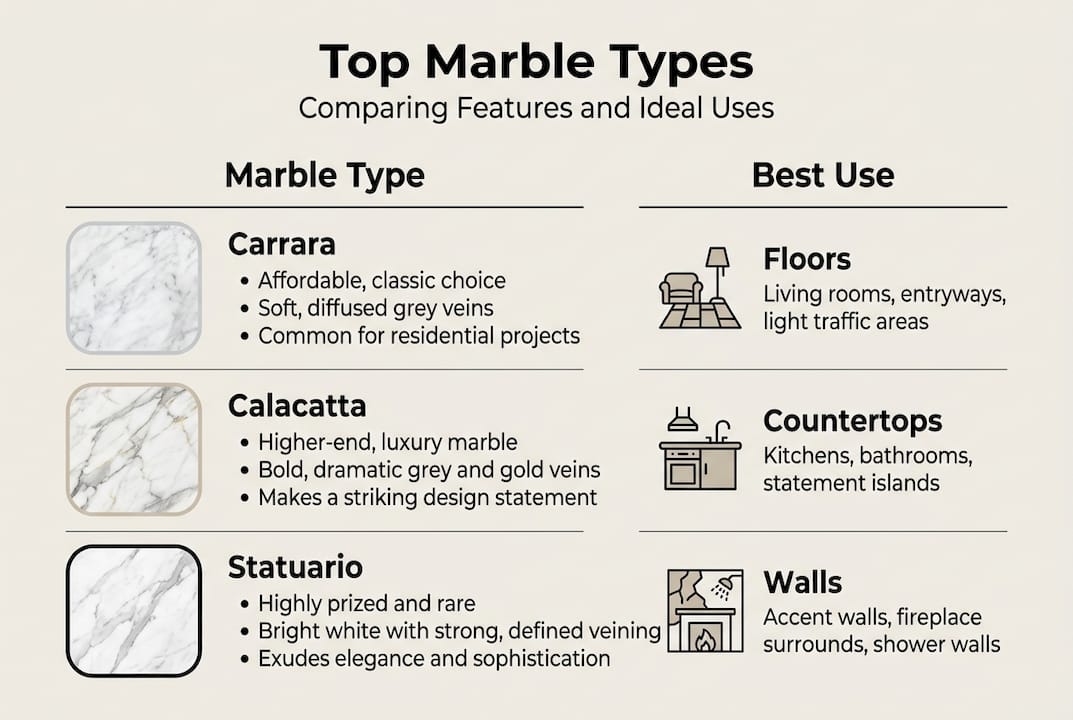
Here is a quick comparison to orient your selection:
| Marble type | Veining style | Best use case | Relative cost |
|---|---|---|---|
| Carrara | Subtle gray | Floors, large surfaces | $ |
| Calacatta | Bold, dramatic | Feature walls, islands | $$$ |
| Statuario | High contrast | Statement pieces, baths | $$$$ |
Travertine tells a different story. Travertine offers rustic texture and earthy tones, but its higher porosity means it requires more maintenance than most marbles. That texture, though, is exactly what makes it so appealing for Mediterranean-inspired or organic modern interiors. It brings warmth that polished marble simply cannot replicate.
What separates a premium grade stone from a standard one comes down to several factors:
One thing worth embracing early: natural variation is not a flaw. Every slab pulled from the earth is genuinely unique. That individuality, when selected thoughtfully, is what gives a luxury interior its character. Explore the full range of premium marble qualities before committing to a specific stone type.
“The most extraordinary interiors are not built on uniformity. They are built on the confidence to let natural material speak for itself.”
Now that you know your options, making the right choice depends on understanding your space’s specific requirements. Room function is the single most important filter.
Room-specific selection matters enormously: quartzite suits kitchens, marble suits baths, and blending materials delivers both optimal performance and aesthetics. For wet areas like showers or spa baths, filled travertine is the smarter call because the filling prevents water from penetrating the natural pores. For food preparation surfaces, you need a stone with strong etch resistance since marble reacts to acids found in citrus and vinegar. High-traffic hallways or commercial lobbies call for harder, denser stones.
Here is a side-by-side look at performance characteristics:
| Stone | Mohs hardness | Porosity | Best room | Avoid in |
|---|---|---|---|---|
| Carrara marble | 3-4 | Low-medium | Baths, bedrooms | Kitchens |
| Calacatta marble | 3-4 | Low-medium | Feature walls | High-acid areas |
| Travertine | 3-4 | High | Accent walls, floors | Wet areas (unfilled) |
| Quartzite | 7 | Very low | Kitchens, high traffic | N/A |
For high-traffic use, quartz-rich marble is recommended, and you should avoid acids on marble surfaces while sealing travertine frequently. The Mohs scale measures scratch resistance on a 1-10 range. Marble sits at 3-4, meaning it scratches more easily than quartzite at 7. That does not make marble a poor choice. It just means placement matters.
Here is a practical selection process to follow:
Visiting a slab yard is non-negotiable for premium projects. Photos and samples simply cannot capture how a full slab reads in natural light. You need to see the actual piece that will go into your home.
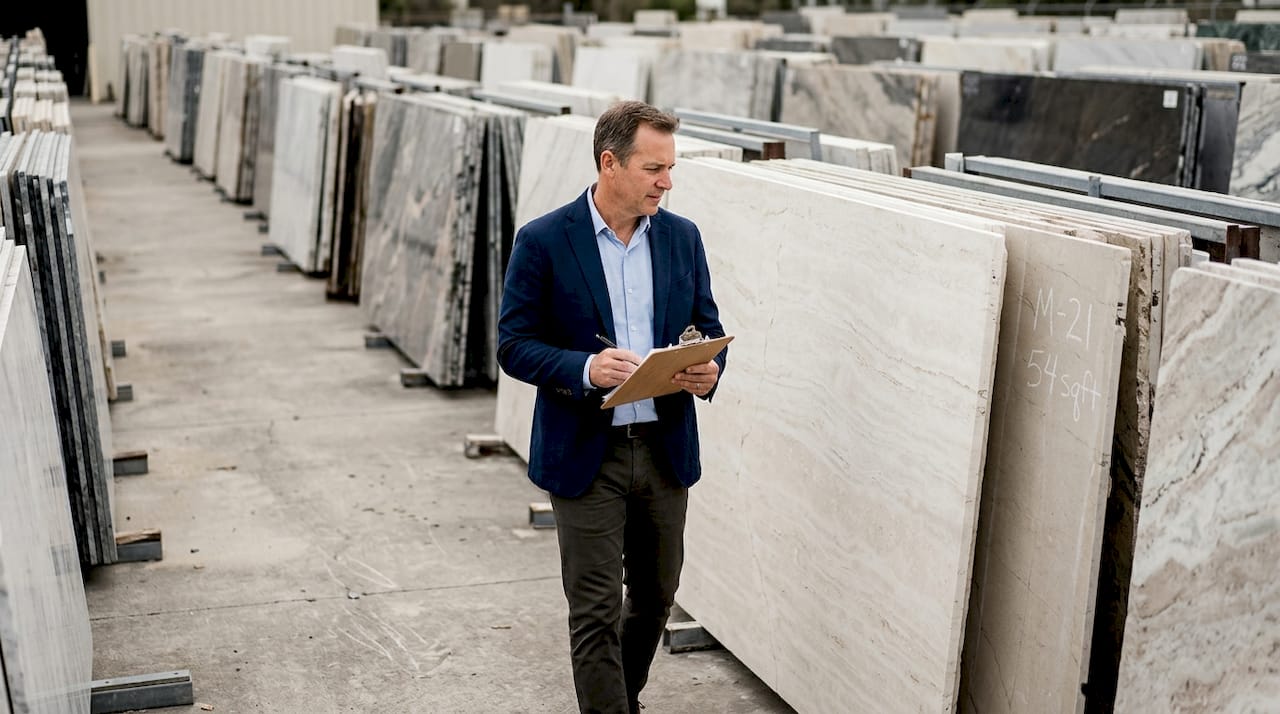
Pro Tip: Ask your supplier directly about stone provenance and grading standards. Reputable suppliers will have documentation. If they hesitate, that tells you something important about the product’s quality. Review what defines best marble for interiors before your slab-yard visit so you know exactly what questions to ask.
After selecting your ideal stone, expert installation and maintenance ensure it shines for decades. Even the finest Calacatta slab will underperform if the installation is rushed or careless.
A professional installation follows a precise sequence:
Nanotech sealers represent a genuine advancement in stone protection. They penetrate the stone at a molecular level rather than sitting on the surface, which means they do not alter the appearance. Nanotech sealers boost stain resistance by up to 80%, making them the right choice for bathrooms, kitchens, and any high-traffic area.
Maintenance schedules differ by stone type. Marble needs resealing every 12-18 months. Travertine, because of its higher porosity, needs attention every 6-12 months. Review stone decor maintenance tips and keep a simple calendar reminder so the schedule does not slip.
Pro Tip: Always request a nanotech sealer specifically for high-traffic zones, food surfaces, and bath areas. Standard sealers wear faster and leave stone more vulnerable between maintenance cycles. Check the marble decor checklist to confirm your installer is following best-practice protocols.
Callout: Proper installation reduces cracking risk by 50% and nanotech sealers improve stain resistance by 80%. These are not minor details. They define whether your investment holds its value.
With the technical foundation established, let’s explore how premium stone transforms interior vision into reality. The most compelling stone interiors in 2026 share one quality: intentionality. Every surface placement has a reason.
The most popular uses of marble and travertine in luxury interiors right now include:
On the trend side, reclaimed marble is up 25% in luxury spaces, and patina enhances value when the stone is high grade. This shift reflects a broader appetite for authenticity. Clients are actively seeking pieces with history, not just pristine surfaces.
Mixed textures are also gaining ground. Pairing polished marble with honed travertine in the same space creates depth and visual contrast that a single-material approach cannot achieve. Oversized slabs with minimal grout lines are another strong trend, reinforcing that seamless, architectural quality that defines contemporary luxury.
European sourcing and reclaimed stone add provenance and exclusivity that mass-produced alternatives simply cannot match. Sustainability is becoming a genuine purchase driver, not just a marketing point. Knowing where your stone came from and how it was extracted adds a layer of meaning to the material itself.
Explore the latest marble trends to see how leading designers are combining these elements in current projects.
“Patina and marks tell a story in luxury design. The most memorable interiors are the ones that carry evidence of time, origin, and craft.”
Most articles about luxury stone stop at aesthetics and maintenance schedules. What they rarely address is the emotional dimension of working with natural material, and why that dimension is actually central to what makes a space feel extraordinary.
Chasing perfection is the most common mistake in premium stone projects. Clients sometimes reject slabs with unusual veining or slight tonal variation, searching for something that looks more uniform. But that uniformity is exactly what separates a luxury stone surface from a manufactured one. The quirks are the point.
Patina enhances luxury in high-quality stone, but it frustrates with lower grades. This is a critical distinction. A small inclusion in a Statuario slab becomes a conversation piece. The same flaw in a commodity stone just looks like a defect. Grade determines whether imperfection reads as character or as a problem.
The tactile experience of stone is something photographs cannot convey. Running your hand across a honed travertine surface or a polished marble countertop creates a physical connection to the material that synthetic alternatives cannot replicate. That sensory quality is part of what people are paying for, even if they cannot articulate it.
Provenance matters too. Knowing that a slab came from a specific quarry in Tuscany or Turkey gives the material a story. That story becomes part of the home. Read more on luxury marble perspectives to understand how leading designers factor provenance into their sourcing decisions.
Ready to curate spaces that combine legacy, performance, and artistry? The knowledge in this guide gives you a strong foundation, but the real transformation happens when you pair that knowledge with the right materials.
At Marmorique premium stone collections, every piece is sourced with the same criteria this guide outlines: verified provenance, premium grade, and artisanal craftsmanship. Whether you are looking for a travertine lamp that anchors a living room or a custom marble bathroom set that rivals a five-star hotel, the collection is built around the principle that luxury stone should be both beautiful and enduring. Personal consultations are available for tailored design guidance, so your vision translates exactly to the finished space.
With professional installation and consistent maintenance, both marble and travertine can last 15-20 years or more in luxury interiors. The key variables are sealing frequency and avoiding harsh cleaning products.
Seal marble every 12-18 months and travertine every 6-12 months to maintain optimal stain resistance and surface integrity. High-traffic or wet areas may need attention at the shorter end of that range.
Use marble for luminous drama in baths and social spaces, travertine for warmth and organic texture in accent areas, and quartzite for kitchens or high-traffic zones where durability is the top priority.
Absolutely. Visiting slab yards and selecting individual slabs allows you to match veining, tone, and finish precisely to your design intent, making every installation genuinely one of a kind.


