Your Cart (0)
Your cart is empty
Free express shipping

Drawer menu
Free express shipping

Most people walk past a marble slab and see stone. What they’re actually looking at is a geological autobiography, written in minerals over millions of years. The assumption that all marble looks more or less the same is one of the most common and costly mistakes in luxury interior design. Veining is what separates a slab that commands attention from one that blends into the background. Understanding the different types of veining patterns, how they form, and how they behave in real spaces gives you a serious advantage when choosing marble for your home or project.
| Point | Details |
|---|---|
| Veining defines marble | Unique marble veining arises from natural mineral deposits and geological forces, making every piece one of a kind. |
| Pattern impacts design | The style, color, and scale of veining dramatically influence the mood and luxury of any space. |
| Selection is personal | Choosing the right veining pattern depends on your aesthetic goals, room usage, and lighting. |
| Proper care matters | Maintaining veining clarity requires gentle cleaning, regular sealing, and avoiding harsh chemicals. |
| Authenticity adds value | Natural marble veining enhances the uniqueness and long-term value of interior design. |
Marble veining refers to the lines, streaks, and swirls that run through a marble slab. These aren’t decorative additions. They’re the result of intense geological activity that took place deep within the earth over thousands to millions of years. When limestone undergoes heat and pressure during metamorphic transformation, mineral impurities like iron oxides, clay, and silica get pushed through the stone. Those minerals crystallize into the veins you see on the surface.
Because natural veins in marble form due to mineral impurities and metamorphic processes, no two slabs are ever identical. This is the fundamental reason marble remains irreplaceable in luxury design. Every piece is genuinely one of a kind.
Veining influences far more than appearance. It affects how light reflects off the surface, how a slab feels in a room, and even which applications it suits best. A marble with bold, sweeping veins reads very differently on a bathroom wall than a subtle, barely-there pattern on a kitchen countertop.
Here’s a quick look at how veining characteristics break down:
| Characteristic | Description |
|---|---|
| Color | Determined by mineral type (iron = red/gold, chlorite = green) |
| Width | Ranges from hairline cracks to thick, dramatic bands |
| Direction | Linear, diagonal, or chaotic depending on geological forces |
| Density | Sparse or heavily concentrated across the slab |
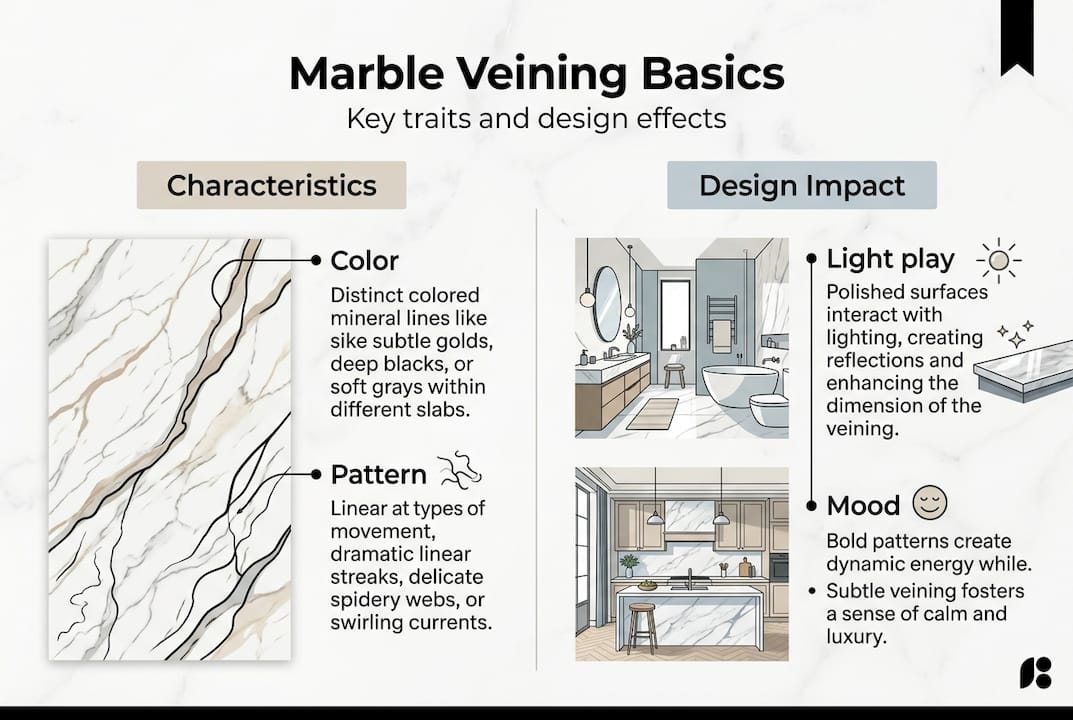
When you’re selecting marble for bathrooms or any high-visibility space, veining density and direction should be part of your decision from the start, not an afterthought.
Key reasons veining matters in design:
Not all veining looks the same, and the differences between pattern types are dramatic. Once you know what to look for, you’ll never see marble the same way again.
The most recognized veining types include:
Famous marble varieties each carry a signature veining style. Calacatta, Carrara, and Statuario are among the most prized, each valued for its distinct look. Calacatta is known for thick, dramatic gold or gray veins on a bright white background. Carrara has softer, more linear gray veins on a cooler white base. Statuario sits between the two, with bold veins and a luminous, warmer white tone.
| Marble type | Veining style | Best application |
|---|---|---|
| Calacatta | Bold, thick, dramatic | Feature walls, statement countertops |
| Carrara | Soft, linear, subtle | Flooring, large-format tiles |
| Statuario | Bold with warm tones | Bathroom vanities, focal pieces |
| Arabescato | Intricate, web-like | Decorative accents, art pieces |
When designing with marble veins, the pattern type should match the application. A brecciated marble on a feature wall creates drama. The same slab on a floor in a small room can feel overwhelming.
Pro Tip: In smaller rooms, lean toward linear or feathery veining patterns. They add character without making the space feel visually crowded.
Veining isn’t just a visual detail. It’s a design tool that shapes how a room feels the moment you walk in. The scale, contrast, and direction of veins all send signals to the eye and brain about the nature of a space.

Bold, high-contrast veining is directly associated with luxury marble interiors and dramatic, high-end design. Pronounced veining signals rarity and intentionality. It tells anyone who enters the room that a deliberate, sophisticated choice was made. That’s why you see it in hotel lobbies, luxury spas, and high-end residential kitchens.
Subtle veining, on the other hand, creates calm. A Carrara marble bathroom with soft gray lines reads as serene and timeless. It doesn’t compete with fixtures or art. It supports the overall atmosphere without demanding attention.
Here’s how different veining styles influence mood:
When choosing bathroom marble, think about the emotional experience you want to create. A master bath designed for relaxation calls for very different veining than a powder room meant to impress guests.
The direction of veining also plays a role. Vertical veins draw the eye upward and make ceilings feel higher. Horizontal veins ground a space and make it feel wider. This is a subtle but powerful tool in spatial design.
Choosing the right veining pattern is part instinct, part strategy. Here’s a step-by-step approach that works for both homeowners and designers.
For expert tips on marble selection, the principle of balancing personal taste with long-term value always applies. A veining style you love today should also appeal broadly enough to support resale value.
“The slab you see in the showroom is not the slab you’ll live with. Always view the full piece in your intended lighting before committing.”
Pro Tip: Never choose marble from a small sample tile alone. Request to view the entire slab. Veining can shift dramatically from one end to the other, and a sample only shows you a fraction of the story.
Once you’ve invested in a marble with exceptional veining, protecting it becomes a priority. The good news is that proper care isn’t complicated. It just requires consistency and the right products.
The most important step is sealing. Routine sealing protects veining and prevents staining by creating a barrier between the stone’s porous surface and everyday liquids. Most marble surfaces should be sealed once or twice a year, depending on use and traffic.
For daily cleaning, keep it simple:
Common mistakes that damage veining include using the wrong cleaning products, skipping sealing, and placing hot items directly on the surface. Heat can cause micro-fractures along existing veins, widening them over time.
For marble maintenance advice that keeps your stone looking its best, the rule is always gentleness first. Marble is durable, but it rewards careful handling.
Pro Tip: Use only pH-neutral cleansers specifically formulated for natural stone. Standard household cleaners are often too acidic or alkaline and will gradually etch the surface, dulling the clarity of your veining over time.
Polishing once or twice a year also helps maintain the reflective quality of the stone, which is what makes veining truly pop under light.
Engineered stone has come a long way. Some products do a convincing job of mimicking marble’s color palette. But here’s what they can’t replicate: the genuine randomness and geological depth of real veining. A machine can print a pattern. It cannot recreate the way a vein shifts in width, changes direction unexpectedly, or catches light differently at every angle.
When you choose real marble’s value over an imitation, you’re choosing something that carries a story no factory can manufacture. That vein in your countertop formed under conditions that no longer exist. It’s genuinely irreproducible.
We’ve seen a clear shift in what luxury homeowners and top designers are asking for. The demand isn’t just for marble that looks good in photos. It’s for stone that has presence, variation, and authenticity. Engineered alternatives tend to look perfect in a way that actually feels sterile. Real marble has imperfections that make it feel alive.
From our perspective, veining is the single most important factor in determining whether a marble piece becomes a conversation piece or just another surface. It’s not about spending more for the sake of it. It’s about investing in something that genuinely cannot be replicated, and that will only grow more meaningful over time.
Now that you understand what makes marble veining so powerful, the next step is finding pieces that bring that knowledge to life in your own space.
At Marmorique, every piece in our collection is selected for the quality and character of its natural stone. Our artisan marble soap dish is a perfect example of how even a small object can showcase the beauty of authentic veining in everyday life. For something more sculptural, the marble grape ornament demonstrates how natural stone transforms a decorative accent into something genuinely extraordinary. Each piece reflects the craftsmanship and attention to natural detail that defines true luxury stone decor.
Authentic marble veining forms naturally through mineral deposits during metamorphic processes. While engineered stone mimics color but not true veining, the variation and depth of real veins cannot be fully replicated.
Calacatta, Statuario, and Arabescato are renowned for their bold, striking veins and are among the most sought-after choices for high-impact luxury interiors.
Always ask to see the full slab before it’s cut, and view it under your intended lighting conditions. Lighting and slab layout significantly change how veining reads once installed.
Veining doesn’t reduce marble’s core strength, but more porous veins may need more frequent sealing and gentler cleaning to stay protected and looking their best.


