Your Cart (0)
Your cart is empty
Free express shipping

Drawer menu
Free express shipping

TL;DR:
- Sealed marble provides essential protection against stains and etching, preserving its luxurious appearance over time.
- Proper sealing involves applying a penetrating or topical barrier that repels liquids, reducing maintenance efforts.
Marble has always been the gold standard for luxury interiors, but there’s a widespread assumption that its beauty is self-sustaining. The reality? Untreated marble is surprisingly porous, and without a proper seal, even a glass of red wine or a splash of lemon juice can leave a permanent mark. Sealed marble changes that equation entirely. In this guide, you’ll learn exactly what sealing does, why it matters for high-end decor, and how to make smart decisions about selecting and maintaining marble surfaces that stay stunning for years.
| Point | Details |
|---|---|
| Sealed marble benefits | Sealed marble offers superior protection against stains and damage, making it ideal for luxurious interiors. |
| Protection vs. maintenance | Even sealed marble requires regular upkeep and periodic resealing for long-lasting beauty. |
| Choosing quality products | Selecting reputable sealers and proper care routines preserves marble’s look and value. |
| Luxury and practicality | Sealed marble brings together high-end design and everyday usability in kitchens, baths, and accents. |
Marble forms over millions of years through the metamorphosis of limestone under intense heat and pressure. The result is one of the most visually striking stones on earth, with its signature veining, depth, and luminous surface. But that same crystalline structure comes with a trade-off: marble is naturally porous. Left untreated, it acts almost like a sponge, drawing in liquids, oils, and microscopic particles that permanently alter its color and surface texture.
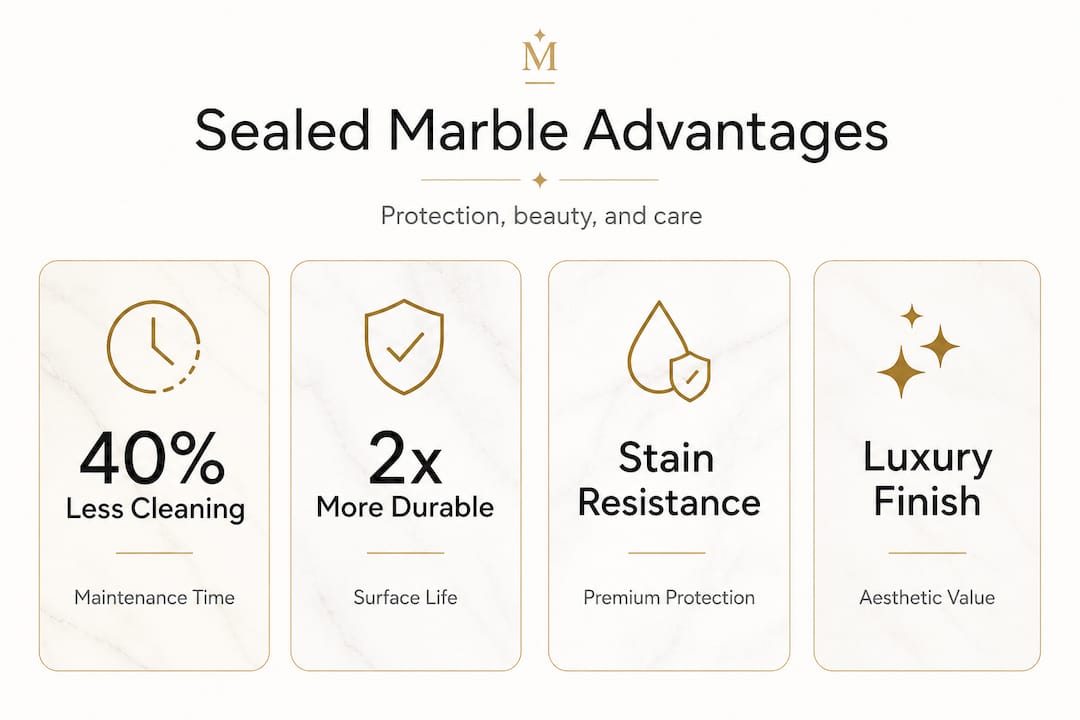
Sealing is the process of applying a penetrating or topical protective layer to the marble’s surface. A penetrating sealer soaks into the stone and fills its microscopic pores, creating an invisible barrier that repels liquids before they can be absorbed. A topical sealer, by contrast, sits on top of the surface and forms a physical shield. Both approaches serve the same fundamental purpose: preventing the stone from absorbing what it shouldn’t.
According to our marble maintenance guide, sealing marble prevents absorption of spills and slows etching. Etching is a chemical reaction that occurs when acidic substances like citrus juice or vinegar come into contact with calcium carbonate in the marble, leaving dull, slightly rough patches on the surface. Sealing dramatically slows this process, giving you more time to wipe up spills before any damage sets in.
Here’s a quick look at how sealed and unsealed marble compare across the key factors homeowners care about most:
| Feature | Sealed marble | Unsealed marble |
|---|---|---|
| Stain resistance | High | Low |
| Etching protection | Moderate | Minimal |
| Cleaning effort | Low | High |
| Ideal for wet areas | Yes | No |
| Visual impact | Preserved | Degrades quickly |
Unsealed marble in a luxury setting isn’t just a maintenance headache. It’s a liability. Key reasons why sealing is non-negotiable in high-end applications include:
The moment marble is installed in a luxury kitchen, a statement bathroom, or even a decorative accent table, sealing stops being optional. It becomes the foundation of proper stone care.
Once you understand what sealing is, the next question is: what does it actually do over time? The answer is more significant than most homeowners expect.
A quality penetrating sealer works at the molecular level. It fills the stone’s pores with a silicone or fluoropolymer-based compound that repels water and oil-based liquids. Think of it like a rain jacket for your marble. Water beads up and sits on the surface rather than soaking in, giving you a window of time to wipe it away without consequence. This is especially valuable in kitchens where cooking oils, coffee, and wine are constant hazards.
Sealing also protects against long-term wear that accumulates invisibly. Every time someone walks across a marble floor or drags a dish across a marble countertop, microscopic surface damage occurs. Sealed marble is more resistant to this kind of gradual degradation, maintaining its polished finish for significantly longer.
| Condition | Sealed marble | Unsealed marble |
|---|---|---|
| After 1 year of use | Minimal surface change | Visible etching and dullness |
| Wine spill (15 min) | Easily wiped clean | Likely stain |
| Oil spill (10 min) | No absorption | Absorbed, dark stain |
| Bathroom humidity | No impact | Surface degradation |
| Cleaning frequency | Weekly light clean | Daily attention needed |
As our proper marble care resource confirms, routine sealing helps maintain marble’s luster and its resistance to stains over time. This isn’t just cosmetic. Marble that loses its surface integrity becomes more difficult to restore and may eventually require professional honing or polishing, which adds significant cost.
“The most expensive marble care decision is usually the one you delay too long. A bottle of sealer applied once or twice a year costs a fraction of what professional restoration runs.”
Pro Tip: Not all sealers are created equal. Avoid generic hardware store products and opt for a stone-specific, penetrating impregnator rated for the marble type you have. Glossy Calacatta marble and honed Carrara marble, for example, have different surface textures and may require slightly different sealer formulations for optimal results.
One thing many homeowners overlook is that sealing also makes everyday cleaning safer. Harsh cleaners damage marble, but sealed marble is far more forgiving during routine wiping since the sealer acts as a buffer. You can use a mild pH-neutral cleaner without worrying as much about the cleaner itself interacting directly with the stone.
Sealed marble is exceptional, but no material is perfect for every situation. Understanding the full picture helps you plan smarter and avoid surprises after installation.
Advantages of sealed marble:
Potential drawbacks to keep in mind:
📊 Statistic spotlight: Sealed marble can reduce household maintenance time by up to 40% compared to unsealed stone, according to stone care specialists. For busy households, that time saving translates directly into less stress and a surface that always looks guest-ready.
The most common pitfall homeowners fall into is treating the first seal as a permanent solution. Sealers degrade. Heat, cleaning products, foot traffic, and daily use all gradually wear them down. The sealing advice from stone care professionals is consistent: schedule your resealing in advance, rather than waiting until you notice problems. By that point, some damage may already have occurred.
Another area worth flagging is cleaning product choice. Many popular household cleaners are too acidic or alkaline for marble. Bleach, vinegar-based sprays, and citrus-infused products can all strip sealers and etch the stone beneath. When in doubt, check the cleaning marble accessories guidance to make sure your routine is stone-safe.
Knowing the benefits and limitations of sealed marble is useful. Acting on that knowledge with a smart selection and care routine is what actually keeps your interior looking the way it should.
Selecting the right sealed marble:
Building a simple care routine:
Following a simple marble cleaning guide and sealing routine preserves marble’s appearance across years of use. Here’s what that routine looks like in practice:
Use the marble maintenance tips as your baseline reference, and you’ll always know where you stand.
Pro Tip: Before introducing any new cleaning product to your marble, test it on a small, inconspicuous area and wait 24 hours. Some products cause gradual dulling that isn’t immediately visible. This single habit has saved many homeowners from accidentally stripping the finish off beautiful stone surfaces.
When it comes to placement, sealed marble shines in these specific areas: kitchen islands and countertops, bathroom vanities and shower surrounds, fireplace surrounds and hearths, accent tables, lamp bases, and decorative bookends or bowls. Each of these applications benefits from sealed protection since they all face either moisture, food contact, or heavy handling.
Here’s something we’ve observed consistently: homeowners spend considerable time and money selecting the right marble and the right sealer, and then they treat the job as done. Sealing is seen as a one-time event, not a practice.
The truth is that consistent marble care is what separates surfaces that age beautifully from ones that slowly deteriorate. The sealer is a starting point, not a finish line.
What really protects marble long-term is a collection of small, consistent habits. Blotting spills immediately. Keeping cutting boards and coasters in active use, not just as decoration. Choosing pH-neutral cleaners every single time, even when a stronger product seems faster. Scheduling resealing on a calendar before the surface shows signs of wear.
The homeowners whose marble still looks extraordinary after 10 or 15 years of daily use aren’t doing anything dramatic. They’ve just built these micro habits into their routines. They treat their marble the way someone with a great skincare routine treats their skin: consistently, gently, and proactively.
There’s also an aesthetic dimension that rarely gets discussed. Marble that’s been cared for over many years develops a subtle, lived-in richness. The veining deepens slightly. The surface takes on a warmth that brand-new marble doesn’t quite have. This patina is only possible if the underlying stone is protected. Neglected marble doesn’t age gracefully. It just deteriorates.
The investment in sealed marble is not just financial. It’s a commitment to caring for something beautiful, and that commitment is what delivers the return.
You now have a clear picture of what sealed marble is, how it works, and how to care for it properly. The next step is finding pieces that combine that protection with exceptional design.
At Marmorique, we curate a collection of natural marble and stone decor crafted for both beauty and lasting performance. From marble lamps and accent tables to bathroom sets and decorative accessories, each piece is selected for quality of material and finish. Whether you’re styling a kitchen, a bathroom, or a statement living space, you’ll find sealed marble pieces designed to elevate your interior and stand the test of time. Browse the full collection at marmorique.com and discover what truly refined stone decor looks like.
Sealed marble has a protective barrier applied to its surface that prevents stain absorption and reduces damage from moisture and everyday spills. The sealer fills the stone’s natural pores, making it far more resistant to the kinds of staining and etching that quickly degrade untreated marble.
Most marble surfaces benefit from resealing every 6 to 12 months, with high-traffic areas like kitchen counters needing attention on the shorter end of that range. As our marble luster guide notes, routine sealing maintains marble’s resistance and appearance over the long term.
Yes, sealing reduces the risk significantly but doesn’t make marble completely stain-proof. If spills sit for extended periods or the sealer has worn thin, even sealed marble can absorb staining agents, which is why prompt cleanup and regular resealing are both essential.
Sealed marble is one of the best choices for kitchens and bathrooms precisely because those environments involve constant moisture and spill exposure. With proper sealing, marble handles both areas beautifully while maintaining its luxury appearance far better than untreated stone would.
Polishing is a finishing process that affects how smooth and reflective the marble’s surface is. Sealing is a separate protective treatment that applies an invisible barrier to shield the stone from damage. You can have marble that is both polished and sealed, or honed (matte finished) and sealed. They address completely different aspects of marble quality.


