Your Cart (0)
Your cart is empty
Free express shipping

Drawer menu
Free express shipping

TL;DR:
- Interior beauty relies on principles like balance, proportion, and material quality, not just decor.
- Natural stone like marble and travertine adds timeless elegance through veining and light interaction.
- Achieving luxury requires intentional design choices, skilled installation, and restrained material use.
Most people assume a beautiful room comes down to picking the right sofa or finding the perfect rug. But stunning interiors are built on something less visible and far more deliberate. The principles of balance, proportion, and material quality work quietly beneath the surface, shaping how a space feels before anyone consciously registers why. Natural stone, particularly marble and travertine, plays a central role in this equation. These materials carry centuries of design intelligence in their veining and texture. This guide breaks down the core principles behind visually compelling interiors and gives you a practical framework for applying them with confidence.
| Point | Details |
|---|---|
| Balance shapes comfort | Symmetry, proportion, and visual weight determine how relaxed or energized a space feels. |
| Material selection matters | Choosing the right marble or travertine finish defines elegance, durability, and lighting effects. |
| Blend styles for harmony | Combining minimalism and maximalism with quality materials creates spaces that are both welcoming and sophisticated. |
| Craftsmanship is essential | Working with skilled professionals ensures luxury interiors maintain their beauty and value for decades. |
Beautiful spaces are not accidents. Every room that feels instinctively right is governed by a set of principles that designers have refined over centuries. Understanding these principles gives you the ability to diagnose what a space is missing and make corrections with precision rather than guesswork.
The foundational concepts are balance, proportion, scale, rhythm, and harmony. Each one addresses a different dimension of how the eye and mind process a room. Proportion refers to the size relationships between objects. Scale describes how those objects relate to the human body and the room itself. Rhythm creates visual movement through repeated elements. Harmony ties everything together into a unified whole.
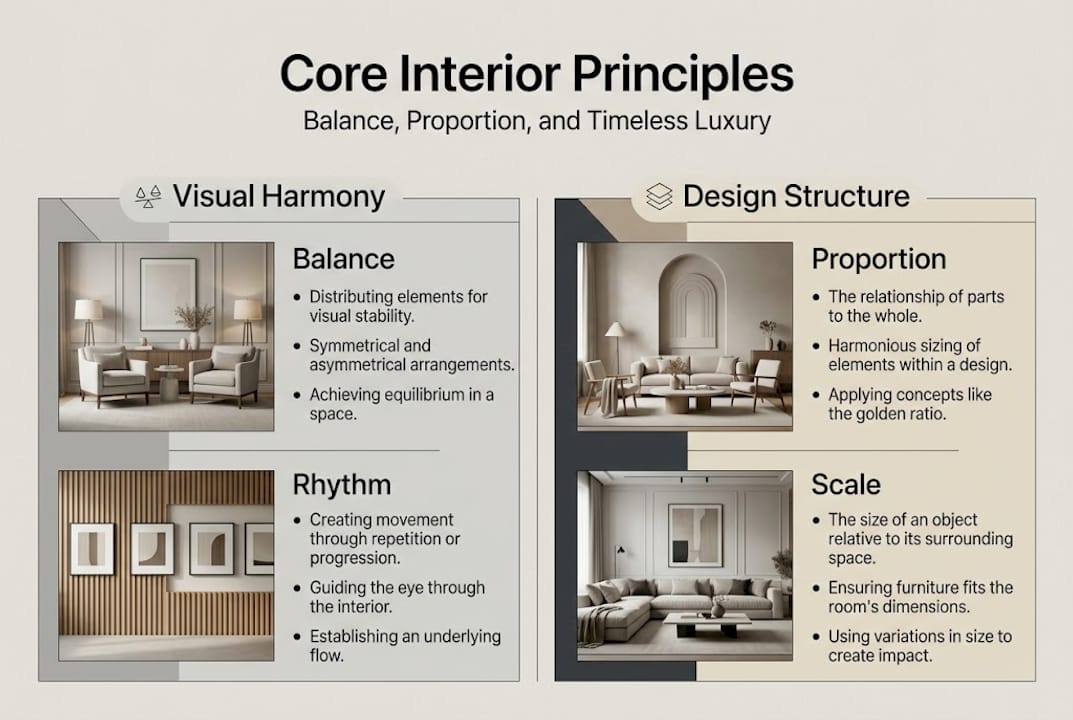
Balance is the most immediate of these principles. Balance distributes visual weight through three distinct modes: symmetrical (equal visual weight on both sides), asymmetrical (different elements that achieve equilibrium through careful placement), and radial (elements arranged around a central point). Improper balance creates a subtle but persistent sense of unease in occupants, even when they cannot identify the source.
Here is a quick reference for how each principle affects perception:
| Principle | What it governs | Effect when done well | Effect when ignored |
|---|---|---|---|
| Balance | Visual weight distribution | Calm, stability | Tension, unease |
| Proportion | Size relationships between elements | Cohesion | Awkwardness |
| Scale | Object size vs. room and human scale | Comfort | Overwhelm or emptiness |
| Rhythm | Repetition and pattern | Energy, flow | Monotony or chaos |
| Harmony | Overall unity of elements | Elegance | Visual noise |
Material selection is inseparable from these principles. When you choose best marble types for interiors, you are not just picking a surface. You are selecting a visual anchor that will influence every other decision in the room.
Research confirms that symmetry is universally preferred across genders and design styles, while slight angular furniture forms tend to appeal more to male respondents. This data reinforces what experienced designers already know: the geometry and arrangement of furnishings shape perception at a psychological level.
“The goal is not perfection but intentional tension. A room that is too symmetrical can feel sterile. The art is knowing exactly how much asymmetry to introduce before the balance breaks.”
Thoughtful window solutions and balance also play a role in visual equilibrium, since natural light framing affects how weight is perceived across a room’s surfaces.
Once you understand the principles, material selection becomes a strategic decision rather than a stylistic preference. No material demonstrates this better than natural stone. Marble and travertine have anchored luxury interiors for millennia, and their staying power is not sentimental. It is structural and sensory.
Marble and travertine enhance timeless elegance through natural veining, light diffusion, and proven durability spanning over 2,000 years. The finish you choose determines the character of the stone in context:
Here is how marble and travertine compare across key design considerations:
| Feature | Marble | Travertine |
|---|---|---|
| Density | High | Medium |
| Veining | Dramatic, bold | Subtle, linear |
| Light interaction | High reflection (polished) | Warm diffusion |
| Best use cases | Feature walls, countertops, statement floors | Flooring, bathrooms, outdoor areas |
| Maintenance | Seal annually, avoid acids | Seal annually, fill pores if desired |
| Aesthetic mood | Formal, dramatic | Warm, organic |
Light interaction is where these materials truly earn their place in luxury design. Polished marble bounces both natural and artificial light across a room, making spaces feel larger and more dynamic. Travertine, with its porous surface and warm tones, diffuses light in a way that creates intimacy and softness. Choosing between them is a question of the emotional register you want the room to occupy.

Pro Tip: Match your finish to the function of the space. Use polished marble in formal areas like entryways or dining rooms where drama is appropriate. Choose honed or tumbled finishes in bathrooms and living spaces where comfort and grip matter more.
When choosing marble furnishings for a project, consider how the stone’s natural pattern will interact with the room’s existing geometry. A heavily veined Calacatta marble table in a room with strong architectural lines creates a compelling tension. A softer Carrara piece in the same room would blend rather than anchor.
Exploring shutter design ideas alongside stone selection can help you control how light enters and activates your stone surfaces throughout the day.
Material choice alone does not determine a room’s success. The broader design philosophy you adopt shapes how every element, including your stone surfaces, is perceived. The debate between minimalism and maximalism is not about which is better. It is about understanding what each delivers and what each risks.
Minimalism reduces cognitive load. Minimalism reduces stress and mental fatigue, a finding supported by Princeton University research on visual clutter. Clean lines, limited palettes, and deliberate negative space allow the materials themselves to carry the room. In a minimalist interior, a single marble table or a travertine lamp becomes the entire story.
Maximalism, by contrast, celebrates accumulation and layering. It boosts creativity and emotional engagement but carries a real risk of sensory overload when executed without discipline. The key distinction is curation. Maximalism done well is intentional abundance. Done poorly, it is just clutter with expensive furniture.
The most compelling current direction is what designers call quiet luxury: a hybrid approach that combines minimalism’s restraint with maximalism’s warmth and depth. It favors neutral palettes, rich textures, and heritage materials over trend-driven decoration.
Here is a practical process for finding your own aesthetic balance:
Pro Tip: If you are uncertain whether a space leans too far toward maximalism, remove three objects and live with the result for a week. If the room feels more intentional, you had too much. If it feels empty, you were closer to balance than you thought.
For guidance on which stone varieties suit each design philosophy, see best marble for each style. Carrara marble’s soft gray veining suits minimalist schemes beautifully, while bolder stones like Nero Marquina work well in maximalist or dramatic settings.
For deeper inspiration on layering and abundance, maximalist interior design resources from Architectural Digest offer strong visual references.
Theory becomes valuable only when it translates into action. Integrating marble or travertine into a space requires a structured process, not just good taste. Skipping steps leads to costly mistakes that are difficult to reverse once stone is installed.
A reliable workflow for luxury marble integration follows five stages: assess the space for light and flow, select stone varieties based on the room’s visual role (Carrara for subtle refinement, Calacatta for bold statements), coordinate skilled installation, verify functionality before finalizing, and establish a maintenance plan including sealing one to two times per year.
Here is that process in detail:
Common mistakes to avoid:
Pro Tip: Use 3D visualization tools before committing to a stone selection. Seeing the material rendered in your actual space, with accurate light modeling, prevents expensive surprises and builds client confidence.
For a complete reference on making the right material decisions, the marble furnishing selection guide covers variety, scale, and placement in depth. A broader luxury design guide can also help you future-proof your choices against shifting trends.
After studying how the most enduring luxury interiors are built, one pattern becomes clear: the spaces that age best are never the most extravagant. They are the most intentional.
The instinct to equate luxury with abundance is understandable but ultimately misleading. A room filled with expensive objects that lack a coherent visual logic does not feel luxurious. It feels anxious. True luxury is the experience of a space that has been thought through completely, where every surface, proportion, and material earns its presence.
Natural stone is central to this philosophy not because it is expensive but because it is irreducibly real. Marble and travertine carry the evidence of geological time in their patterns. They develop patina. They respond to light differently at 8 a.m. than at 8 p.m. No synthetic material replicates that sensory depth.
Our recommendation is always to invest in skilled execution and restrained palettes before adding decorative layers. A single well-placed travertine surface in a thoughtfully proportioned room will outlast any trend. For guidance on selecting luxury marble that serves this philosophy, the principles covered here are your starting point.
The principles in this guide only become transformative when paired with materials that can actually carry them. Informed choices and quality craftsmanship are where lasting elegance begins.
At Marmorique, every piece in our collection is selected for its natural character, finish quality, and ability to anchor a room with genuine presence. Whether you are sourcing a statement marble table, a travertine lamp, or a complete bathroom set, our curated range gives you the material foundation that serious design demands. Explore the full collection of luxury marble and travertine decor and find the pieces that bring your vision to life with the craftsmanship it deserves.
Marble is denser with dramatic veining and high gloss potential, making it ideal for bold statements. Travertine is softer and more textured, diffusing light with warmth that suits organic and relaxed interiors.
Start with neutral foundations and layer texture before color. A quiet luxury approach that combines minimalist clarity with subtle warmth through natural materials tends to produce the most enduring results.
Marble should be sealed 1-2 times per year, cleaned exclusively with pH-neutral products, and protected from acidic liquids like citrus juice or wine to prevent etching.
Honed and tumbled finishes provide more grip underfoot and are significantly less slippery than polished marble. Honed finishes offer matte safety benefits that make them the preferred choice for bathroom floors and family living areas.


