Your Cart (0)
Your cart is empty
Free express shipping

Drawer menu
Free express shipping

TL;DR:
- Honed marble features a matte, non-reflective surface created through abrasive polishing.
- It is favored for its resistance to etching and slip resistance, especially in kitchens and bathrooms.
- Proper sealing and maintenance are essential due to its porous nature, but it offers a warm, natural aesthetic.
Most people picture marble as glossy, reflective, and almost impossibly sleek. But the most sought-after marble surfaces in luxury interiors today are anything but shiny. Honed marble, with its smooth, matte finish and understated elegance, is quietly becoming the preferred choice for designers who know that restraint is its own form of sophistication. In fact, fabricators prefer honed marble for 90% of kitchen installations because it hides etches far better than its polished counterpart. This guide walks you through everything you need to know about honed marble, from how it’s made to where it shines brightest.
| Point | Details |
|---|---|
| Honed marble basics | Honed marble is a smooth, matte-finished stone that offers a contemporary look and practical advantages for high-end spaces. |
| Craftsmanship matters | Proper honing technique and consistent grit steps are essential for a beautiful, even finish. |
| Maintenance needs | Honed marble requires regular sealing and gentle cleaning to maintain its understated elegance. |
| Design versatility | Its low-glare finish makes honed marble ideal for kitchens, baths, and modern commercial interiors. |
| Expert tip | Prioritize edge-to-field grit matching and sealing for the most durable and attractive results. |
Honed marble is natural marble that has been sanded to produce a flat, non-reflective surface. Instead of the mirror-like sheen you see on polished marble, honed marble has a soft, velvety quality that absorbs rather than reflects light. It still feels smooth to the touch, but there is no glossy topcoat or chemical buffing involved. The finish comes entirely from abrasion, specifically from progressively finer grits of diamond abrasive pads applied to the stone surface.
The contrast between honed and polished marble is striking, even when you’re looking at the exact same stone variety.
| Feature | Honed marble | Polished marble |
|---|---|---|
| Surface appearance | Matte, soft, non-reflective | High-gloss, mirror-like |
| Tactile feel | Smooth, slightly velvety | Slick, glass-like |
| Etch visibility | Low (etches blend in) | High (etches stand out sharply) |
| Light behavior | Diffuses light evenly | Reflects light intensely |
| Color depth | Softer, more natural tones | Vivid, saturated color |
The honing process involves working through a series of abrasive grits, typically starting coarse and finishing at 200 to 400 grit, depending on the desired level of matte. Here is what differentiates a well-executed hone from a subpar one:
One technical detail that matters enormously in professional installs is that skipping grit steps causes uneven, cloudy finishes. Always match edges to the field grit. This is a detail that separates a luxury finish from a mediocre one. When you commission honed marble work, it is worth asking your fabricator specifically how they handle edge consistency.
The journey from quarry block to finished honed surface is more labor-intensive than most people realize. Understanding the process helps you appreciate why skilled fabrication matters so much for achieving that perfectly even matte finish.
“Honed marble’s more porous nature demands rigorous sealing, but its superior etch-hiding makes it the preferred choice of fabricators for the majority of kitchen installations.”
The reason honed marble hides etches so well comes down to surface geometry. Polished marble has a crystalline surface that reacts violently with acids, leaving dull spots that contrast sharply against the sheen. On a honed surface, that same etch is barely perceptible because the surrounding surface is already matte.
Pro Tip: If you are sourcing custom honed marble, ask your fabricator to show you both the field finish and the edge finish under natural light before installation is complete. Inconsistencies are much easier to address before the stone is set than after.
Making the right choice for your project means weighing what honed marble does brilliantly against where it asks more of you.
Advantages:
Drawbacks:
| Feature | Honed marble | Polished marble |
|---|---|---|
| Etch visibility | Low | High |
| Slip resistance | Better | Lower |
| Stain resistance (unsealed) | Lower | Higher |
| Maintenance frequency | Higher | Lower |
| Design trend alignment | Very current | Classic |
| Ideal for wet areas | Yes | Less ideal |
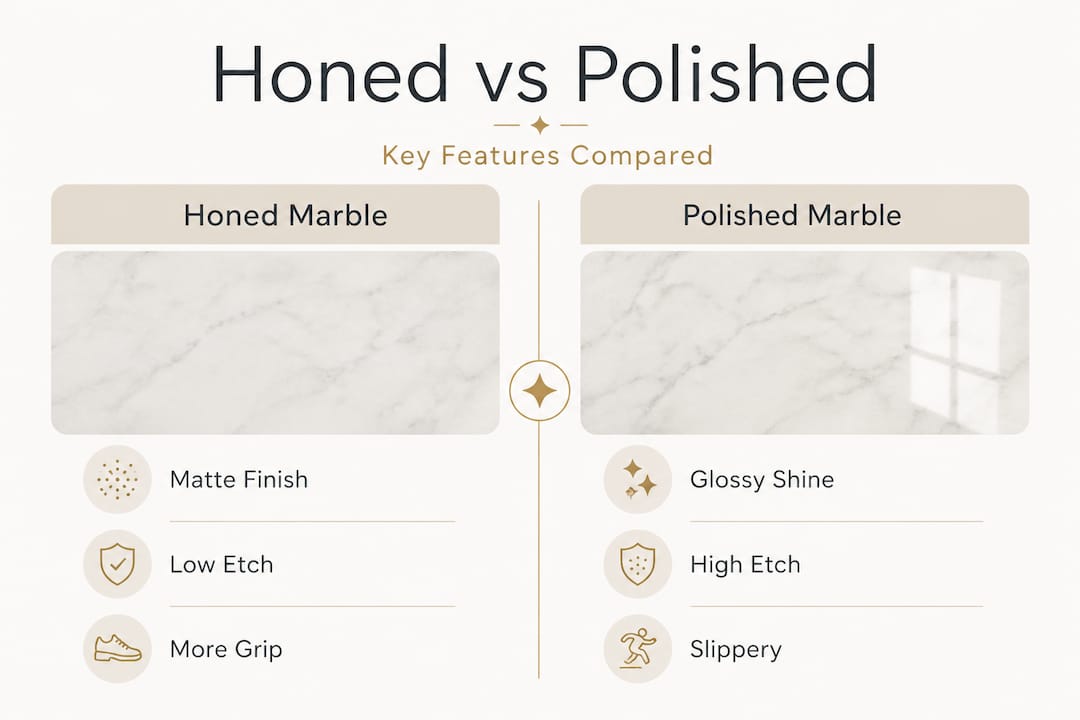
Understanding the full picture of marble decor benefits helps you place honed marble within a broader design strategy rather than treating it as an isolated material choice.
Pro Tip: Apply a high-quality penetrating sealer immediately after installation and again every 6 to 12 months depending on how heavily the surface is used. In kitchens, lean toward the shorter interval.
Honed marble is extraordinarily versatile. Its matte quality makes it just as appropriate in a sleek modern penthouse as it is in a timeless, European-inspired villa. The key is matching the finish to the functional and visual demands of the space.
Kitchen countertops and islands: This is where honed marble earns its strongest reputation. The etch-hiding quality is practically indispensable in a working kitchen where acidic foods and drinks are part of daily life. A honed Calacatta or honed Statuario countertop delivers visual drama without the anxiety of every lemon wedge leaving its mark.
Bathroom floors and walls: The slip-resistant quality of honed marble makes it the intelligent choice for wet floor areas. Large-format honed marble tiles in a master bath create a spa-like atmosphere that polished tiles simply cannot replicate. The softness of the finish makes the space feel warmer and more intimate.
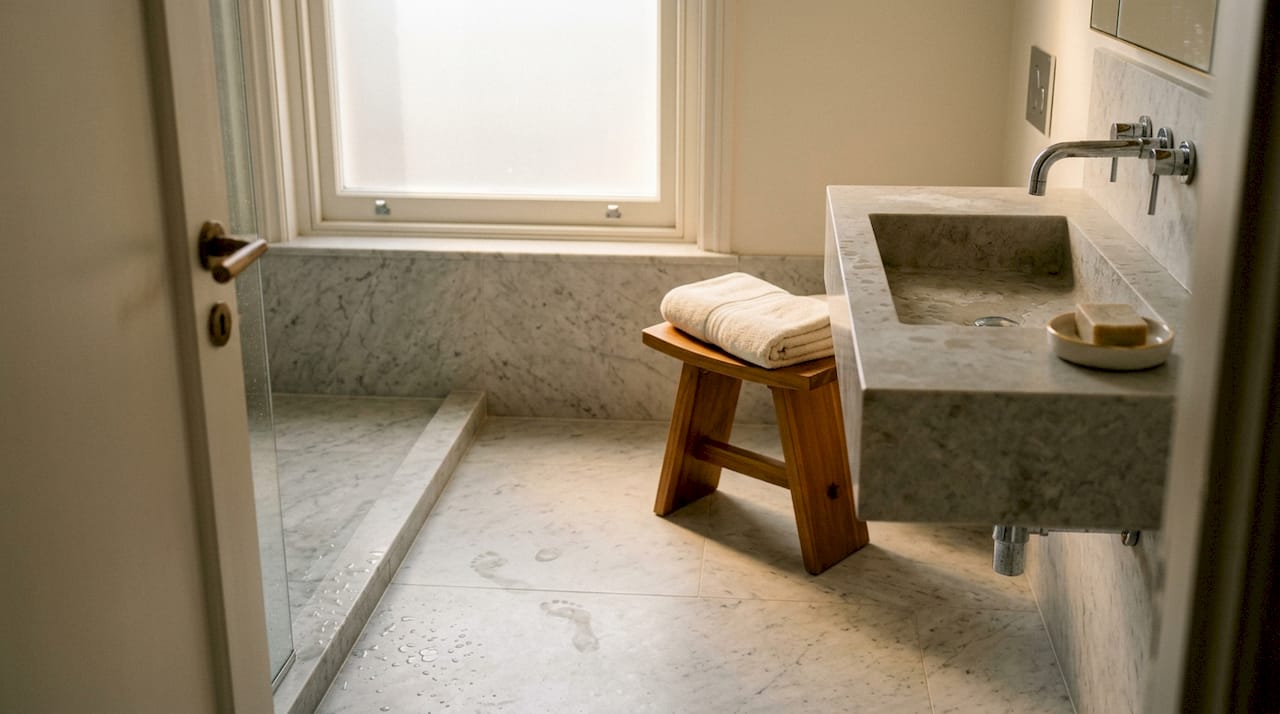
Flooring in living areas and hallways: Honed marble floors in common areas develop a beautiful patina over time. Unlike polished floors that show every footprint and scuff, a well-sealed honed floor wears gracefully and requires only routine sweeping and occasional damp mopping.
Accent walls and feature panels: A floor-to-ceiling honed marble panel in an entryway or behind a fireplace is one of the most powerful design moves available in luxury residential work. The absence of glare lets the natural veining take center stage.
Custom furniture: Honed marble tabletops, console surfaces, and coffee tables are increasingly popular because the matte finish holds up better to everyday contact than polished marble. A honed Nero Marquina dining table, for example, pairs beautifully with warm brass or aged oak.
Honed marble also performs exceptionally well in commercial luxury environments. Hotel lobbies, high-end restaurant interiors, and boutique workspaces are all prime settings. The luxury marble inspiration found in these spaces consistently leans toward matte finishes for their ability to create atmosphere without visual noise. In commercial settings, the added slip resistance of honed floors is also a liability consideration that responsible designers take seriously.
Best material pairings for honed marble:
The honest truth about honed marble maintenance is that it is not difficult, it just requires consistency. Most people who experience problems with honed marble surfaces can trace them back to infrequent sealing or using the wrong cleaning products.
The marble maintenance basics required for honed surfaces are the same foundation principles that protect any natural stone investment over the long term.
Pro Tip: Do a simple water test to check your sealer’s effectiveness. Drop a few beads of water on the surface. If they bead up, the sealer is working. If they absorb quickly, it is time to reseal.
Because honed marble is more porous by nature, the sealing step is not optional. Treat it as a non-negotiable part of your ongoing care routine, not an afterthought.
There is a persistent anxiety in the design world about recommending honed marble to clients who are not “experienced” with natural stone. The assumption is that it will look tired or stained within a year if not treated perfectly. This fear is largely outdated.
Modern penetrating sealers have transformed the practical reality of honed marble. A properly sealed honed surface in a busy kitchen or commercial space will perform admirably with nothing more than daily wiping and a biannual reseal. The etch-hiding superiority of honed marble means the surfaces that worry clients most, the ones facing wine, coffee, and citrus, are actually better served by honed than polished finishes.
The deeper truth is that most experienced designers choose honed marble not just for looks but for what it does to the light and atmosphere of a room. Polished surfaces create reflective planes that can make a space feel harder and more formal. Honed marble absorbs and diffuses light, making rooms feel warmer, more grounded, and more human. That is not a small thing in luxury interior design, where emotion and comfort drive decisions just as much as aesthetics.
The current cultural drift toward “quiet luxury,” with its emphasis on understatement, natural materials, and tactile richness, is exactly where honed marble has always lived. It did not need to catch up to a trend. The trend caught up to it. When you look at the marble benefits for designers from a long-term perspective, honed finishes consistently deliver more livable, more emotionally resonant spaces than their polished counterparts.
The designers who get the most out of honed marble are the ones who stop treating it as a compromise and start treating it as the first choice.
If this guide has sparked ideas for your next interior project, you are already thinking the way the best designers think. Honed marble brings together tactile elegance, practical durability, and timeless visual character in a way very few materials can match.
At Marmorique, we curate a carefully selected range of premium natural stone pieces that bring the understated beauty of honed and natural-finish marble into your home or commercial space. From statement table surfaces to refined bathroom accessories, every piece is chosen for its craftsmanship and its ability to elevate a room. Browse our full luxury marble collection to find the pieces that speak to your design vision and bring the quiet sophistication of natural stone into your space.
Honed marble needs more frequent sealing but is better at hiding scratches and etches than polished surfaces, making it a practical choice for kitchens and high-use areas.
Unsealed honed marble can stain more readily due to its porosity, but regular sealing minimizes this risk significantly and keeps the surface performing well over time.
Yes; its matte finish helps hide etching from acids and its texture improves slip resistance, making it a preferred option for both kitchens and wet bathroom floors.
Use only pH-neutral cleaners specifically formulated for natural stone. Avoid acidic or bleach-based products, as they can etch the surface and degrade the protective sealer.
Sealing every 6 to 12 months is recommended depending on usage, with kitchen and bathroom surfaces requiring the shorter interval for reliable protection.


