Your Cart (0)
Your cart is empty
Free express shipping

Drawer menu
Free express shipping

TL;DR:
- Travertine’s natural variation and timeless warmth create unique, authentic luxury interiors.
- It offers thermal comfort, slip resistance, and durability suitable for indoor and outdoor spaces.
- Proper sealing and maintenance ensure travertine’s long-lasting, elegant performance.
Choosing the right material for a luxury interior is never simple. Every surface must perform beautifully under scrutiny, hold up to daily life, and feel genuinely elevated rather than just expensive. Travertine is the stone that designers keep returning to, not because it’s trendy, but because it consistently delivers where other materials fall short. From its warm, organic tones to its surprising thermal comfort and slip resistance, travertine brings a rare combination of beauty and practicality to high-end homes and commercial spaces. This article breaks down the most compelling, expert-backed benefits so you can make a confident, informed decision.
| Point | Details |
|---|---|
| Unique natural beauty | Travertine’s colors and patterns create one-of-a-kind luxury decor for any space. |
| Exceptional comfort | Thermal properties keep surfaces cool or comfortable all year, enhancing home enjoyment. |
| Durability and ease | Properly sealed, travertine is resilient, ages gracefully, and is easy to maintain. |
| Safe and versatile | Slip-resistant and perfect for indoor-outdoor spaces, travertine brings both style and safety. |
With selection challenges in mind, let’s explore the first and most iconic reason why travertine stands out: its timeless natural beauty.
Travertine forms over thousands of years as mineral-rich water deposits calcium carbonate in layers, creating the warm beige, cream, and tan tones that have graced everything from ancient Roman baths to contemporary penthouses. Those colors are not manufactured or applied. They are geological, which means they carry a depth and warmth that no engineered stone can replicate. When you place travertine in a room, you are introducing something that took nature millennia to create.
One of the most striking qualities is its porosity. Travertine’s natural porosity ranges from 10 to 70%, and this variation is what gives each tile or decor piece its distinctive surface texture. Those small pits and channels catch light differently throughout the day, creating visual depth that flat, polished surfaces simply cannot achieve. In a luxury setting, that kind of layered visual interest is exactly what separates a designed space from a merely decorated one.
No two pieces of travertine are identical. The veining, the color gradients, the surface movement — all of it shifts from slab to slab. For a homeowner or designer seeking exclusivity, this is a genuine advantage. You are not installing a material that your neighbor can replicate exactly. You are curating something singular. Explore design ideas with travertine to see how this individuality translates into real spaces.
“Travertine provides timeless natural beauty with unique textures, warm tones, and variations that enhance luxury interiors, adding warmth, depth, and authenticity; no two pieces are identical.” — Livinator
Travertine also ages with grace. Unlike materials that look worn and tired after a decade, travertine develops a patina that actually adds to its heritage appeal. Surfaces soften, edges round slightly, and the stone begins to tell a story. For clients who want their spaces to feel lived-in and layered rather than showroom-fresh, this aging quality is a feature, not a flaw. Understanding travertine’s role in luxury design helps clarify why so many top designers specify it for landmark projects.
Pro Tip: Choose a honed or brushed finish rather than polished if you want the natural texture and warmth of travertine to read most clearly in your space.
While aesthetics are paramount, true luxury also requires comfort, especially in climates that test materials to their limits.
Travertine has a natural ability to stay cool underfoot, even in direct sunlight or warm indoor environments. This is one of its most underappreciated practical advantages. In a sun-drenched bathroom or a south-facing living area, walking barefoot on travertine feels genuinely pleasant rather than harsh. Travertine stays cool underfoot in hot climates, is heat-resistant for fireplace surrounds, and remains comfortable year-round.
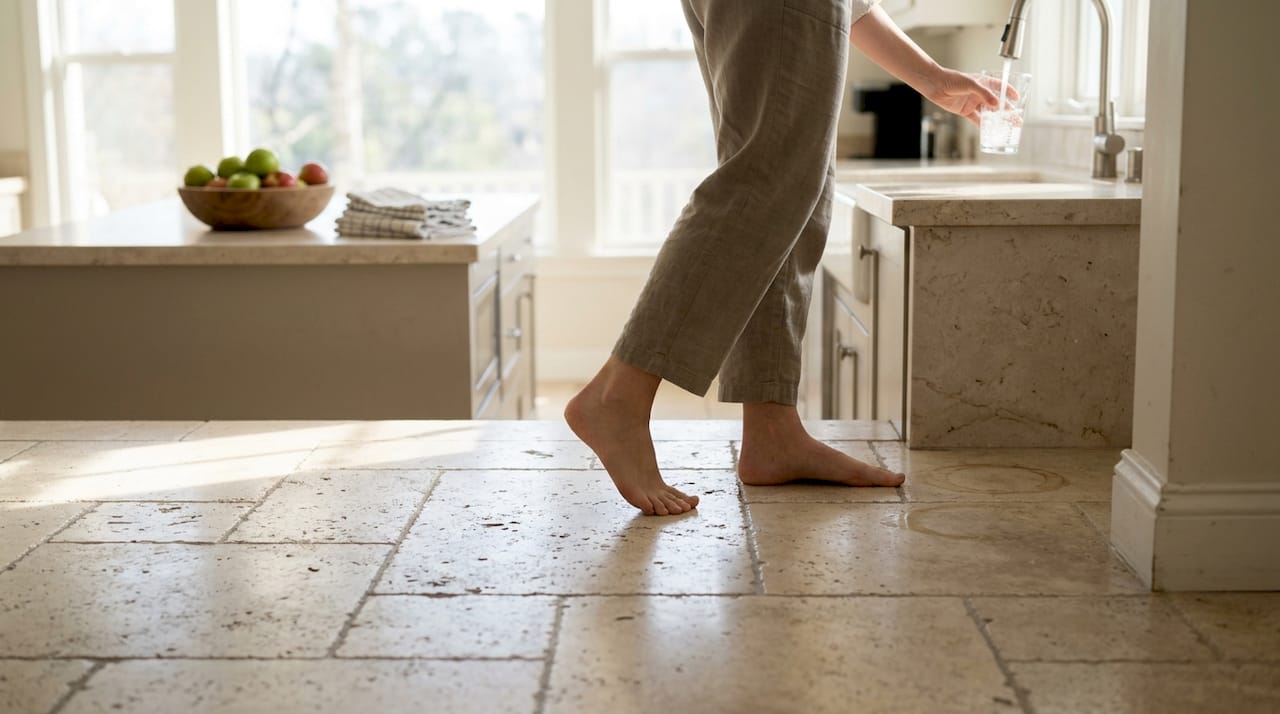
For spaces with underfloor heating systems, travertine performs well because it conducts and distributes warmth evenly across large surface areas. You avoid the hot spots and cold patches that some thicker or denser stones can create. The result is a floor that feels consistently comfortable whether the heating is running or not.
| Setting | Travertine performance | Why it works |
|---|---|---|
| Pool surrounds | Excellent | Stays cool, slip-resistant texture |
| Bathroom floors | Excellent | Comfortable barefoot, moisture-tolerant |
| Fireplace surrounds | Very good | Heat-resistant up to high temperatures |
| Underfloor heating | Very good | Even heat distribution across surface |
| Covered patios | Excellent | Handles temperature shifts without cracking |
Travertine’s Mohs hardness rating sits between 4 and 5, which places it in a range that balances durability with workability. It is hard enough to handle the demands of high-traffic luxury spaces but not so dense that it becomes cold and unforgiving underfoot. This middle ground is exactly what makes it so versatile across different rooms and climates.
Pro Tip: If you are installing travertine in an outdoor area with cold winters, opt for a filled and sealed finish to reduce water absorption and protect against freeze-thaw stress.
For patios, pool surrounds, and spa areas, where guests are often barefoot and surfaces are frequently wet, travertine’s thermal properties combine with its texture to create an experience that feels both safe and indulgent. Discover more about using travertine for comfort in both indoor and outdoor luxury settings.
An inviting material must not only look and feel good but should also withstand years of use and maintain its value.
Travertine is a genuinely durable stone. In high-traffic areas like hotel lobbies, residential entryways, and commercial showrooms, properly installed and sealed travertine holds up exceptionally well. The key word is sealed. A quality penetrating sealer fills the stone’s pores, preventing moisture, oils, and stains from penetrating the surface. Once sealed, day-to-day cleaning requires nothing more than a pH-neutral cleaner and a soft mop.
“Porous travertine is more vulnerable to freeze-thaw and salt than dense marble, but it ages gracefully and is superior for outdoor or slip-prone areas.” — Livinator
One of travertine’s most practical qualities is how it handles minor wear. Small scratches and surface scuffs tend to blend into the stone’s natural texture rather than standing out as obvious damage. Over time, the surface develops a patina that actually camouflages the kind of light wear that would make a polished marble floor look tired. For busy households or commercial properties, this is a meaningful advantage. Read more about travertine durability insights to understand how it compares over a full lifecycle.
Pro Tip: Reseal travertine every one to two years in high-traffic areas to maintain its stain resistance and keep the surface looking its best without heavy restoration work.
For luxury homeowners who want a material that rewards proper care without demanding constant attention, travertine strikes the right balance. It is not fragile, and it is not high-maintenance when treated correctly from the start.
Beyond indoor performance, travertine excels in spaces where safety and all-weather usability meet luxury design.
Travertine’s natural surface texture gives it a level of grip that smoother stones simply cannot match. This is not a manufactured quality added through treatment. It is inherent to the stone’s structure. In wet environments like pool decks, outdoor showers, and spa areas, that natural traction is a genuine safety feature that also happens to look beautiful.
| Feature | Travertine | Marble |
|---|---|---|
| Slip resistance (wet) | High (natural texture) | Lower (polished surface) |
| Outdoor durability | Good with sealing | Moderate |
| Freeze-thaw tolerance | Moderate | Higher (denser) |
| Aging appearance | Graceful patina | Shows wear more visibly |
| Barefoot comfort | Excellent | Good |
For outdoor or slip-prone areas, travertine outperforms denser stones like marble precisely because its texture provides grip rather than a slick surface. Marble, while visually stunning, becomes dangerously slippery when wet. Travertine does not carry the same risk, which is why it is the preferred choice for pool surrounds and outdoor entertaining areas in luxury properties.
Here is how to maximize travertine’s outdoor performance:
Explore trends in travertine design to see how leading designers are using travertine to blur the boundary between interior and exterior luxury spaces. The visual continuity that travertine enables, flowing from a living room through glass doors to a terrace, is one of the most sought-after effects in contemporary high-end architecture.
After a practical comparison, let’s consider a dimension of luxury that’s less often discussed: authenticity.
Engineered stones have improved dramatically. Some are nearly indistinguishable from natural stone in photographs. But in person, in a space you live in every day, the difference is felt rather than seen. Travertine carries the kind of organic imperfection that makes a room feel genuinely curated rather than assembled from a catalog. Those small variations in tone and texture are not flaws. They are proof of origin.
We are seeing a clear shift in what luxury clients actually want. The clinical perfection of uniform surfaces is giving way to materials that feel real, warm, and layered with history. Travertine is uniquely positioned for this moment. Its natural character brings personality to large, open-plan spaces that would otherwise feel cold and anonymous.
Designers who specify travertine are making a statement about what they value: substance over surface, authenticity over imitation. If you want a space that communicates genuine taste rather than just high spending, explore why authenticity matters in today’s luxury design conversation. Travertine is not just a material choice. It is a design philosophy.
Having examined what sets travertine apart, the next step is making this design statement a reality.
Travertine’s combination of natural beauty, thermal comfort, durability, and slip resistance makes it one of the most well-rounded luxury materials available. Whether you are designing a private residence, a boutique hotel, or a high-end spa, the right travertine piece elevates every surface it touches.
At Marmorique, we curate a collection of travertine decor and stone pieces selected specifically for luxury interiors. From statement lamps to bathroom accessories and decorative objects, each piece reflects the craftsmanship and natural character that travertine is known for. Explore travertine decor to find pieces that match your vision, and visit our luxury travertine inspiration blog for design guidance from our team.
Travertine offers more natural variation and warmth, with unique textures giving each piece individual character unlike the more uniform appearance of marble or granite. That individuality is what makes it a genuine statement material in high-end interiors.
Yes. Travertine is naturally slip-resistant and ideal for wet, high-end spaces like bathrooms and pools. Its superior grip in slip-prone areas makes it a safer choice than polished marble when properly finished.
Travertine stays cool underfoot in hot climates and is heat-resistant enough for fireplace surrounds, making it comfortable and functional across a wide range of conditions throughout the year.
When properly sealed, travertine is low-maintenance and durable. It ages elegantly over time, camouflaging light wear while remaining straightforward to clean with standard pH-neutral products.


