Your Cart (0)
Your cart is empty
Free express shipping

Drawer menu
Free express shipping

Luxury commercial spaces demand more than surface beauty—they require materials that truly perform under pressure while making an unmistakable statement. For interior designers and architects, marble’s blend of aesthetic excellence and functional durability sets it apart in projects aiming to impress the world’s most discerning clientele. Selecting the right marble goes beyond visual impact, offering a long-term advantage that anchors brand credibility, elevates guest experience, and distinguishes every space with enduring sophistication.
| Point | Details |
|---|---|
| Marble Enhances Brand Perception | Marble communicates professionalism and luxury, making it a vital element in establishing brand credibility in commercial spaces. |
| Durability Justifies Investment | Marble’s long-lasting nature and resistance to wear in high-traffic areas provide significant returns on investment over time. |
| Selection Drives Functionality | Choosing the right marble type and finish is essential for meeting specific functional and aesthetic needs in different commercial applications. |
| Proper Maintenance is Key | Regular maintenance and timely sealing of marble surfaces prevent degradation and preserve their luxurious appearance. |
Marble transforms commercial spaces into environments that communicate sophistication and permanence. Unlike residential applications, commercial marble serves a strategic purpose: it establishes credibility, attracts premium clientele, and justifies investment through longevity.
Commercial spaces demand materials that perform multiple functions simultaneously. Marble accomplishes this by combining aesthetic excellence with functional durability, creating spaces where design and practicality align perfectly.
Your commercial environment makes a statement before anyone speaks. The material you choose communicates your brand’s values, quality standards, and commitment to excellence.
Marble delivers several critical advantages in commercial contexts:
These characteristics explain why marble dominates luxury hotels, corporate headquarters, and high-end retail environments worldwide.
Marble in commercial settings isn’t just decoration—it’s a strategic investment that directly influences client perception and business credibility.
Marble performs beyond aesthetics in commercial applications. Its density and composition make it suitable for high-traffic zones where cheaper materials would degrade rapidly.
When clients walk into spaces featuring marble surfaces, they unconsciously register quality. This psychological response to natural stone drives purchasing decisions, booking confidence, and repeat business. Marble in luxury design creates lasting impressions that directly impact revenue.
The specific applications vary by commercial context:
Each application demands thoughtful marble selection based on finish, color, and vein patterns.
Investing in marble for commercial spaces generates measurable returns. Properties featuring premium marble command higher rental rates, attract quality tenants, and appreciate faster than comparable properties with standard finishes.
Architects and designers recognize that marble solves a core commercial challenge: creating differentiation. When competitors use similar layouts and conventional materials, marble becomes your competitive advantage.
Your commercial marble selection reflects strategic thinking about long-term value rather than short-term cost management.
Pro tip: Start with high-visibility zones like entrances and reception areas where marble’s impact on client perception is greatest, then expand your marble integration as budget allows.
Not all marble performs equally in commercial environments. Your choice of marble type directly impacts durability, maintenance requirements, and the visual statement your space makes to clients and visitors.
Each marble variety offers distinct characteristics that suit different commercial applications and design goals. Understanding these differences helps you select the right material for your specific needs.
Carrara marble dominates commercial installations because of its neutral aesthetic and reliable performance. This Italian marble features soft white backgrounds with subtle gray veining that complements virtually any design direction.

Statuario marble offers a whiter, cleaner appearance than Carrara, making it ideal for spaces requiring maximum brightness and luxury perception. The crisp veining pattern creates visual interest without overwhelming the environment.
Calacatta marble delivers bolder veining and warmer tones than its cousins. Commercial designers favor Calacatta for accent walls and feature installations where dramatic visual impact matters.
These three marble types form the foundation of most luxury commercial projects because they work with countless design palettes.
To help you select the right marble variety for commercial interiors, consider this comparative overview:
| Marble Type | Visual Character | Durability in Commercial Use | Best Application Zone |
|---|---|---|---|
| Carrara | Soft gray veining | High | Reception, corridors |
| Statuario | Bright white, clean | High | Boardrooms, offices |
| Calacatta | Bold, warm veining | Medium-High | Accent walls, features |
| Black Marquina | Deep black, stark lines | High | Executive areas, retail |
| Green Marble | Rich green, organic | Medium | Hospitality, lounges |
| Red/Burgundy | Vibrant red shades | Medium | Restaurants, entertainment |
When neutral tones don’t fit your brand identity, colored marble varieties provide sophisticated alternatives:
Colored marbles require careful integration because their visual weight demands thoughtful space planning. Use them as accents rather than dominant surfaces unless your brand strategy demands otherwise.
Selecting marble based on brand psychology, not just appearance, creates commercial spaces where design reinforces your business messaging.
The finish you choose affects both aesthetics and practical performance in high-traffic areas. Marble interior luxury design depends heavily on finish selection matching your functional requirements.
Polished finishes reflect light and create formal, elegant environments perfect for corporate headquarters and upscale retail. Honed finishes offer sophisticated matte surfaces that hide fingerprints better in hospitality settings. Brushed finishes provide texture while maintaining elegance, working well in contemporary commercial spaces.
Each finish requires different maintenance protocols and shows wear patterns distinctly. Your maintenance staff should understand finish-specific care before installation.
Here is a summary of commercial marble finishes and their typical advantages:
| Finish | Visual Impact | Practical Benefit | Recommended Context |
|---|---|---|---|
| Polished | Highly reflective | Enhances light, formal look | Entryways, luxury retail |
| Honed | Matched and smooth | Hides wear, safer underfoot | Hospitality counters, hotels |
| Brushed | Subtle texture matte | Conceals scuffs, earthy feel | Contemporary, creative offices |
Choose marble varieties based on where they’ll perform:
Different zones demand different performance levels. Your marble selection should match actual usage intensity, not aesthetic desire alone.
Pro tip: Request sample pieces in actual lighting conditions from your commercial space before committing to large marble installations—artificial showroom lighting reveals different color characteristics than natural commercial environments.
Marble delivers a rare combination: it looks extraordinary while performing exceptionally well in demanding commercial environments. This dual advantage explains why architects and designers consistently specify marble for premium projects.
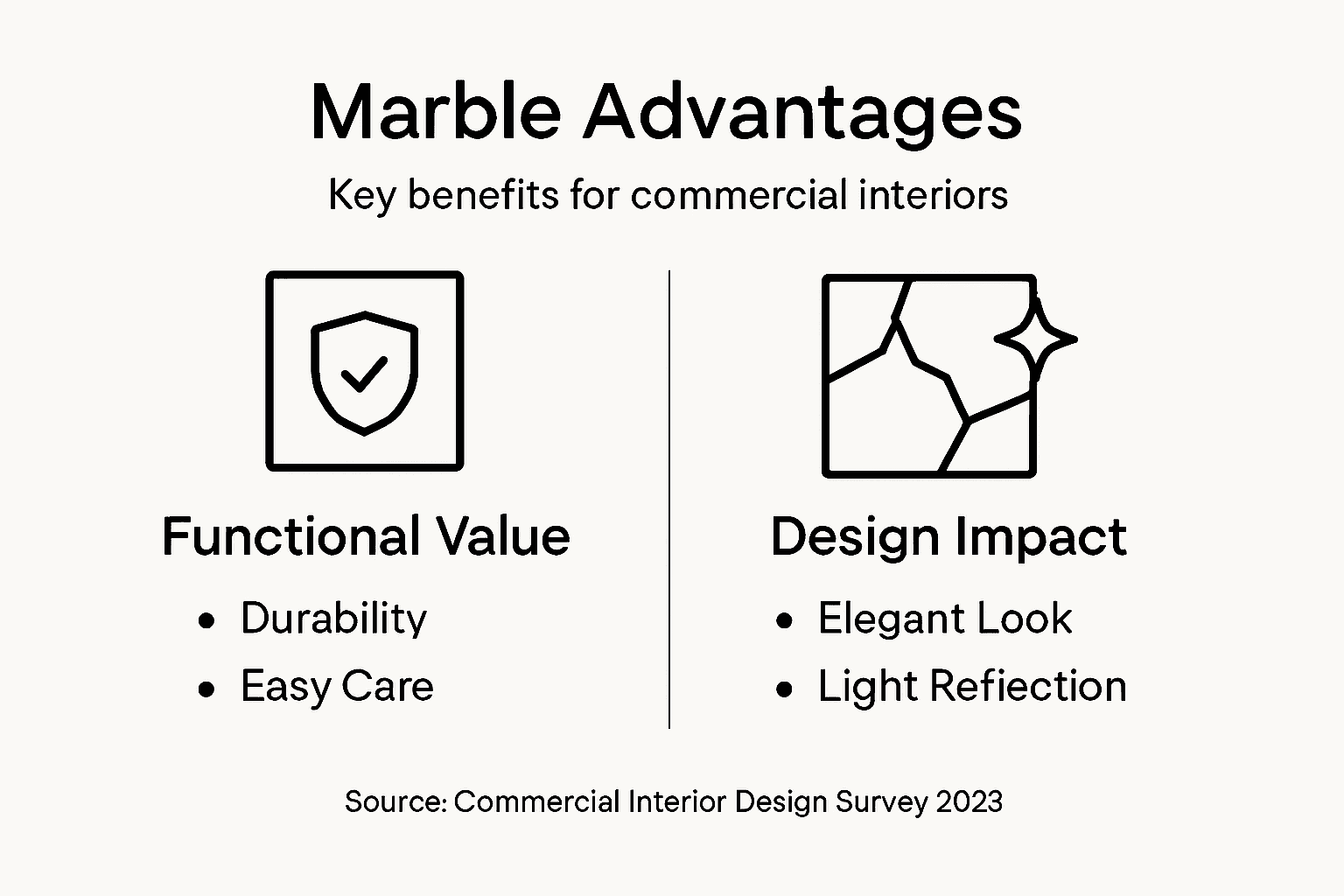
The material works harder than its aesthetics suggest, solving practical challenges while creating the visual sophistication your brand requires.
Polished marble surfaces reflect light in ways that expand perceived space. In compact reception areas or corridors, marble’s reflective qualities create an impression of openness and airiness that smaller square footage couldn’t otherwise achieve.
This optical effect matters significantly in commercial real estate. Tenants perceive spaces as larger and more valuable when marble surfaces bounce natural and artificial light throughout the environment.
Light reflection also reduces dependency on artificial lighting, lowering energy costs while improving the quality of the visual environment for occupants.
Marble’s natural density makes it remarkably resilient in high-traffic zones. Marble’s resilience to wear and heat enables its use in hotel lobbies, corporate offices, and retail environments where thousands of daily interactions occur.
Unlike softer materials that degrade visibly within months, marble maintains its appearance across decades. This longevity justifies the initial investment through reduced replacement costs.
The material resists temperature fluctuations without warping or cracking, making it suitable for spaces with significant climate control demands.
Marble communicates before your business does. Color selection and vein patterns create specific brand narratives:
Each choice shapes visitor perception during their first seconds in your space. Strategic marble selection amplifies your brand messaging through material psychology.
Marble transforms functional necessity into brand communication, where durability and beauty work together to influence business outcomes.
Contrary to assumptions about luxury materials, marble simplifies maintenance in commercial settings. Its sealed surface resists staining better than porous alternatives, requiring only regular professional cleaning protocols.
No specialized equipment or harsh chemicals are needed. Your facility management team can maintain marble surfaces using standard commercial cleaning practices.
The material’s durability means maintenance focuses on preservation rather than repair or replacement. Long-term cost analysis consistently favors marble over competing materials.
Marble adapts to virtually any commercial aesthetic:
This versatility explains marble’s dominance across diverse commercial sectors worldwide.
Pro tip: Combine marble with complementary materials strategically—use marble as anchor surfaces in high-visibility zones while employing cost-effective materials in secondary areas to maximize impact while controlling total project expenses.
Marble’s reputation as a luxury material sometimes overshadows its practical value proposition. When you calculate the total cost of ownership across decades, marble consistently outperforms cheaper alternatives in commercial environments.
Understanding the relationship between durability, maintenance demands, and long-term costs helps you justify marble investments to stakeholders.
Marble outlasts most commercial materials by significant margins. A properly installed marble floor can function flawlessly for 50+ years, while vinyl composites typically require replacement within 10-15 years.
This longevity stems from marble’s natural composition and density. The stone resists the dimensional changes that plague synthetic materials when exposed to temperature fluctuations and foot traffic.
Your initial marble investment yields returns through decades of reliable performance without visible degradation.
Commercial marble maintenance challenges require specialized knowledge to preserve both appearance and function. High-traffic zones demand different care protocols than lower-use areas.
Marble needs regular sealing to resist staining and moisture penetration. Most commercial installations require professional sealing every 12-24 months, depending on traffic intensity and usage patterns.
Damaging chemicals and abrasive cleaning methods accelerate wear, so facility staff must understand proper marble care procedures before installation begins.
Successful commercial marble maintenance balances preservation with practical cleaning needs:
These protocols prevent expensive restoration while maintaining the luxurious appearance that justifies your investment.
Marble maintenance isn’t an expense; it’s insurance protecting a significant asset while preserving brand perception.
Initial marble costs run 2-4 times higher than vinyl or laminate alternatives. This upfront premium feels substantial until you factor in replacement cycles.
Over 30 years, marble costs less per year than materials requiring replacement twice during the same period. Factor in facility downtime, installation disruption, and environmental waste from discarded materials, and marble’s cost advantage becomes overwhelming.
High-traffic commercial zones particularly favor marble because replacement costs for cheaper materials compound rapidly.
Maximize your marble investment by focusing on high-impact zones:
This tiered approach delivers marble’s prestige where it matters most while controlling overall project costs.
Proper maintenance prevents exponentially expensive restoration. A sealed marble floor resists staining for years, but unsealed marble deteriorates rapidly in commercial settings.
Invest in professional sealing immediately after installation. This single preventive measure extends the maintenance window and reduces long-term care costs dramatically.
Your marble surfaces represent permanent brand assets, not consumable materials. Maintenance investments protect far more value than they cost.
Pro tip: Establish a dedicated marble maintenance budget separate from general facility upkeep—professional sealing and specialized cleaning cost far less than damage repair and justify their expense through extended material life and preserved appearance.
Marble installation determines whether your commercial space achieves its design potential or encounters costly problems. Professional installation combined with thoughtful usage protocols separates successful marble projects from disappointing ones.
Your approach during these critical early stages influences marble performance and aesthetics for decades.
Successful marble projects begin with detailed site assessment and material selection aligned with actual commercial usage patterns. Architects and designers must evaluate foot traffic intensity, environmental conditions, and maintenance capacity before specifying marble locations.
Wrong marble selections for specific zones create maintenance nightmares. High-traffic corridors need darker, more forgiving finishes while reception areas can showcase lighter, more dramatic veining.
Coordinate with facility management teams during planning to ensure they understand coming maintenance responsibilities.
Proper substrate preparation prevents future failures. Uneven or unstable substrates cause cracking and movement regardless of marble quality. Experienced installers spend significant time creating level, stable foundations before marble ever touches the surface.
Mortar selection matters critically. Wrong mortar compositions expand and contract differently than marble, creating separation and cracking. Professional installers use specifications matched to climate conditions and marble type.
Sealing must occur immediately after installation. This single step prevents staining that compromises appearance and creates expensive restoration demands.
Different commercial applications require distinct installation techniques:
Each application presents unique structural and aesthetic demands. Marble installation planning ensures every application receives appropriate technical execution.
Marble thrives in properly managed commercial environments but struggles when subjected to abuse. Establish clear usage guidelines for occupants and facility staff:
These simple practices extend marble lifespan dramatically while preserving its appearance.
Professional installation combined with informed usage creates commercial marble that performs beautifully for 50+ years without expensive restoration.
Installation protocols must align with your maintenance plan. Professional sealing during installation establishes a maintenance schedule that protects your investment.
Document all installation specifications, sealing products used, and recommended care procedures. This information guides future maintenance teams and prevents damaging incompatible cleaning methods.
Transition your project successfully by training facility staff on marble-specific care before your project concludes.
Respect the marble. Experienced installers handle slabs carefully, protect finished surfaces during construction, and address damage immediately. Poor handling during installation creates damage that undermines even premium marble specifications.
Walk through completed installations before final acceptance. Verify sealing completion, inspect seams for consistency, and confirm that all surfaces meet your aesthetic and functional standards.
Pro tip: Specify a one-year warranty period with your installer covering any sealing issues or installation defects discovered after project completion—this ensures accountability and protects your investment during the critical break-in period.
The article highlights the crucial role marble plays in commercial settings by enhancing brand perception, durability, and luxury appeal. If you are seeking to create visually stunning reception areas, durable high-traffic floors, or striking feature walls, choosing the right marble is essential to communicate professionalism and longevity. Your commercial interiors deserve materials that combine timeless elegance with practical performance.
Explore Marmorique’s curated collection of high-quality natural marble and travertine decor pieces designed to transform commercial environments. From luxurious bathroom sets to artisan-crafted tables and lamps, our products offer the perfect blend of craftsmanship and durability to reinforce your brand identity. Visit Marmorique today to discover how our premium stone solutions can elevate your space and deliver lasting impressions. Start creating an ambiance of sophistication right now and make your investment count.
Marble enhances ambiance by establishing visual authority, providing durability for high foot traffic areas, and aligning with brand values that convey luxury and quality.
Marble communicates professionalism and sophistication, instantly establishing credibility and attracting premium clientele, thereby influencing client perception positively.
Classic white and gray marbles like Carrara, Statuario, and Calacatta are popular for their elegant aesthetics and durability. Colored varieties like black marquina, green, and red marble can be used for specific brand statements.
Marble surfaces should be professionally cleaned and sealed every 12-24 months, depending on usage. Regular maintenance helps preserve their appearance and extend their lifespan.


