Your Cart (0)
Your cart is empty
Free express shipping

Drawer menu
Free express shipping

TL;DR:
- Choosing the right marble finish is crucial for a space’s look, feel, and longevity.
- Proper specification involves evaluating samples under actual lighting and detailed documentation.
- Correctly specified finishes enhance durability, appearance, and client satisfaction over time.
Imagine a stunning master bathroom, every surface clad in Calacatta marble, only to reveal uneven gloss, visible fingerprints on every panel, and a finish that clashes with the ambient lighting. The culprit is almost never the stone itself. It is a poorly specified finish. Choosing the right marble finish is one of the most consequential decisions in high-end interior design, affecting how a space feels, how it ages, and how much maintenance it demands. This guide walks you through every stage of the specification process, from understanding finish types to verifying installed surfaces, so your luxury projects deliver exactly the impact they promise.
| Point | Details |
|---|---|
| Know the finish types | Each marble finish offers different qualities that suit distinct spaces and design goals. |
| Prepare before specifying | Gather all requirements, samples, and references to ensure a seamless specification process. |
| Follow clear steps | Detailed specification and communication prevent installation errors and costly corrections. |
| Verify for quality | Inspect marble surfaces thoroughly to confirm they match the design specification and project needs. |
| Elevate luxury with care | Thoughtful selection and specification of marble finishes increase both beauty and value in luxury interiors. |
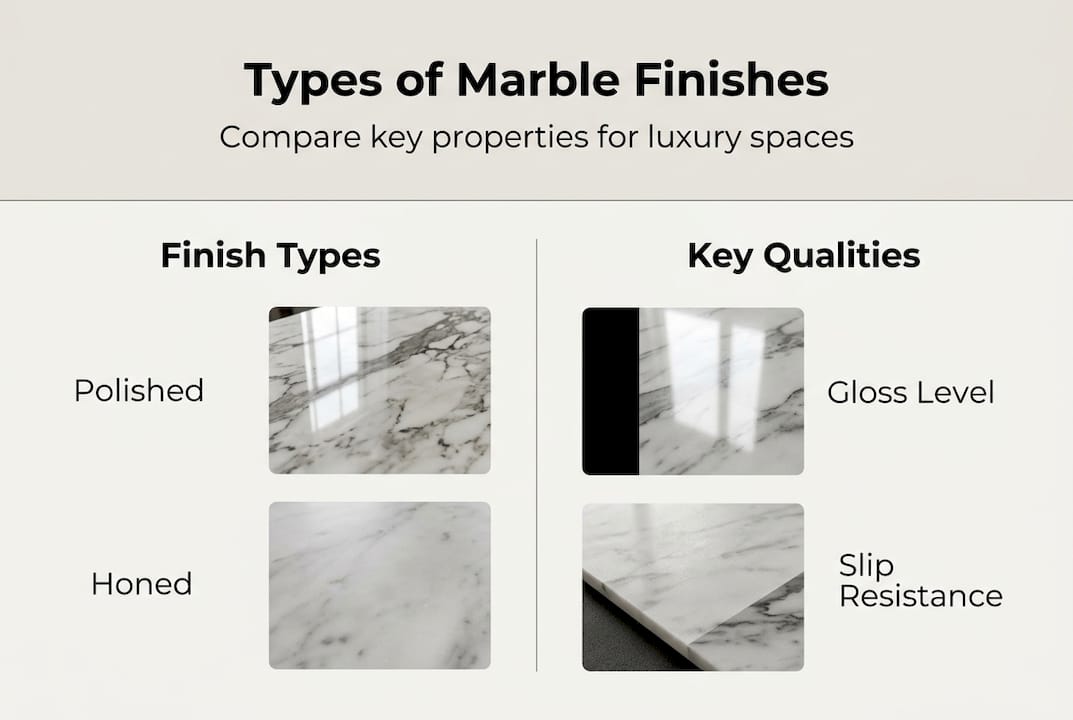
Before you can specify with confidence, you need to know what each finish actually does to the stone. Different marble finishes offer varying levels of gloss, texture, and maintenance requirements, and selecting the wrong one for a given application is a mistake that is expensive to reverse.
Here is a breakdown of the five finishes you will encounter most often in luxury residential and commercial projects:
The table below summarizes each finish across the criteria that matter most for specification:
| Finish | Gloss level | Slip resistance | Best application | Maintenance level |
|---|---|---|---|---|
| Polished | High | Low | Feature walls, tabletops | High |
| Honed | None | Moderate | Floors, counters, bathrooms | Moderate |
| Brushed | Low | Good | Outdoor areas, transitions | Low to moderate |
| Tumbled | None | High | Rustic or heritage interiors | Low |
| Leathered | Low sheen | Moderate | Kitchens, spa bathrooms | Low to moderate |
For a deeper look at how each finish behaves over time, the marble decor tips resource covers real-world applications across different interior styles. Understanding these characteristics before you ever pull a sample is what separates reactive designers from truly authoritative ones.
Understanding finish types is critical, but you must prepare thoroughly before specifying them for your project. Proper preparation ensures that marble finishes meet both durability and design objectives, and skipping this stage is where most specification errors originate.
Start with a requirements checklist for each area where marble will be installed:
Once you have your checklist, gather your specification tools. You need physical stone samples (minimum 12 by 12 inches for floors, 6 by 6 inches for accents), supplier spec sheets with technical data, lighting references from the project’s electrical plan, and photographs of the installed space or architectural renderings.
The table below maps common design goals to the most appropriate finish:
| Design goal | Recommended finish |
|---|---|
| Maximum visual drama | Polished |
| Understated elegance | Honed |
| Tactile luxury | Leathered |
| Aged, artisanal character | Tumbled or brushed |
| Outdoor durability | Brushed |
Pro Tip: Always view marble samples under the actual project lighting, not in a showroom or under office fluorescents. A finish that looks perfect in a supplier’s warehouse can appear flat or overly reflective once installed. Bring samples to the site and observe them at different times of day before finalizing your specification.

Building solid stone care routines into your specification from the start also protects the client’s investment long after installation is complete.
With your requirements and tools in place, it is time to specify marble finishes for your luxury project with confidence. The specification process affects installation outcomes and long-term appearance, so precision at this stage pays dividends for years.
Follow these steps to produce a specification that leaves no room for misinterpretation:
“The difference between a good specification and a great one is the level of detail that anticipates every question an installer might have before they ask it.”
Common pitfalls at this stage include using vague finish descriptions like “matte” or “shiny,” submitting samples without accompanying spec sheets, and failing to specify the sealing requirement. These gaps lead to mismatched results and costly remediation.
Pro Tip: Specify both the finish and the maintenance instructions as a single document. Clients who understand how to care for their marble surfaces preserve the finish far longer, which reflects well on your work. The decor tips for luxury homes resource offers additional context on pairing finishes with interior styles.
After specifying finishes, the final verification safeguards your investment and design goals. Verification ensures that the marble finish matches the original design intent and prevents expensive corrections after the fact.
Conduct your inspection using the following process:
The table below outlines common issues and their likely causes:
| Issue | Likely cause | Corrective action |
|---|---|---|
| Uneven gloss | Inconsistent polishing | Re-polish affected areas |
| Color mismatch | Mixed stone batches | Replace non-conforming tiles |
| Surface marks | Improper sealing | Re-seal with correct product |
| Rough texture | Incorrect finish applied | Refinish to specification |
If you identify a discrepancy, document it immediately with photographs and written notes referencing the original spec sheet. Submit a formal non-conformance report to the supplier or installer. Do not allow the project to proceed until the issue is resolved in writing. Preserving marble surfaces after installation also depends on correct sealing and cleaning protocols being handed over to the client at project completion.
Most high-end projects use beautiful stone. Far fewer use it brilliantly. The gap between the two almost always comes down to finish specification. Generic choices, a polished floor here, a honed counter there, produce interiors that feel expensive but not considered. True luxury is felt in the details that most people cannot name but everyone notices.
The best marble specifications we have seen share one quality: they treat finish, lighting, and decor as a single system rather than separate decisions. A leathered marble island that mirrors the texture of a linen upholstery nearby is not an accident. It is the result of a designer who specified with intention.
There is also a longevity argument that is often overlooked. A finish that is correctly specified for its environment and properly maintained holds its character for decades. A poorly chosen finish degrades visibly within a few years, and no amount of cleaning restores it. Investing the time to specify correctly is, ultimately, the most cost-effective decision you can make for your client. For further inspiration on pairing stone with interior design, the luxury marble decor insights blog is worth exploring.
If you are ready to bring your marble specification to life with pieces that reflect the same level of craftsmanship, Marmorique offers a curated collection of natural stone accessories designed for luxury interiors.
From the tactile elegance of an artisan marble soap dish crafted from solid natural stone, to the sculptural beauty of a marble grape cluster ornament that adds dimension to any curated shelf or tabletop, every piece is made to complement a thoughtfully specified interior. These are not decorative afterthoughts. They are finishing touches that reinforce the quality of the stone you have already specified throughout the space.
The main types are honed, polished, brushed, tumbled, and leathered, each offering distinct appearance and tactile qualities for different design needs. Different finishes create unique looks and affect durability across various applications.
Always assess samples under intended project lighting and in the space where they will be installed for accurate color and texture evaluation. Lighting and environment affect stone appearance in ways that showroom conditions cannot replicate.
Yes, finishes like polished surfaces require more regular cleaning and care, while honed finishes are less prone to visible marks but may absorb stains more readily. Finish type determines maintenance frequency and the cleaning method required.
Document the issue immediately with photographs, compare against the original spec sheet, and request corrective action from the supplier or installer in writing. Verification and documentation are key to resolving finish discrepancies efficiently.


